
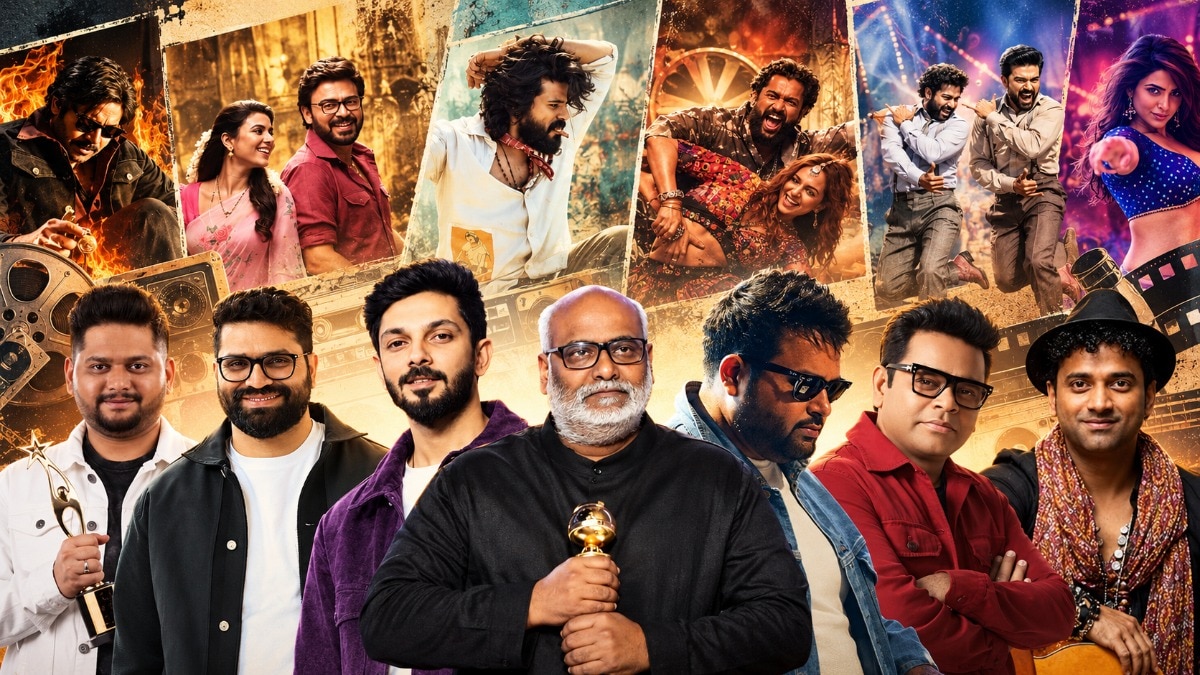
Cinema is one of the few art forms where sound and visuals must work together. Filmmakers know that audiences might forgive an average visual experience, but they rarely overlook bad sound. Music has long been one of Indian cinema’s biggest strengths, and Telugu cinema has played a significant part in that legacy.From Aa Ante Amalapuram in Arya (2004), which found admirers well beyond Telugu-speaking audiences before social media promotions, to Naatu Naatu from RRR (2022), which won an Academy Award, Telugu film music has repeatedly shown that it can travel across cultures and languages. But something feels different in 2026. Telugu cinema continues to make ambitious films and spend heavily on production, yet its music is struggling to create the same cultural impact. Individual songs trends, dance numbers dominate Instagram Reels, and background scores elevate theatrical moments. Albums that leave a lasting impression through both their songs and their score, however, have become increasingly hard to find. This raises an uncomfortable question: is Telugu film music slowly dying? To answer it, we need to look at the developments shaping the industry.Too much on too fewOne of the biggest concerns is the shortage of established composers working consistently at the top of the industry. Devi Sri Prasad, one of Telugu cinema’s most celebrated music directors, has had relatively few prominent projects in the last couple of years. His recent work includes Thandel (2025) and Kuberaa (2025), while his association with Pushpa 2: The Rule (2024) and the upcoming Ustaad Bhagat Singh has brought its share of controversy around music. He is now exploring an acting career as well.Thaman S, meanwhile, remains one of the busiest composers around, with roughly 16 projects listed across 2025 and 2026. His slate includes Game Changer (2025), Daaku Maharaaj (2025), They Call Him OG (2025), Akhanda 2, The Raja Saab and Ustaad Bhagat Singh. Others are making their presence felt, and Bheems Ceciroleo has landed major projects with Chiranjeevi and Venkatesh. Still, the pool of established composers who consistently handle big-ticket Telugu films remains small. That creates enormous pressure. When two or three films by the same composer release within a short span, the challenge is not just delivering songs. It is finding a distinct sound for each film and making sure the music gets the time it deserves. Thaman himself has spoken about this. In an interview with journalist Rajesh Manne, he said, “In the 24 crafts, Music is the last department in the production. After everything is done, we come to music. If the film’s copy is ready two months ago, I can give music before one month.”The problem, then, is not necessarily a lack of ability. It is a combination of limited star talent for mainstream projects, heavy workloads and tight deadlines.Where are the next generation?Look at Tamil, Malayalam and Kannada cinema, and a difference stands out. Each industry has brought newer composers into the mainstream and let them develop distinct musical identities. Anirudh Ravichander has become one of Tamil cinema’s biggest musical exports, even working on major Hindi projects such as Jawan (2023). Sai Abhyankkar is drawing attention with projects like Karuppu, OM and Raaka. Malayalam cinema has Sushin Shyam, Jakes Bejoy, Hesham Abdul Wahab, Christo Xavier and Mujeeb Majeed, each with a different sensibility. Kannada cinema has seen Charan Raj, Ravi Basrur and B. Ajaneesh Loknath make their mark. Telugu cinema has talent of its own. Vivek Sagar, Gowra Hari and Sinjith Yerramilli have shown an ability to create interesting sounds, and Bheems Ceciroleo is making inroads. But very few newer names have consistently broken into the biggest star-led projects and delivered albums that become cultural talking points.This is where responsibility shifts to filmmakers and producers. It is not enough to celebrate homegrown talent when an independent album works. The industry must trust these composers with bigger films, larger budgets and room to grow. Without that, the gap between emerging talent and mainstream opportunity will only widen.Imported talent for local storiesPerhaps the most interesting shift is in the choice of composers for upcoming projects.And look at 22 projects featuring established Telugu stars and younger actors over the last two years shows a growing presence of composers from other industries. Anirudh Ravichander, Ravi Basrur, GV Prakash, Santhosh Narayanan, A. R. Rahman, Jakes Bejoy, Gopi Sundar, Vishal Chandrashekhar and B. Ajaneesh Loknath are all securing prominent assignments.It is most visible in the line-ups of the biggest stars. Jr NTR moves from Anirudh for Devara (2024) to Ravi Basrur for Dragon. Prabhas has worked with Santhosh Narayanan on Kalki 2898 AD (2024) and Thaman on The Raja Saab, with Vishal Chandrashekhar and Harshavardhan Rameshwar associated with Fauzi and Spirit. Allu Arjun has Sai Abhyankkar for Raaka and Anirudh for AA23, and Ram Charan has A. R. Rahman on Peddi. Mahesh Babu is the exception, continuing with Thaman and Keeravani. The trend extends to younger actors too. Nani worked with Jakes Bejoy on Saripodhaa Sanivaaram (2024) and has Anirudh on The Paradise. Vijay Deverakonda collaborated with Gopi Sundar on The Family Star (2024), Anirudh on Kingdom (2025) and Ajay & Atul on Ranabaali. Cross-industry collaboration is no longer an occasional experiment. It cuts across star hierarchies and generations.This is not necessarily a problem. Outside composers can bring new sounds, techniques and perspectives, and Telugu cinema’s growing reach means filmmakers are rightly looking beyond geographical boundaries.There is, however, a contradiction. Of the 22 projects examined, 10, or about 45 per cent, draw on regional settings, communities, history, folklore or mythology. Pushpa, RRR, Devara, Thandel, Ranabaali and The Paradise are all rooted in specific cultural identities. Yet many of these culturally specific stories are being entrusted to composers from outside the Telugu industry.Take Ranabaali. Despite its rooted subject, Ajay-Atul’s music prompted conversations about cultural connect. Devara’s songs found considerable traction among younger audiences, but questions remained about whether the music fully captured the film’s world. The distinction matters. This is not about questioning the talent of composers from other languages. It is about whether Telugu cinema is giving enough space to its own musical sensibilities while telling stories deeply tied to its culture.Composers from Tamil, Malayalam and Kannada cinema are finding space in Telugu films, including some of the biggest. But how many Telugu composers get comparable opportunities in those industries? The number appears far smaller, and perhaps the responsibility does not lie with those industries. Thaman told Suman TV, “Anirudh gets films easily in Telugu, but it is hard for me to get opportunities in Tamil films. The Tamil industry has stronger unity, which I feel is missing in the Telugu film industry.”If Telugu cinema is hesitant to trust its homegrown composers with its biggest projects, why should other industries take that leap of faith? Before expecting recognition elsewhere, the industry needs to create opportunities for its own talent at home.Should directors take ownership?It would be unfair to place the entire burden on music directors. The director plays an equally important role in how music fits into a film.Take The Paradise. Director Srikanth Odela had a clear vision of the film’s cultural identity, and the music, including Anirudh’s Yeshanagula, reflects an attempt to capture that world. It shows that an outside composer can create something deeply connected to a Telugu story when the filmmaker has a clear musical vision. Not every collaboration will work this way, but the point stands: a composer needs direction, time and a clear understanding of the world being built. Thaman told Great Andhra that the problem is not a lack of capable composers. “It’s not that we are not able to give music or not that we are not capable. The films are overloading. Our Industry is beautiful, it is an open and great Industry, people from all languages are surviving here,” he said.His remarks bring the discussion back to the industry’s working culture. When composers are brought in late, given tight schedules and expected to deliver pan-India albums, the creative process inevitably suffers. Thaman’s comments about reworking the entire Game Changer album and replacing singers underline the pressure. Speaking about The Raja Saab, he revealed that the music company was investing Rs 30-40 crore in the album, leaving him responsible for creating newer tunes that could work across markets.When virality matters more than longevityA song that trends for a week is different from one that becomes part of a family’s musical memory. A younger audience may discover a track on Instagram, use it for an edit and move on to the next viral sensation. But songs such as Godavari Gattu from Sankranthiki Vasthunam (2025) show how music can become part of everyday family listening. Telugu cinema needs both, not one at the cost of the other. Telugu cinema was, is and hopefully will continue to be known for its music. There is a long-standing belief in the industry that if audiences connect with even two songs from a film, they are more likely to turn up at theatres. Music is that deeply woven into the relationship between Telugu films and their audiences. It helps them celebrate, remember characters and connect with stories long after release.If an industry with such passionate music audiences begins to lose that connection, the warning signs cannot be ignored. The answer is not to shut the door on outside talent, but to create more opportunities for homegrown composers, give music the time it deserves and look beyond viral hooks. If this imbalance continues for a few more years, Telugu cinema risks losing one of its biggest strengths, and the slow death of Telugu film music could become inevitable.- Ends
Is Telugu cinema music dying a slow death?
Full Article
Original Source
Read the full article at Indiatoday →KhanList aggregates and links to publicly available news content. We do not host full articles from third-party sources. Always verify important information with original sources.