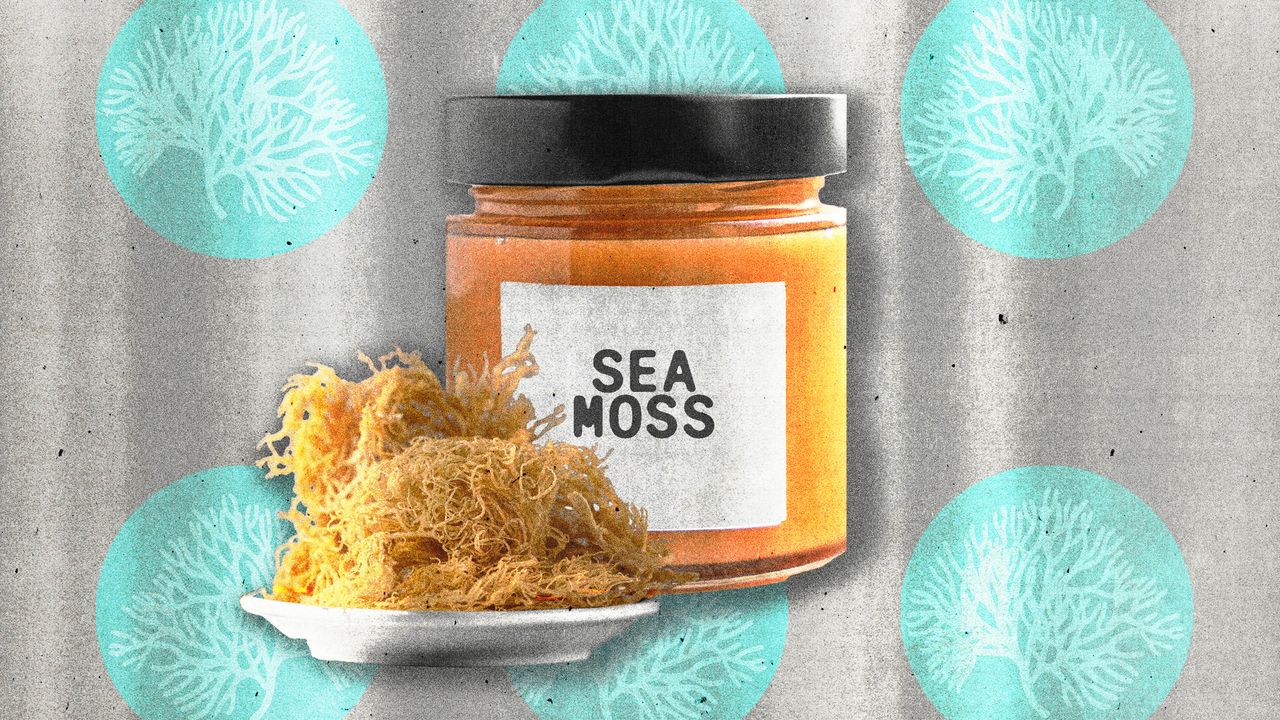
If you’ve ever found yourself wandering the supplement aisles of Erewhon in wonder, you’ve probably seen the high-end health grocer’s mesmerizing rainbow of jarred sea moss gel. But a quick browse around the store today would reveal just how trendy the so-called superfood has become. It’s in Hailey Bieber’s popular Strawberry Glaze Skin Smoothie, and all over the beverage aisle, including as the hero ingredient in the functional beverage brand MOSS.Beyond health food stores, you may have also come across wellness influencers talking about how sea moss can support your gut, thyroid, and skin. Is what they claim about sea moss benefits true or is this a trend that should stay in LA? We talked to five registered dietitians to find out.What is sea moss?“Sea moss is a type of edible red seaweed,” says Gage Blottenberger, a registered dietitian with the University of Maryland Baltimore Washington Medical Center.“It can be either harvested or farm-raised, and it’s typically dried and then processed into gels, powders, or capsules,” he says.The sea moss you see sold in most stores is primarily sourced from islands in the Caribbean (especially St. Lucia and Jamaica) and the North Atlantic coastline (including Ireland, Canada, and Maine), says registered dietitian Xavier Toledo, LDN. It’s most commonly consumed as a gel, which is made by soaking the seaweed for roughly a day until it expands, rinsing it, blending it with water, and then allowing it to refrigerate for a couple of hours to thicken. You can either go through this process yourself using dried sea moss, or you can buy it in prepared gel form (as seen on the aforementioned Erewhon shelves).Though it can be eaten as-is with a spoon, it has become especially popular as an additive to smoothies, oatmeal, or soups. As you might imagine, it tastes a bit ocean-y, which is why some brands blend it with fruit to balance the taste.Sea moss benefits: fact or fiction?Wellness influencers swear by sea moss for everything from healing their leaky gut to regulating their thyroid. We took all the claims to qualified registered dietitians to separate the health facts from pure hype.The claim: It’s good for your gut.True or false: True.Of all the health claims being made about sea moss, Health Loft registered dietitian Heather Ritter, RDN, says this one is the most plausible. “Sea moss is a source of fiber, which acts as a prebiotic and supports beneficial bacteria in the gut,” Ritter says. Registered dietitian Gillean Barkyoumb, adds that it’s specifically a source of soluble fiber. (That’s the type of fiber that helps slow digestion and encourages the growth of more good gut bacteria.)While sea moss does have fiber, Toledo points out that every plant-based food has fiber and there are plenty of foods that have way more of it than sea moss. If you look at the label of most sea moss supplements, the fiber content is often less than a gram. His opinion: If you want to integrate sea moss into your diet as a way to get more fiber, that’s fine, but there are more effective ways to do it.As for any claims about sea moss being used to fix “leaky gut,” that’s when all five dietitians say the research is more murky. Despite what you may hear anecdotally on social media, there is no scientific proof backing this up.The claim: It has 92 of the 102 trace minerals your body needs.True or false: False.Toledo and Ritter both point out that one of the common claims on sea moss product packaging is that it contains 92 minerals of the 102 minerals the body needs. “This is misleading. Our bodies require only 20 trace minerals, not 92, so I would advise skepticism toward this specific marketing language,” Ritter says. Toledo concurs. “There is nothing in nutritional science about the body needing 102 trace minerals. This is a random claim that’s just being repeated over and over,” he says.That doesn’t mean that sea moss doesn’t contain trace minerals—also called "microminerals" —that the body needs in very small amounts. In fact, it does include trace minerals such as iron, zinc, iodine, and manganese. Just don’t fall for the marketing message that it meets needs that don’t even exist.The claim: It’s good for your thyroid.True or false: False.All of the dietitians we talked to say that sea moss is rich in iodine, which supports thyroid health. “Iodine plays a role in making T3 and T4 thyroid hormones, which support thyroid function and metabolism. It’s beneficial for both men and women,” says Jordan Hill, a registered dietitian at Top Nutrition Coaching. Barkyoumb adds that iodine is used by the thyroid to make hormones, which regulate metabolism, energy, and testosterone production.That said, Toledo says that the vast majority of people in the U.S. get enough iodine naturally and don’t need to specifically seek out more. “This is because we have iodized salt, and plenty of people are getting enough of that in their diet,” he says.In fact, getting too much iodine can backfire. “Excessive iodine intake isn’t always beneficial. In iodine-sufficient individuals, which is most Americans, additional iodine from sea moss can disrupt thyroid function rather than support it. There are documented case reports of sea moss triggering thyroid dysfunction in individuals with underlying thyroid conditions,” Ritter says. To this point, a 2026 scientific article published in Case Reports in Endocrinology explicitly says iodine-rich supplements like sea moss can trigger thyroid dysfunction.With all this in mind, there’s no need to consume sea moss specifically to get more iodine. You’re very likely already getting enough.The claim: Sea moss is good for your heart.True or false: True.Barlyoumb says that some early scientific evidence shows that sea moss may help support healthy cholesterol and blood pressure levels. This, she says, is likely because of its iron, magnesium, and calcium content. Blottenberger says that, like other plant-based foods, sea moss contains antioxidants, which also contribute to heart health.To her point, a small scientific study published in Marine Drugs in 2019 found that consuming 100 milliliters of sea moss gel for 60 days successfully helped lower LDL cholesterol. That said, all of the dietitians say that more robust scientific research needs to be done to confirm the connection.Should you try it?While the health claims surrounding sea moss are overblown, the dietitians we talked to say that as long as you don’t have a thyroid disorder, trying it likely isn’t going to hurt you. If you’re someone who likes trying all the latest wellness trends and it gets you excited about eating healthy, Blottenberger says to knock yourself out. After all, we all could benefit from getting more fiber.Even though sea moss is considered a trendy wellness ingredient in the States, Toledo points out that it’s a regular part of Caribbean culture. So he suggests integrating it into Caribbean-inspired meals, but if you’re literally plugging your nose trying to down a sea moss-spiked smoothie because you want to reap its benefits, he suggests skipping it. There’s nothing in sea moss that’s so special you can’t find it somewhere else.If you are going to try sea moss, it’s important to buy it from a company you can trust. If the sea moss jar or supplement you’re eying doesn’t have a nutritional panel that specifies exactly how much fiber, iodine, and other nutrients are in it, Toledo says to look for another.As with other supplements, Hill says to stick with sea moss supplements that are third-party tested. “With sea moss specifically, I’d recommend purchasing from a company that is transparent about sourcing and origin to ensure a quality product with optimal mineral content,” she says. Ritter adds that it’s best to “look for third-party testing for heavy metals such as arsenic, lead, cadmium, and mercury. Sea moss absorbs contaminants from the water it grows in, so contamination levels can vary depending on the source and may not always be tested.”It’s also important to be aware of outlandish claims, like the one about sea moss containing 92 of the 102 essential trace minerals. “Some sea moss, like Erewhon’s, claims to be ‘wildcrafted,’ but that term doesn’t have a standardized definition,” Toledo says. Don’t fall for buzzwords.With all this in mind, a little sea moss every once in a while won’t hurt you Just don’t expect it to be the miracle worker the internet claims it to be.
Is Sea Moss Worth the Hype? Here’s What Experts Think
Full Article
Original Source
Read the full article at Gq →KhanList aggregates and links to publicly available news content. We do not host full articles from third-party sources. Always verify important information with original sources.