
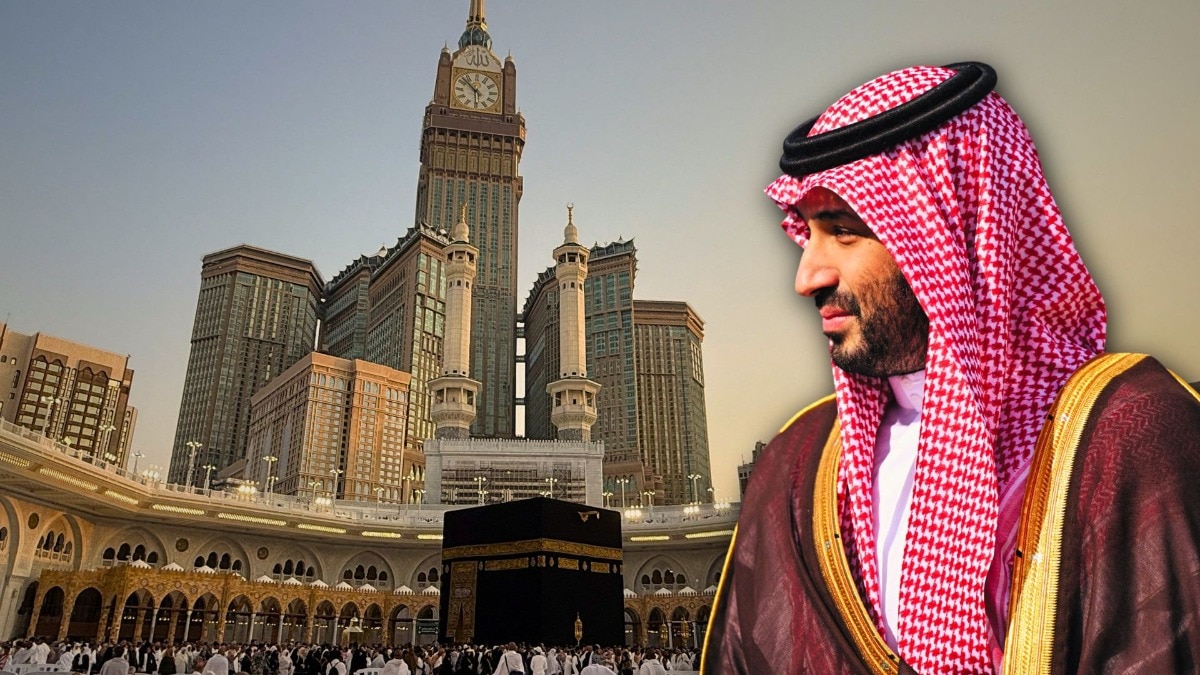
Saudi Arabia said it intercepted a Houthi drone that targeted Mecca, but the Iran-backed militia denied it aimed at the city that houses one of Islam's holiest sites. Riyadh's claim sparked consternation across the Muslim world. Is Saudi using the holy sites of Mecca and Medina as a levarage in the war against the Houthis?The Saudi administration led by Crown Prince Mohammed bin Salman blamed the Iran-backed Houthi militia of targeting the holy city of Mecca. (Image: Reuters and Getty)Sirens blared in Mecca on Tuesday afternoon. Saudi Arabia's Directorate of Civil Defence issued a warning for aerial threats for Mecca and two other cities, asking people to move indoors. Such an alert was unusual for Mecca, the city that houses one of Islam's holiest sites. Later, Riyadh said that a drone fired towards Mecca by the Yemen-based Houthis had been intercepted. The Houthis, a Iran-backed militia, trashed the charge that it targeted Mecca even as the Saudi claim sparked consternation in the Muslim world. But the question here — is Saudi Arabia, with its back to the wall in the fight against the Houthis — using the Mecca card?Saudi Arabia said on Wednesday that a Houthi drone was intercepted south of Mecca before it could enter the holy city's restricted airspace. Saudi authorities described the safety of the two holy mosques — in Mecca and Medina — and pilgrims as the "red line".The Houthis denied targeting Mecca. Open-source intelligence also didn't report any shooting down of a drone or missile directed at Medina.The facts of what happened remain contested. But the political meaning of the situation is harder to miss and ignore. By placing Mecca at the centre of the latest confrontation with the Iran-aligned Houthi militia, Saudi Arabia is invoking one of the most powerful sources of its religious and diplomatic legitimacy. The question, therefore, is not simply whether a Houthi drone was actually aimed at Islam's holiest city. It is also whether Mecca's extraordinary religious status is being turned into a strategic instrument at a moment when Riyadh is facing military pressure, attacks on its territory and uncertainty over how much external backing it can secure.That distinction matters because Saudi control of Mecca and Medina is not an ancient hereditary possession of the House of Saud. The dynasty's control of the Hejaz region, where the two holy mosques are located, came through the conquest of the region in the 1920s. It turned into the custodian of the two of Islam's holiest shrines. What followed was the transformation of that territorial conquest into a powerful religious institution, one that gives the Saudi monarchy an influence extending well beyond its borders. The name of Mecca has also been used to give defence pacts a religious legitimacy. Saudi Arabia, Pakistan and Turkey signed a Nato-like defence agreement and named it the Mecca Defence Alliance. A REPORTED DRONE, THE HOLY CITY OF MECCA AND THE RED LINEOn Tuesday evening, Saudi air defences intercepted and destroyed what the Saudi-led Coalition to Restore Legitimacy in Yemen called a "Houthi drone south of Makkah, before it entered the prohibited airspace over the holy city".The coalition spokesperson, Major General Turki al-Malki, called it the second Houthi attempt to target Mecca, referring to a "2017 ballistic-missile incident". Saudi Arabia said the latest episode threatened pilgrims and residents and stressed that the security of the Two Holy Mosques was a "red line"."This can only be described as a disgraceful act, an attempt to target the birthplace of revelation, the land of the message, and the destination that draws the hearts of millions of Muslims from around the world," Al-Maliki was quoted as saying by Asharq Al-Awsat, a London-based Arabic newspaper.Al-Maliki of Saudi Arabia called this a "deliberate act" by the Houthi militia "intended to provoke the feelings of millions of Muslims".The Saudi general was clearly drawing the red line and reiterating the importance of Mecca to billions of Muslims worldwide. He was also portraying the Houthis as those who attacked on an Islamic holy site.The Houthi militia, which too is an Islamic outfit, denied that they targeted Mecca or any other holy site of Islam.Houthi military spokesperson Brigadier General Yahya Saree lashed out at the Al Saud regime of Saudi Arabia, calling the attempt to blame the outfit a deception, while denying that it posed a threat to the holy sites."The fabrications and lies promoted by the criminal Al Saud regime regarding the targeting of the Honorable Mecca cannot deceive anyone, for it is they who desecrate it with debauchery and licentiousness and by importing prostitutes, and there is no threat from Yemen to the sanctities," the statement of Houthis posted on Telegram said.Saree said Houthi operations were directed at "its oil facilities and military bases, which are far removed from the sacred sites."At this stage, two questions arise. One, where was the alleged drone headed, and second, how has Saudi Arabia chosen to frame the incident?The answer to the first question remains disputed. But the second is clear.Riyadh has elevated the incident from another attack on Saudi territory to a threat involving Islam's holiest city and the safety of pilgrims. That gives the episode the significance that an attack on a military installation, oil facility or other strategic target would not carry in quite the same way.PAKISTAN TOO INVOKES SECURITY OF MECCA, MEDINA AS DUTYThe question gains relevance when one sees how Pakistan, one of the signatories of the Mecca Defence Agreement, is also playing the Mecca card.Pakistani Prime Minister Shehbaz Sharif on Wednesday denounced the alleged Houthi attack on Mecca.Any involvement in the Middle East crisis and fighting against a Muslim country will trigger outrage in Pakistan. The invocation of the Islamic holy sites by Pakistani leaders is a way of justifying any role in the spiralling crisis in the Middle East."I condemn in the strongest possible terms the dastardly and heinous attempted drone attack against the Holy Site of Makkah Al-Mukarramah," posted Shehbaz Sharif on X on Wednesday.Then Sharif went on to say that the security and the sanctity of Mecca and Medina is a "duty that every Pakistani carries close to their heart"."Pakistan stands unwaveringly, shoulder to shoulder with the brotherly Kingdom of Saudi Arabia, in the defence of its sovereignty, and territorial integrity, as well as for the security and sanctity of the Haramain Sharifain — a duty that every Pakistani carries close to their heart," read Sharif's post.THE HIDDEN POWER OF THE HAJJ FOR SAUDI ARABIAControl over Mecca and Medina gives Saudi Arabia authority over the practical machinery of the Hajj and Umrah. That means visas, pilgrim quotas, transport, security, infrastructure, crowd management and access to the holy sites.Millions of Muslims from across the world therefore interact with the Saudi state through one of the most important religious obligations in Islam.This is not simply administrative control. It creates huge diplomatic influence. Remember, Islam is the second-largest and the fastest-growing religion in the world.A dispute between Saudi Arabia and another Muslim-majority country can spill into questions surrounding pilgrimage arrangements. The Saudi-Iranian relationship provides a particularly clear example of this.After Riyadh and Tehran severed diplomatic relations in 2016, negotiations over arrangements for Iranian Hajj pilgrims became entangled with the wider geopolitical rivalry. Saudi authorities said Iran had failed to agree to the arrangements, while academic research has described the Hajj dispute as a part of the broader Saudi-Iranian geopolitical confrontation.At the same time, Saudi Arabia has invested enormous resources in expanding and administering the holy sites. The result is the unique combination that the kingdom has created.Oil gives Saudi Arabia economic power, while Mecca and Medina give it religious and diplomatic reach and influence. The city of Mecca in Saudi Arabia is precisely 1,809km away from Yemen's capital Sanaa. (Image: Google Earth/Author) IS SAUDI ARABIA USING MECCA AS A LEVERAGE IN WAR AGAINST HOUTHIS?Revered by Muslims across the world, Mecca is no oil facility and any attack on the holy city sparks concern across the world.The Houthis have attacked Saudi military and strategic targets during the latest escalation, while the wider conflict has threatened Saudi infrastructure and oil-export routes.The Houthis dominating the important trade chokepoint Bab el-Mandeb might not mean anything much for people thousands of kilometres away, but a drone aimed at Mecca has a very different significance.Calling the security of the holy sites at Mecca and Medina a "red line" turns the Saudi-Houthi conflict into more than a bilateral confrontation. It places the entire Muslim community, and the sanctity of its holiest sites, in the frame.That can generate diplomatic pressure against the Houthis and, indirectly, against their Iranian backers. It could, for all you know, give Islamic nations the reason to join Saudi Arabia in fighting the Houthis.An attack on an airbase or energy installation is an attack on a country, any attack directed at Mecca and Medina can be framed as an attack on the Ummah.The latter invites reactions from governments and religious institutions far beyond the countries directly involved in the Yemen conflict. The Organisation of Islamic Cooperation has already condemned the reported incident, demonstrating how quickly the issue can move from a Saudi security claim into a wider Islamic diplomatic issue.Whether Riyadh is deliberately exploiting the current Mecca incident as a political lever, however, is an interpretation based on the accusations and denials, rather than an established fact.What can be established is that Saudi Arabia has chosen to frame the alleged drone incident in the strongest possible religious terms and not merely as an intrusion into Saudi airspace, but as a threat to the security of Mecca, the Two Holy Mosques and pilgrims. What can be safely said is that it is using its identity as the "Custodian of the Two Holy Mosques" in the conflict against the Houthis.- EndsPublished By: Avinash KateelPublished On: Sep 16, 2026 15:37 IST
Is Saudi Arabia playing the Mecca card in its war against Houthis?
Full Article
Original Source
Read the full article at Indiatoday →KhanList aggregates and links to publicly available news content. We do not host full articles from third-party sources. Always verify important information with original sources.