
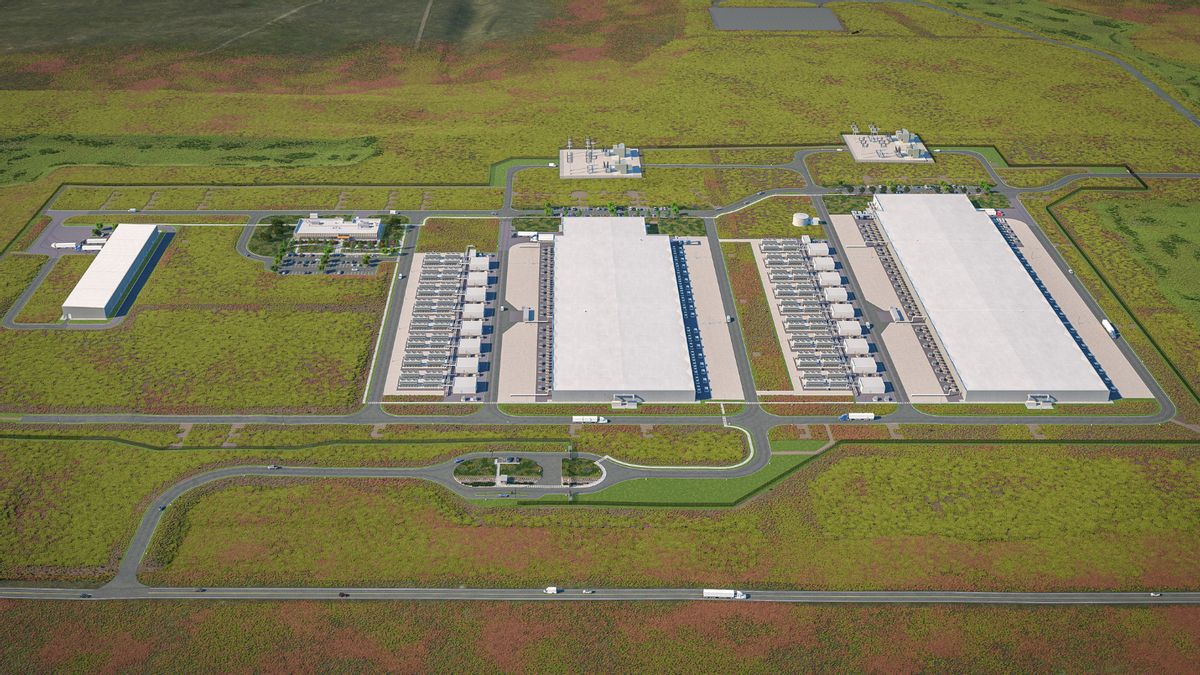
In June 2026, the Cheyenne Board of Public Utilities said it identified Cupriavidus gilardii in the city's wastewater in February. Published July 17, 2026 In July 2026, a claim circulated online that the city of Cheyenne, Wyoming, had identified a rare, drug-resistant bacteria in the city's water (archived). The source of the bacteria, according to the posts, was a massive nearby data center owned by Meta, the technology giant that operates Facebook, Instagram and WhatsApp. Snopes readers searched the site looking for more information about the rumor. Based on reporting in local news outlets, the claim appears to consist of a mixture of true and exaggerated information. Crucially, Snopes could not independently verify the most significant detail — that the city had traced the bacteria to Meta's data center — and therefore cannot give the rumor a simple true or false rating. Here's what's we know ... According to a Cheyenne Board of Public Utilities news release on June 26, 2026, laboratory staff identified a bacteria named Cupriavidus gilardii in the city's wastewater in February. (It's important to note at this point that the bacteria was not reported to have entered the city's drinking water supply). The board's staff traced the bacteria's source to "an industrial user within the system," though they did not name what the source was. They did announce that the source was "immediately and permanently" barred from discharging into the city's wastewater. Snopes contacted representatives from the Cheyenne Board of Public Utilities, Meta, and Fortis Construction, Meta's contractor on the data center. We heard back from Meta, whose response will be detailed below, and the Cheyenne Board of Public Utilities, which declined to comment, as of this writing, but said it would release a detailed statement by July 19. This story will be updated with new information as we learn more. Cupriavidus gilardii Though the social media posts were correct in describing C. gilardii as a rare bacteria, the description of "drug-resistant" requires more scrutiny. Those words imply that the bacteria can be hard to treat with antibiotics, presenting an increased level of danger to the general public. Reviewing medical journals for records of C. gilardii revealed that while the bacteria does have some drug resistance, infections are very rare and generally opportunistic — that is, they occur in people with weak immune systems, including children, the elderly and people recovering from surgeries. The infection can be fatal. The city of Cheyenne treats some of its wastewater and uses it to irrigate parks, golf courses and other green spaces, according to the Laramie Boomerang, a local Wyoming newspaper. The board was concerned that using the contaminated wastewater in sprinklers would aerosolize the bacteria and increase the risk of infections. According to the Cheyenne Board of Public Utilities' news release, C. gilardii is a naturally occurring bacteria and is "commonly found in soil and groundwater environments." This may have made it hard for the board to determine where the bacteria originated from. The data center Meta first announced the 715,000-square-foot facility in 2024, estimating it would invest more than $800 million in the area. The tech company delegated building the facility to a contractor, Fortis Construction. According to the local news reports, the Cheyenne Board of Public Utilities ultimately traced the bacteria to the site of the data center, and sent its notice of noncompliance to a third company, Goat Systems LLC. The news reports say Goat Systems is a shell company Meta set up to manage the project. Snopes was unable to independently verify any of those details. Meanwhile, Francis Brennan, speaking on behalf of Meta, said via phone call and email that the board sent its notice about the bacteria to Fortis Construction. In response, the company stopped flushing wastewater into the system and hired an independent investigator to test for the bacteria. Meta said no evidence of the bacteria was found despite repeated tests. Brennan also noted that the board had not provided Meta, or the public, any evidence that the bacteria came from the data center. Sources "Cheyenne Won't Take Data Center Wastewater After Meta Contractor Contaminated System." Cowboy State Daily, https://cowboystatedaily.com/2026/07/02/cheyenne-wont-take-data-center-wastewater-after-meta-company-contaminated-system/. Accessed 15 July 2026.Eagle, Alyssa Tolman Wyoming Tribune. "Cheyenne BOPU Traces Rare Bacteria Discharge to Meta Data Center Contractor." Wyoming Tribune Eagle, 4 July 2026, https://www.wyomingnews.com/laramieboomerang/news/cheyenne-bopu-traces-rare-bacteria-discharge-to-meta-data-center-contractor/article_df359a2e-bc2f-41e7-a80f-cdb0ca41b4d8.html.Fang, Xuejie, et al. "Infection Caused by Cupriavidus Gilardii in a Convalescent COVID-19 Patient." International Journal of Infectious Diseases, vol. 134, Sept. 2023, pp. 287–89. DOI.org (Crossref), https://doi.org/10.1016/j.ijid.2023.07.015.'Fortis Building Meta's Cheyenne Campus'. Fortis Construction, http://fortisconstruction.com/news/fortis-building-metas-cheyenne-campus/. Accessed 16 July 2026.Gillespie, Dianne. "Hello, Cheyenne!" Meta Data Centers, 2 July 2024, https://datacenters.atmeta.com/2024/07/hello-cheyenne/.Isaji, Yuto, et al. "A Case of Fatal Cupriavidus Gilardii Sepsis Following Cord Blood Transplantation: Pitfalls of Novel Antimicrobial Agents." International Journal of Infectious Diseases, vol. 164, Mar. 2026, p. 108443. DOI.org (Crossref), https://doi.org/10.1016/j.ijid.2026.108443.Karafin, Matthew, et al. "Fatal Infection Caused by Cupriavidus Gilardii in a Child with Aplastic Anemia." Journal of Clinical Microbiology, vol. 48, no. 3, Mar. 2010, pp. 1005–07. PubMed Central, https://doi.org/10.1128/JCM.01482-09.Luscombe, Richard. "Wyoming Tightens Wastewater Rules after Meta Datacenter Contractor Flushed Contaminated Water." The Guardian, 8 July 2026. US News. The Guardian, https://www.theguardian.com/us-news/2026/jul/08/meta-datacenter-ai-wyoming-water.Randall, Doug RandallDoug. "Cheyenne's Goat Systems Faces Wastewater Compliance Issues Impacting Data Center Operations." KGAB AM 650, 2 July 2026, https://kgab.com/cheyenne-data-center-discharge-issues/.Rogelberg, Sasha. "Wyoming Officials Say Meta's 715,000-Square-Foot Data Center Is Responsible for Contaminating Its Water System with a Rare Bacterium." Fortune, https://fortune.com/2026/07/10/wyoming-officials-meta-715000-square-foot-data-center-responsible-contaminating-water-system-rare-bacterium/. Accessed 15 July 2026."Two Cases of Cupriavidus Gilardii Infection... : Medicine." Ovid, https://doi.org/10.1097/MD.0000000000049476. Accessed 15 July 2026.Wilkins, Joe. "Meta's AI Data Center Caught Leaking Deadly Bacteria Into Water Town Uses for Irrigation." Futurism, 6 July 2026, https://futurism.com/health-medicine/meta-ai-data-center-pathogen-bacteria-water.Zhang, Zhen, et al. "First Case Report of Infection Caused by Cupriavidus Gilardii in a Non-Immunocompromised Chinese Patient." IDCases, vol. 10, 2017, pp. 127–29. DOI.org (Crossref), https://doi.org/10.1016/j.idcr.2017.10.009. By Jack Izzo Jack Izzo is a Chicago-based journalist and two-time "Jeopardy!" alumnus. Article Tags
Is rare bacteria in Wyoming city's water linked to Meta data center? What we know
Full Article
Original Source
Read the full article at Snopes →KhanList aggregates and links to publicly available news content. We do not host full articles from third-party sources. Always verify important information with original sources.