
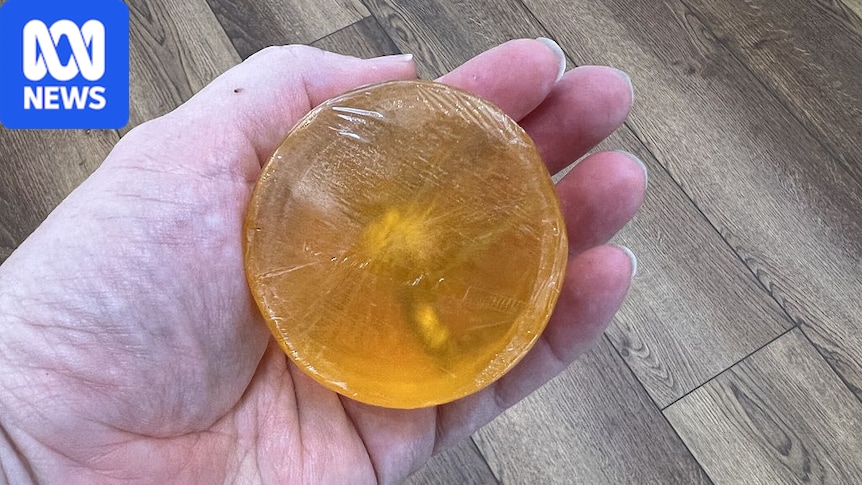
Do people smell different as they get older?Radio National's What's That Rash? received several emails from listeners who were concerned about "old person smell" after seeing ads for persimmon soap in their social media feeds. Here's one of the emails:I have been seeing so many posts on Instagram about persimmon soap that is marketed as getting rid of "old person smell".According to the marketing, as we age we excrete an oil that has an odour that permeates our clothes and houses that apparently the old person cannot smell but everyone else can. Even if we wash our body and clothes daily it won't get rid of the odour except if you use persimmon soap.As I am over 70 and do wash my body daily and launder clothes regularly, I am very worried I might be a smelly old lady without knowing it!Is there any truth in this, and if there is, is there any scientific evidence that using persimmon soap works?We looked at the (small amount of) research, and spoke to experts. Here's what we found:Is 2-nonenal the culprit?According to advertisers and some researchers, "old person smell" is caused by a chemical called 2-nonenal.It's described as a musty, greasy and sometimes grassy odour.Deshan Sebaratnam, a dermatologist at The Skin Hospital in Sydney, says many different variables can contribute to someone's smell."The bacteria on their skin, the composition of their oil and sweat, hormones, diet, hygiene practices [and] genetics," Dr Sebaratnam says."There is some evidence that 2-nonenal may contribute, but it is based on a small group of people."The claim originated from a 2001 study of 22 Japanese people that found 2-nonenal was only present in men aged 40 and over.Another Japanese study in 2016, this time with 27 participants using a different measurement, also found 2-nonenal increased with age.But the findings have not been replicated outside of Japan.Another small study in the US in 2009, was unable to detect the chemical in men or women over 39.The authors concluded that 2-nonenal "might be a diet-linked, cultural phenomenon, which may not generalise to non-Japanese populations"."The large consumption of fish and marine-based foods in the Japanese diet may lead to a build-up of unsaturated fatty acids and lipid peroxides with aging," they wrote.While evidence for 2-nonenal is shaky, another small study suggests humans can accurately guess a person's age based on smell alone.Body odour "donors" wore T-shirts with armpit pads for five nights before they were presented to the study's sniffers.While the sniffers could identify older donors, they rated their smell as less intense and less unpleasant than younger donors.Does persimmon soap reduce odours?Advertisers claim persimmon soap can get rid of "old person smell".Online sites sell the orange-coloured soap for up to $72 for a single bar.These ads declare their "clinically proven" and "doctor-backed" soaps don't just cover up the supposed smell, but neutralise or even eliminate 2-nonenal."I have reservations about there being anything particularly special about persimmon soap," Dr Sebaratnam says.He says any soap will bind to oils on the skin "and help with odour".So where did the persimmon claim come from?Advertisers claim their persimmon soaps can "neutralise" 2-nonenal. (Unsplash: Eden)In 2012, researchers tested a soap containing persimmon, oolong, sweet and green tea extracts on a small group of middle-aged Japanese men concerned about their smell.After using the soap for four weeks, participants and "odour judges" said participants smelled nicer, researchers reported in the niche Journal of the Japanese Odor and Fragrance Environment.But the researchers didn't compare the persimmon blend to any other soap.That means there's no way to know whether this subjective change in smell was due to the persimmon, the tea, or more thorough washing brought on by the pressures of the study.How shame sells productsGiselle Newton, a digital sociologist at the University of Queensland who tracks advertisements for the Australian Ad Observatory, has noticed a clear pattern in health and hygiene ads."We see messages of urgency, encouraging consumers to take care of themselves in particular ways," Dr Newton says."When all of a sudden there's panic around particular people smelling a particular way, it encourages them to buy different products."A single bar of persimmon soap can set you back anywhere between $8 and $72. (Getty Images: Smith Collection/Gado)Ads for persimmon soaps marketed online to older people for "age-related body odour" or kareishū use words such as "feel close to the ones you love again", "smell normal", "feel like yourself again" and "your family will notice the difference."While these tactics have been used for years on billboards, television and websites, Dr Newton says using personal data to target people on social media takes this to another level."It feels very different when it's personalised."If advertisers are, to a certain extent, fabricating problems with people's bodies, then they should be held accountable for that."Our bodies all have natural processes that are part of being human."
Is 'old person smell' real? How social media harnesses shame for sales
Full Article
Original Source
Read the full article at Abc →KhanList aggregates and links to publicly available news content. We do not host full articles from third-party sources. Always verify important information with original sources.