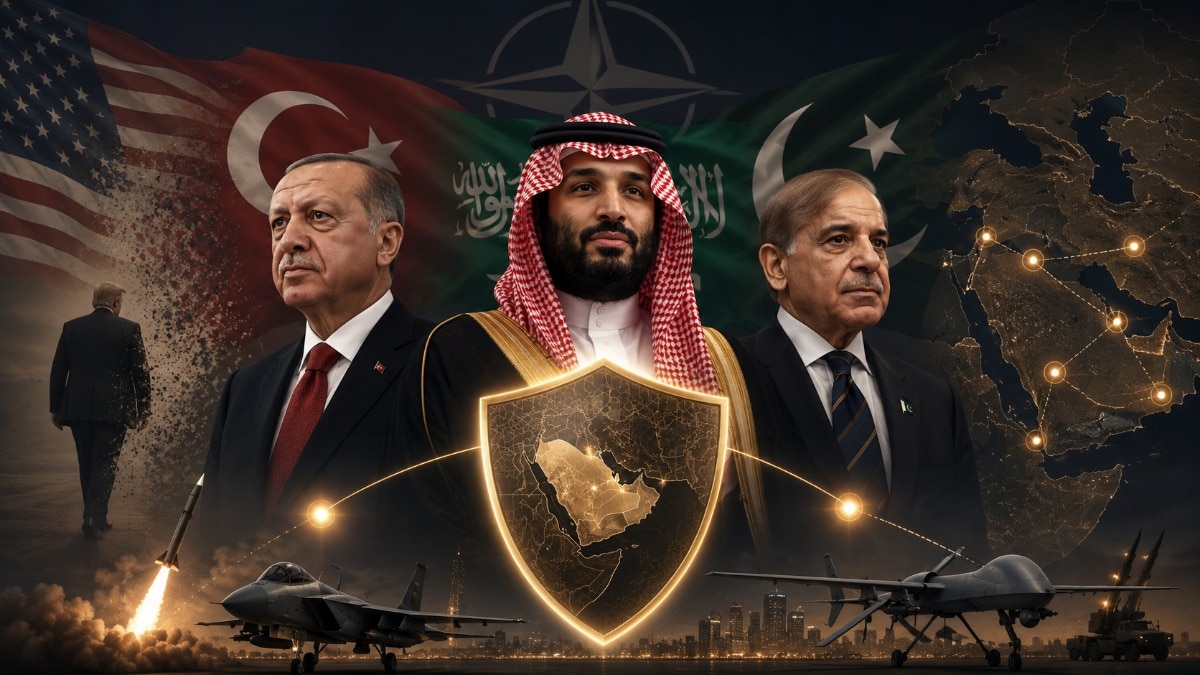
The Pakistan-Saudi Arabia-Turkey defence pact, signed in Mecca last week, might expand to include more Islamic countries. Middle Eastern nations are lining up as the US fails as a security provider amid Iran's attacks. Is the birth of an Islamic Nato a first sign of a post-American security order in the Middle East?In the Mecca pact, Pakistan contributes nuclear deterrence, Turkey brings defence technology, and Saudi Arabia provides financial muscle. (Image: AI-Generated)The Mecca Joint Defence Agreement, which experts say is the Islamic Nato or the Sunni Nato, was signed only days ago. Its architects already want it to grow. Ankara has made it clear that Pakistan, Saudi Arabia and Turkey are only the beginning. More regional Islamic countries are expected to come under the umbrella of the pact. Like Nato's Article 5, the Mecca Pact treats an armed attack on one member as an attack on all.Egypt, which has Africa's most powerful military, has been identified as the next likely entrant. Qatar, Kuwait, Jordan, Azerbaijan and Syria have also emerged in discussions, according to experts.The pact with Turkey, a Nato member, and Pakistan, a major non-Nato ally, comes amid an increasing scrutiny of Washington's security umbrella over the Middle East (West Asia) and its periphery. The US has done little even as countries hosting American bases came under missile and drone strikes from Iran.The Mecca Pact appears to be the Middle East's answer to a changing world order where the US had been the region's unquestioned security provider. The US-Israel-Iran war, uncertainty over American security guarantees, Iran's display of military might and the desire among regional powers to rely less on outside actors have all converged to create the pact, say experts. The three founding members insist it is a defensive arrangement, not an anti-Iran alliance or an alternative to Nato. But its ambitions, even in its first few days, appear sky-high. Many analysts believe it marks the first attempt in decades to build a regional security architecture led by Muslim powers.Saudi Arabian political scientist Mansour Almarzoqi, taking to X, argued that much of the commentary on the defence pact has missed the bigger picture. "The Makkah Pact is just the foundational step towards something bigger. A framework for aggregating the might of the three global middle-size powers. There is an emerging world order". He also asked if Ankara's move reflects growing doubts about "US and Nato reliability." Former National Security Council Secretariat official and strategic expert Tara Kartha noted that a US Congressman had claimed President Donald Trump helped broker the Mecca Agreement. The Turkey–Saudi Arabia–Pakistan pact's real test would come when one member faces an attack the others would rather avoid, say experts. (File Image/ AFP) After the US-Israeli strikes on Iran began on February 28, Tehran responded with waves of missiles and drones targeting Israel, Gulf states and US bases, which resulted in dozens of casualties, damage to military and civilian infrastructure, and disruption of shipping through the Strait of Hormuz.While US and allied air defences intercepted most incoming threats, some attacks penetrated the shield, hitting bases, energy facilities, airports and ports. The UAE was the worst hit. The war in the Middle East has since continued in cycles of Iranian attacks and US retaliation. This has also made the US's Gulf allies aware that even overwhelming American military support could not fully insulate the region from the fallout of the war.The US is now desperately looking for an exit from the war it started.By prioritising the reopening of the Strait of Hormuz over an immediate nuclear deal, the Trump administration appears to be lowering its main war objectives in search of a politically viable off-ramp, reported The Wall Street Journal. With midterm elections approaching and fuel prices under pressure, the move could be interpreted as an attempt to claim victory by American President Donald Trump without securing a comprehensive settlement.WHO COULD JOIN THE MECCA PACT NEXT?Turkey is leaving little doubt about the pact's ambitions. Turkish Foreign Minister Hakan Fidan, citing President Recep Tayyip Erdogan's vision, said the alliance should not remain limited to three countries. "We should grow and, if necessary, bring all countries under this umbrella," he said.So far, Egypt is the only country publicly identified by a signatory as the next likely member.Fidan described Cairo as a "natural partner" and said only "technical issues" remained before it could join. Analysts say that Egypt would significantly increase the alliance's political and military weight, though Cairo remains cautious about accepting binding military commitments that could affect its ties with Washington or existing peace treaties.Egypt, Africa's strongest military and the world's 19th most powerful, fields over 4.4 lakh active personnel backed by thousands of tanks and a formidable air and naval fleet.Beyond Egypt, Qatar and Kuwait are widely viewed as the strongest Gulf candidates. Chatham House's Karim Elgendy, speaking to Qatari broadcaster Al Jazeera, called them the "names to watch first". Qatar University's Ali Bakir called Qatar the "most natural" Gulf entrant.Former Qatari Prime Minister Sheikh Hamad bin Jassim Al Thani, in a post on X, expressed hope that all Gulf Cooperation Council (GCC) members would eventually join the Mecca Joint Defence Agreement.The GCC is a six-nation political, economic and security bloc comprising Saudi Arabia, the UAE, Qatar, Kuwait, Bahrain and Oman.Qatar University's Ali Bakir also suggested Jordan, Azerbaijan and Syria could enter the framework relatively quickly. Inside the Mecca Pact's military might. Turkish Foreign Minister Hakan Fidan revealed that several unnamed countries had already expressed interest, reported Anadolu news agency.It's a crystal-clear trajectory for the founder states. They want the alliance to expand beyond three nations into a regional bloc.WHAT DOES EACH MEMBER OF ISLAMIC NATO BRING TO THE TABLE?The construct of the Mecca Pact suggests that it is built around complementarity. Saudi Arabia can contribute enormous financial resources. It has a strategic geography and is one of the Middle East's most developed air forces.Turkey has a Nato-trained military, and an increasingly sophisticated defence manufacturing industry.Pakistan, as it has been a fire-for-hire in the past, has one of the world's largest armed forces and is the "only nuclear-armed Muslim-majority country".Political analyst and commentator on Lebanese and Middle Eastern affairs, Bechara Gerges, taking to X, neatly summed up the equation. "The Mecca pact joins three assets no member holds alone. Saudi money, Pakistan's nuclear arsenal, Turkey's defence industry."Should Egypt eventually join in, analysts believe it would substantially increase the alliance's military and political weight through its large standing army, strategic location at the boundary of Asia and Africa (near the Suez Canal) and an important and established role in Arab diplomacy.If Qatar, Kuwait and other Gulf Sheikhdoms eventually sign the Mecca Pact, the grouping would gain more financial depth and a broader legitimacy in the region. Jordan, Azerbaijan and Syria would extend the alliance's geographic footprint across the Caucasus and the Levant region. A snapshot of Egypt's military might in 2026. What exactly is the birth of this so-called Islamic Nato? Is Washington backing it, or did the US retrenchment — highlighted by the US-Iran war — create the space for it? And with President Donald Trump urging allies to spend more on their own defence and reduce dependence on America, did the US step aside and let its Middle Eastern partners build their own security umbrella?WHY NOW? DID AMERICA'S MIDDLE EAST RETREAT CREATE THE PACT?Perhaps the most important question around the birth of the Islamic Nato is why the alliance has emerged now. Several experts point to the common factor of declining confidence that the United States can guarantee security.Former Director General of Infantry of the Indian Army, General Shashi Asthan (Retired), writing in Modern Diplomacy, argued the agreement is "less a finished alliance and more a strategic hedge" driven by Saudi Arabia's growing insecurity. General Asthana (Retired) wrote that the three countries were pooling military and political strengths because they "no longer take American reliability for granted."US-based New Lines Institute analyst Dania F Arayssi took to X to call the "Makkah Pact, a collective security agreement.""The Makkah Pact is a signalling agreement that the countries in the region can no longer depend on the United States and its military bases in the region for their security and safety, and it's a call for a collective security agreement. It's not a Sunni agreement or anti-Iran agreement, it's a collective security framework for the region," Virginia-based academic Arayssi wrote on X.Indian Army veteran General Asthana (Retired) argued the Mecca pact lacks Nato's integrated command, automatic military obligations and institutional depth, which makes it "a Sunni Nato in style, not structure." The human and financial toll of America's Iran war. Saudi Arabian political scientist Mansour Almarzoqi, who said that "The Makkah Pact is just the foundational step towards something bigger", added that the pact is also about lowering costs through partnerships and preparing for a changing global order.Indian strategic affairs expert Tara Kartha said that Trump "worked out the Mecca Agreement" even as Pakistani Shia clerics branded it a "US-Arab conspiracy"."As a US Congressman claims that Trump worked out the Mecca Agreement, Pakistani Shia clerics, led by prominent scholar Agha Syed Jawad Naqvi, warned Islamabad against an anti-Iran stance under the Mecca Joint Defence Agreement. Naqvi alleged that the trilateral pact is part of a US-Arab conspiracy to drag Pakistan into Middle Eastern conflicts," Kartha wrote on X.Now, the Mecca Pact is in its primitive stage. Would it evolve into an "Islamic Nato" by involving more members or remain a flexible security arrangement would depend on who joins next and how far its members are willing to institutionalise military cooperation among each other. But, irrespective of what the US's intention is, it is now sure that the Middle East is preparing for a future in which it no longer wants to rely on the US for its security.- EndsPublished By: Sushim MukulPublished On: Aug 11, 2026 06:30 IST
Is Mecca pact a US conspiracy? More Islamic nations to join Pak-Saudi-Turkey bloc
Full Article
Original Source
Read the full article at Indiatoday →KhanList aggregates and links to publicly available news content. We do not host full articles from third-party sources. Always verify important information with original sources.