
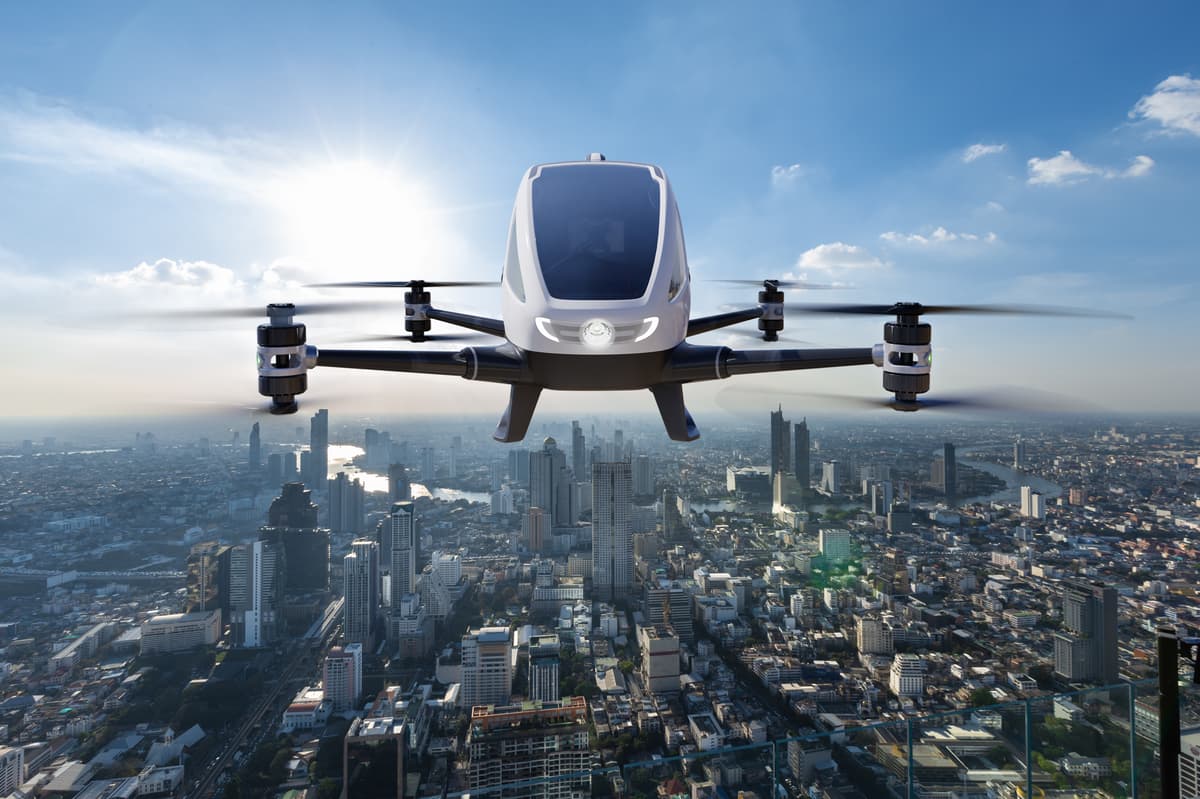
Is this the week that London becomes a fully plugged-in and autonomous future city? Is our capital, founded by the Romans, designed by Wren and Nash, Foster and Rogers, mechanised by the Victorians, finally having its sci-fi moment — driverless cabs on the streets, just like the robot-piloted “Johnny Cabs” in Arnie’s Total Recall movie, and flying drone taxis, like the airborne “Metrokabs” ridden by Rick Deckard in Blade Runner, strafing the London skyline? In Westminster, Uber has been offering preview test fares in its fleet of autonomous, AI-equipped Wayve robotaxis. Despite Uber’s TfL-granted private-hire licences still requiring a qualified driver to be present on each journey and remain responsible for the car at all times, customer interest is sky-high — more than 100,000 London residents have already signed up for the Uber Wayve waiting list. The excitement is overhead too. Just last month, California-based Joby Aviation brought its all-electric air taxi to Tower Bridge, providing a close-up preview of the aircraft that could transform short-distance travel over London and across the UK. The plan is for the aircraft to operate on an Uber-esque, on-demand air-taxi format, allowing up to four passengers to book door-to door rideshare flights to airports and out-of-town destinations at the swipe of an app. Joby’s large electric drone promises to cruise at speeds of up to 200mph, with a range of 100 miles. Take off and landing is vertical — Blade Runner style. A full-scale model of our electric air taxi beside Tower BridgeJoby Aviation via TwitterThe robotaxi trials and the Joby sky cab reveal are part of the Mayor’s grand Transport for London “Vision Zero” strategy, which aims to eliminate all deaths and serious injuries from road collisions by 2041, and a wider world vision for a “triple-zero” urban environment — zero crashes, zero emissions and zero congestion. The future — safe, fast, silent — is getting closer… albeit very slowly, with some serious delays. Mostly across central London.Turns out our city is mapped more for sprawling obfuscation, not neat and tidy source coding. For knowledge, not artificial intelligence. Its narrow and twisty streets are criss-crossed, zig-zagging and labyrinthine, all dead ends, bus lanes, bollards, traffic furniture, major digs, one-way systems, cul-de-sacs, cobbled mews and, at Hyde Park Corner, an insane, lane-less free-for-all — and certainly no orderly, easily programmable grid system. Is London suited to driverless cars?Will a Wayve ever get to successfully navigate, say, the strict but variable and Kafka-esque, clean- air neighbourhood traffic system that operates around the south Fulham/Hurlingham club locale? Already there have been reports of a confused, self-driving Waymo car repeatedly driving up and down Spitalfields cul-de-sac Elder Street, not knowing how to escape and emitting a loud automated siren when reversing. At 5am. Then there is the more pressing people issue. London is an urban-claustrophobia, its roads and pavements, across all boroughs, alive with human traffic. Millions of pedestrians, cyclists, runners, jaywalkers — moving across every stretch of Tarmac, at all hours. Each day there are more than 1.5 million bike rides and 24 million walking trips taken in Greater London, with 38 per cent of all daily journeys taken on foot. Hot metal cars are within literal touching distance of sentient humans at corners and crossings. Crucially, in the Waymo-operational US cities of San Francisco, Phoenix and Los Angeles (walking accounts for only 5 to 10 per cent of all daily trips), jaywalking — ignoring a flashing “don’t walk” sign at a pedestrian crossing — is illegal. In London, as one very human black cab driver recently put it, “jaywalking is a competitive sport”. Stroll through Soho or Shoreditch at any time of day or night and your London strut naturally assumes an imperious “feet first” attitude — all powered vehicles must give way to your pedestrian superiority as you stride down, yes, the middle of the road. Sure, a black cab driver might honk you out of the way, you will step aside and his journey will continue. A Waymo vehicle? It will just stop and wait until the road is clear. Even during a short W1 cab ride, this may happen several times and might become tiresome for the passenger. Walking would definitely be quicker. Or maybe, depending on what the car’s cameras see and compute, its frustrated AI might choose differently and plough ahead. Back in April this year, a Waymo taxi drove into a violent crime scene in north-west London, the autonomous vehicle careering through “Do Not Cross” tape and into a police cordon as officers investigated a double stabbing in Harlesden. This was a strange and mysterious incident redolent of a Philip K Dick sci-fi, a spokesman for Waymo confirming that the driverless car was being manually “driven” at the time of the incident — the company’s “initial analysis” citing human driver error over computer failure, suggesting that the AI car would have identified the danger and stopped had it been in automated mode. Or… just maybe, the red tape, flashing lights and uniformed officers caused the car to revert to some sort of emergency mode and take a more independent initiative? Read MoreAlready there are concerns about automated vehicles’ ability to accurately detect a pedestrianAlready there are concerns about automated vehicles’ ability to accurately detect a pedestrian — the cars’ sensors might confuse a stationary, monochrome, well-upholstered person for a concrete bollard, for example. A man wearing a T-shirt emblazoned with a round red-and-white logo could be mistaken by the autonomous car’s cameras for an actual stop/no entry sign. Even more sinister, and Blade Runner-scary, is the driverless vehicle’s kill priority programming. If an accident or collision is unavoidable, should the robotaxi protect the lives of its passenger or prioritise the third party pedestrians… or the oncoming vehicles? Or sacrifice the lives of two passengers and save five pedestrians. Would it be better to hit a granny but swerve a toddler. Incredibly, this decision may vary depending on country and culture. While writing his excellent, dystopian novel Machines Like Me, London W1 resident Ian McEwan took a deep dive into robot technology, becoming particularly fascinated by driverless cars and the complexly coded moral dilemmas they might face “Which way does the (driverless) car swerve?” Who gets killed? The kid or the pensioner? McEwan wanted to know. Putting a robocab to the test Research, he discovered, had extended across Europe and the United States, and in China. “When Europeans and American North Americans were asked, ‘Who are the most valuable human beings?’ They answered ‘children’. When you ask Chinese people, they said ‘old people’, because you’ve got to respect their wisdom. So, bang go universal values.” Dictatorial regimes, North Korea for instance, could be even more divisive, valuing liveried and uniformed officials — policemen, military personnel, security officials etc — over plain-clothed civilians. Ergo, the driverless car might choose to take you and your Uniqlo-clobbered behind out of the picture, but spare the life of the traffic warden in the shiny peaked cap. Shoppers walk along a busy street in central LondonAFP/GettyOther issues around this slow drive toward Sadiq’s zero crashes/zero emissions/zero congestion El Dorado? Harlesden’s Green Party representative, Cllr Amandine Alexandre, argues that driverless taxis are actually an energy- sapping nuisance, their heavy computing, constantly processing, self-driving systems generating tons of data that needs to be stored in energy- and water-hungry data centres around the city. And with Waymo intelligence not yet programmed to pull over and have a cortado until the next fare is booked, robo taxis are likely to be congestion mongers — unmanaged fleets circling the city without passengers, a practice known as “deadheading” in cabbie-speak — that risk worsening London’s already nose-to-tail gridlock. Would your bicycle-riding, Oyster Card-carrying, mostly car-free, Congestion Charge-avoidant reporter be one of them? I braved London’s lunchtime traffic and cycled over to Westminster for a preview fare in one of the new Uber Wayve Jaguars. I would be Arnie the passenger in my very own Total Recall-style, robotised Johnny Cab… And even on this damp September morning, it definitely feels like the beginning of something really new and exciting. Starting today, Londoners requesting an UberX, Uber Electric or Uber Comfort may be matched with a (supervised) Wayve ride at no extra cost, with upfront fares shown in-app. These lucky new Wayve riders will travel in an all-electric Ford Mustang Mach-E vehicle retro-equipped with Wayve AI Driver tech and multiple surround sensors. Fully integrated Uber Wayve cars will be made by Nissan. A self-driving Uber carUberHeadquartered in London, Wayve co-founders (and Londoners) Alex Kendall, 33, and Amar Shah 38, specifically trained Wayve’s AI technology with the capital’s “challenging” roads in mind. (The thinking being, if you can teach a car to drive in London, it will be able to drive anywhere.) The AI Driver, the duo claims, learns from experience, much like a human, allowing it to scale and adapt to complex environments without relying on traditional HD maps or hand-coded rules. All London drivers are familiar with hand-coded gestures, of course. Adapting the cars to the capital’s chaosI order my ride for 12.30pm and wait in the Raffles Hotel lobby on Whitehall. Two hours later, my driverless cab still hasn’t showed up. Turns out, a perfect storm of central London shit-housery has served up both a 200-strong sit-down protest by the Just Stop Oil group on Parliament Square, and a major, black taxi-on-double-decker-bus collision somewhere on the Embankment. Rerouted traffic moves at a crawl and Wayve’s autonomous, all-singing-and-dancing, all-electric Ford Mustang Mach-E with Wayve VP Kaity Fischer in its back seat, just like every other taxi in Westminster, is a non-mover. Eventually, Fischer shows up. She beat the traffic by jumping out of her driverless car and onto a Lime bike. On her phone’s Uber app she orders our ride. It arrives in silence. Like a hearse. I pop a touch-sensitive pad on the door and climb in. Another swipe of the app and we are off. Look Mum, no hands! Immediately, an elderly couple steps out into the road, just yards ahead of us. (The Wayve people term bicyclists and pedestrians like these “vulnerable road users”). The Mustang slows down and lets them pass. Smooth and impressive. Now we are approaching a red light to turn onto the Embankment. Heavy metal both ways. There’s a contra-flowing lane to negotiate and a small gap between a van and a coach to nick. The Wayve cameras read the situation and we manoeuvre in to the small space in a manner that would make a pro London driver proud. Further up the road, the Mustang politely gives way to a double-decker bus. Which a hardened London driver would never do, obviously. “Too conservative, especially in a city like London, and you’re not going to move anywhere”London’s driving culture, says Detroit-raised Dalston resident Fischer, requires a special style of driving that Wayve likes to call “assertive”. “Levels of assertiveness are important for the vehicle. Too conservative, especially in a city like London, and you’re not going to move anywhere. If you’re too aggressive, the perception of safety could be deteriorated. It’s important that road users and riders feel safe and confident in the technology. But also important that the car actually gets you there too.” To achieve this the artificial intelligence deploys a “naturalistic” process to learning. “It’s an AI-based approach, not a rules-based approach, and that means that the vehicle adapts in a human-like way to these scenarios.” We cruise along at a consistent and exact 20mph, mini roundabouts and give-way junctions anticipated and turned on with a calm and unaggressive, intelligent fluidity. The level of control is weird but also kind of comforting. There is no chat from the supervisor behind the wheel who sits with his palms turned up to prove that he is not interfering and won’t be asking for a tip. We arrive at our destination in Victoria, the journey ending with a confirmation alert on the app. Maybe, vision zero, Future London just arrived here too.
Is London ready for driverless cabs and drone taxis?
Full Article
Original Source
Read the full article at Standard →KhanList aggregates and links to publicly available news content. We do not host full articles from third-party sources. Always verify important information with original sources.