
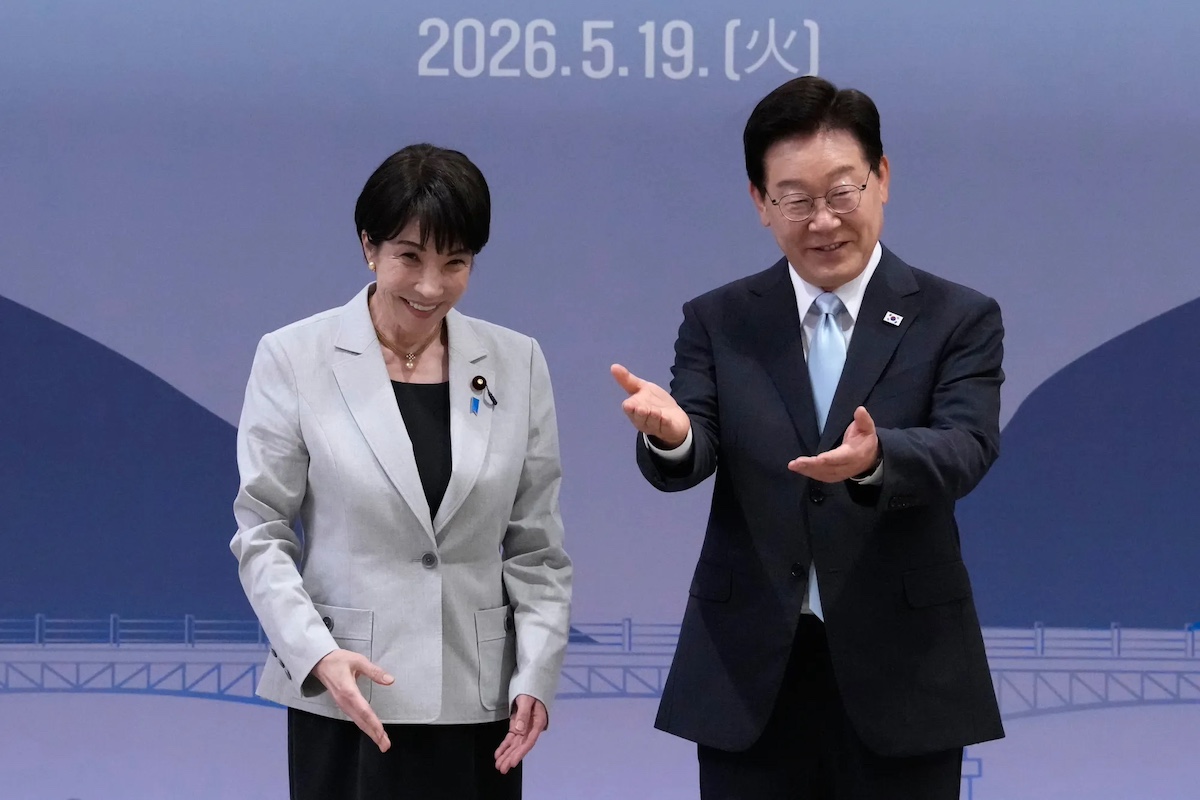
Japan-South Korea ties are on the upswing. After a recent decade of some of the tensest relations since normalization, Seoul and Tokyo appear to be setting aside their differences as they enter a new phase of closer cooperation and active diplomatic initiatives. Under Kishida Fumio and Yoon Suk-yeol, the countries signed a pact with the United States for greater trilateral security cooperation at Camp David in 2023. Now, under Takaichi Sanae and Lee Jae-myung, so-called “shuttle diplomacy” has resumed. Previous antagonistic rhetoric has given way to warm words and promises to deepen cooperation. Yet, we have been here before. Although relations between these East Asian neighbors have been turbulent right from their normalization in 1965 – principally due to persistent clashes regarding the history of Japanese colonial rule of Korea between 1910 and 1945 – there have been episodes of improvement in the past. Around the turn of the millennium, for instance, significant bilateral cooperation occurred, resulting in the 1998 Joint Declaration under Kim Dae-jung and Obuchi Keizo and the joint hosting of the 2002 FIFA World Cup. This prompts the question: can Japan and South Korea’s rapprochement actually endure this time around? Scholars of international relations disagree as to the main drivers of state conduct. While some emphasize what they see as essential features of the international system – such as the distribution of power, alliances and regime type – that drive states towards a “rational” national interest or strategy, others emphasize contingent, socially-constructed factors, such as notions of national identity, that shape state behavior in ways which might surprise observers. The latter perspective has tended to win out in analyses of Japan-South Korea relations. Despite both countries being liberal democracies and key regional allies of the United States, which might imply a strong propensity for close cooperation, including on security, Seoul and Tokyo have been unable to build such an alliance. That’s largely due to conflicting practices of remembering (and forgetting) the history of Japanese colonialism, which shape important elements of their national identities. This clash has made cooperation – and especially security cooperation – a far less “rational” proposition in the minds of many Koreans and Japanese. Today, however, much of the coverage of Japan and South Korea’s improving relations emphasizes these frameworks of rational strategic interest. We are told, in particular, that these warming ties stem, at least in large part, from mutual security threats from China and North Korea, and from the uncertain backing of the United States under Donald Trump. These factors may indeed be pushing Japan and South Korea closer to some extent. Yet, they are also not new. North Korea and China have posed a similar threat to the region’s security for some time, and during Trump’s first administration, when he regularly implied Washington was an unreliable ally, relations between Seoul and Tokyo reached a new low under Moon Jae-in and Abe Shinzo. Despite these purported motivations for strategic cooperation, what has brought the relationship back to acrimony and discord time and time again has been these underlying identity-based frictions relating to the history of Japanese imperialism, which rise to the surface and act as a blocker. So is this time different? That is, are we now seeing a sufficient shift in notions of national identity that could allow for deeper and more enduring cooperation between Tokyo and Seoul? One measure of such shifts is opinion polling. Here, public perception appears to have shifted significantly in each country. A poll conducted by South Korea’s East Asia Institute (EAI) in July 2026, for example, showed that 54% of South Koreans now have a favorable impression of Japan – the highest level since the poll began in 2013. The same poll found fewer Japanese with a favorable view of South Korea, only 35%, but that was still up over 10 percentage points from the previous year’s survey. Yet, polling that asks specifically about attitudes to the history of Japanese imperialism shows how high the hurdle is. Joint polling by the Asahi Shimbun and Dong-A Ilbo in June 2025, for example, showed that 80% of South Koreans agreed that historical issues between the countries were still “not resolved,” and 85% that Japan had not “apologized sufficiently.” These are very large majorities. The EAI polling, therefore, may show that people can increasingly set aside historical issues while developing more generally favorable views of one another. But it may also indicate shallow, temporary boosts in favourability that underlying antagonisms can overcome when a trigger brings them back to the surface. Such a trigger could come from events outside Japan and South Korea’s control, but it could also come from Lee and Takaichi’s own conduct or political calculations, whose core political ideologies and bases exist uncomfortably alongside the positive cadence of their relationship thus far. Lee was previously an outspoken and vicious critic of Japan’s attitude toward its past, while Takaichi has been an adamant historical revisionist on issues such as the “comfort women” and regularly visited Tokyo’s controversial Yasukuni Shrine before her premiership. Japan and South Korea’s long-term difficulties are certainly not inevitable. In the coming decades, it is eminently possible that Tokyo and Seoul could develop a deep and enduring relationship of friendship and cooperation across all realms, including security. But assuming that strategic interest and geopolitical pressures alone can secure such a trajectory would be a mistake. Rather, such a shift in relations requires a broad transformation in how each side sees itself and the other, given their difficult history. While recent polling suggests such a transformation could be underway, we would need to see mutual favorability rise further and remain persistently high for an extended period before we can entertain the prospect of enduring better relations. Dr. Chris Deacon is lecturer (Asst. Prof) in politics and international relations, Department of Politics and International Studies, SOAS University of London.
Is Japan-South Korea rapprochement finally built to last?
Full Article
Original Source
Read the full article at Asiatimes →KhanList aggregates and links to publicly available news content. We do not host full articles from third-party sources. Always verify important information with original sources.