
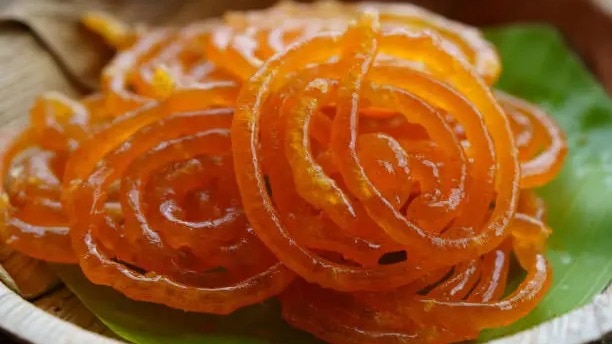
Jalebi, often seen as a quintessential Indian sweet, may not be Indian actually. Surprised? Let's tell you more about this sweet's history.When tiramisu and cheesecake did not exist, jalebi did. (Photo: Unsplash)Who can resist the lure of piping-hot jalebi with samosa or pakora on a rainy evening? Add some garam-garam cutting chai to the mix, and you are all set (Digene can take care of the acidity). When Domino’s pizza and Singapuri chowmein did not exist, jalebi did, and it has a certain nostalgia attached to it that Gen Z and Gen Alpha can never understand. But what if we told you that jalebi does not actually belong to India and has its roots elsewhere? How shocked would you be?The sweet's older history can be traced to West Asia, where similar fried sweets were known as zalabiya or zulabiya. Recipes for zalabiya appear in medieval Arabic cookbooks, including the 10th-century Kitab al-Tabikh by Ibn Sayyar al-Warraq. A later 13th-century cookbook by Muhammad bin Hasan al-Baghdadi also records the sweet.So how did a West Asian sweet become one of India's most recognisable mithais?Over time, the recipe travelled and was adapted in the Indian subcontinent. By around the 15th century, jalebi was already appearing in Indian literary references. The Priyamkarnrpakatha, a Jain text composed around 1450 CE, mentions it in the context of a merchant's dinner. And India, as it often does with food, made the sweet its own. And guess what, even in India the same jalebi has been interpreted in different ways.Same, same but differentIf you have a sweet tooth and love trying delicacies from across the country, you will notice that several states have similar sweets which have different names but the compositions and ingredients are the same. In these cases, it becomes really difficult to track down their origin. For example, imarti is known as amriti in West Bengal and jalebi is called jilipi. “In Bengal, Jilipi can be of multiple varieties. But a thicker batter (with a different recipe) and more complex method is used for making amriti,” says Kolkata-based food writer and blogger Indrajit Lahiri, popularly known as Foodka.“If someone uses chhena base as the batter, it’s named as chhenar jilipi,” Lahiri says. Fried in ghee, he describes it as a delicacy that is now harder to find in Kolkata's sweet shops. It looks like a jalebi, but the colour is somewhat dark brown. In Narajol in Midnapore, meanwhile, jilipi is also made with moong dal or split green gram and is known as moong jilipi or papri.Then there is imarti. Imarti is very similar to jalebi (look wise) but very different when you take a bite. Less syrup, bigger in shape. (Photo: Getty Images) What the North commonly calls imarti is known as jangiri or jangri in parts of South India. Chennai-based food expert Shabnam puts it simply: “Imarti is called Jangiri here. We in south have our version and people in north have their own.”Imarti is made differently from jalebi, traditionally using urad dal batter and producing a thicker, flower-like shape. It is often linked to Mughal-era kitchens, and one popular story says it was created for Prince Salim, later Emperor Jahangir, giving rise to the name Jangiri. But this remains an origin story rather than an established historical fact; there are multiple versions of how the sweet got its name and form.That distinction matters because jalebi and imarti may look like close cousins, but they are not simply regional names for the same thing.So, is jalebi Indian?Its ancestry appears to be West Asian; its Indian identity is undeniable. The jalebi that Indians know today is the result of centuries of adaptation. Its shape, texture, batter, syrup and the ways it is eaten have developed within the subcontinent. Today, it is served at festivals, weddings, religious occasions and even breakfast tables in parts of India.Perhaps that is the more interesting story than arguing over whether jalebi is “Indian” or not. Food rarely stays where it starts.- EndsPublished By: Tiasa Bhowal Published On: Aug 12, 2026 15:55 IST
Is jalebi not Indian? The sweet's history is as twisted as its shape
Full Article
Original Source
Read the full article at Indiatoday →KhanList aggregates and links to publicly available news content. We do not host full articles from third-party sources. Always verify important information with original sources.