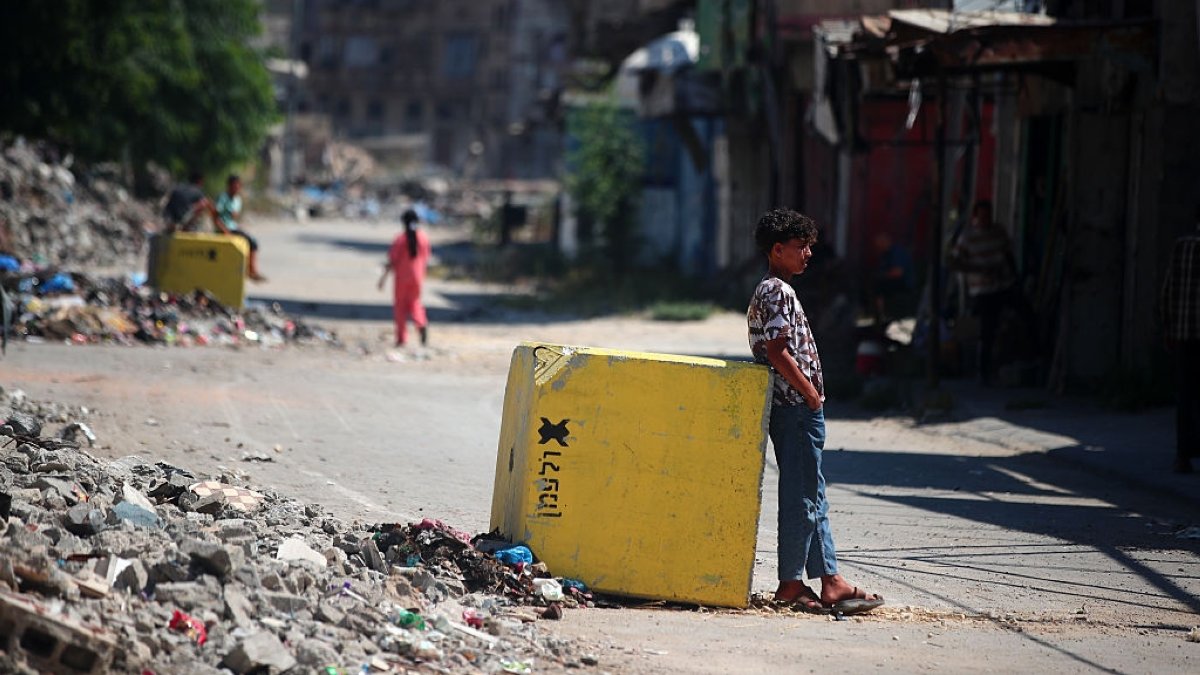
Since Oct. 7, 2023, the war has expanded beyond Gaza and gradually shifted its center of gravity toward Iran and the Gulf. The closure of the Strait of Hormuz and its effects on global energy supplies have further drawn international attention away from Gaza, even as conditions in the Strip remain highly fragile. Against this backdrop, Israel has continued to narrow the Yellow Line, effectively confining Gaza’s population to approximately 40% of the Strip, while carrying out targeted killings. Although the cease-fire has formally remained in place, little progress had been made by July beyond the first phase of the Comprehensive Plan. The uninterrupted delivery of aid through Rafah and Israel’s gradual withdrawal from Gaza, both required under the agreement, remain unresolved. Alongside these developments, Israel has maintained the diplomatic appearance of remaining committed to the agreement while pursuing a different strategy on the ground. The clearest indication of this strategy is the Israeli military’s construction of earth berms along a de facto axis surrounding Gaza. The structure begins in al-Mawasi in the south, extends toward Khan Younis, and continues northwards in separate sections toward Beit Lahia. According to the Associated Press, construction accelerated rapidly during July, and the berm had exceeded 23 kilometers in total length. Israel is also reported to have installed various reconnaissance and surveillance systems along the line. From a tactical and strategic perspective, the structure has two main functions. First, although the berm does not yet resemble the physical barrier that surrounded Gaza before Oct. 7, it is being constructed to restrict above-ground movement. The Israeli military has indirectly confirmed this purpose. Second, the excavation work required for the berm is possibly intended to detect and destroy tunnels that could allow movement from the area inside the narrowed Yellow Line to territory beyond it. Even this possibility suggests that the construction may form part of a longer-term plan. Politically, the berm can be seen as the product of Israel’s efforts to exploit the regional environment and reshape conditions on the ground in line with its own interests. Israel is using targeted killings and intermittent military strikes as key instruments in creating this reality and in repeatedly reminding Gaza’s population of the costs of opposing its policies. This strategy, which relies heavily on brute force, can be regarded as an extension of Israel’s traditional strategic approach. This satellite image from Planet Labs PBC shows a section of an earthen barrier being built by the Israeli military, Gaza, Palestine, July 1, 2026. (AP Photo) Under the terms of the agreement, Israel is expected to withdraw during the subsequent stages. Instead, it has continued to reduce the territory available to Gaza’s population. By constructing the berm, Israel appears to be creating a fait accompli and physically entrenching this territorial confinement. The move therefore suggests that Israel has little intention of proceeding to the later stages of the agreement. With U.S. President Donald Trump’s agenda currently focused on Iran, Israel also appears to enjoy considerable room for maneuver in Gaza. Another dimension of the issue concerns the continued presence beyond the berm of groups opposed to Hamas, including factions associated with criminal activity in Gaza. These groups are scattered around the Strip’s outer areas and remain dependent on Israeli support. Israel has effectively reduced Gaza to a much smaller central enclave while placing several security layers between this enclave and Israeli territory. If the berm eventually develops into a new wall, despite the terms of the agreement, it would constitute the first of these layers. A second layer would consist of territories occupied by anti-Hamas groups, which may gain increasing control unless these areas are opened to new Israeli settlements. The final layer would be Israel’s existing high-technology border system. Together, these layers would establish a new reality that could place the agreement and its guarantors under considerable pressure. Unless the regional environment changes and the Board of Peace directs its attention back toward Gaza, the berm may become the first component of a wider system of barriers. Under such an arrangement, more than two million Palestinians would be forced to live within an increasingly restricted area, while a new and potentially permanent territorial reality is established around them. Once embedded in military routines and physical infrastructure, temporary lines can acquire political durability even without formal annexation or legal recognition. The longer this arrangement remains in place, the more difficult it will become for the guarantors to restore the territorial terms envisaged in the agreement. Therefore, the central question is whether the cease-fire framework can still constrain the facts being created on the ground, or whether those facts will ultimately redefine the framework itself.
Is Israel’s new berm cementing Gaza’s shrinking geography?
Full Article
Original Source
Read the full article at Dailysabah →KhanList aggregates and links to publicly available news content. We do not host full articles from third-party sources. Always verify important information with original sources.