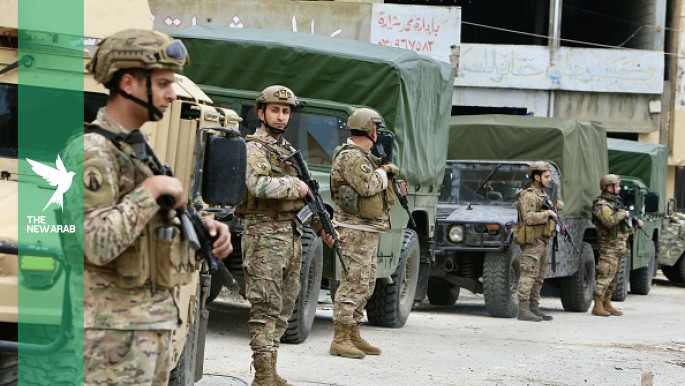
The Lebanese Armed Forces are meant to deploy within pilot zones agreed to with Israel [Getty]The Trump administration hailed last week's Rome talks as a breakthrough towards implementing a US-backed framework for southern Lebanon, presenting agreement on "pilot zones" as the first concrete step towards stabilising the border. But before implementation has begun, it is already facing serious doubts. A virtual technical meeting between Lebanese, Israeli and US military representatives, scheduled for Friday to begin implementing the pilot-zone agreement reached in Rome, was postponed before it took place amid disagreements over the next phase of the process. The dispute has raised questions over whether the US-backed framework can deliver on its promise of reciprocal implementation if Israel is unwilling to begin withdrawals from occupied territory. Pilot zones hit first hurdle Following US-mediated talks in Rome last week, US officials described discussions as "productive and positive", announcing agreement on guidelines for phased pilot zones across southern Lebanon. Under the proposal, Israeli forces would withdraw from designated areas, the Lebanese Armed Forces (LAF) would deploy, and armed groups would be excluded before the process expanded elsewhere. The initiative is intended to reinforce last year's ceasefire and revive implementation of UN Security Council Resolution 1701 through reciprocal confidence-building measures. A technical military committee was expected to meet shortly afterwards to begin implementation. Instead, according to Lebanese and regional media reports, those talks have now been postponed after Beirut insisted the initial pilot zones should include territory currently occupied by Israel. 'A test of the framework's credibility' Karim Bitar, associate professor of international relations at Saint Joseph University in Beirut, said the postponement exposed far deeper problems than a simple scheduling dispute. "It is definitely more than a simple procedural setback," he told The New Arab. "It sheds a crude light on a structural weakness that has actually existed since the framework was first unveiled." Bitar said the agreement assumed reciprocal implementation, but its drafting created an uneven sequencing of responsibilities. "Lebanon was being asked to move first on very difficult measures politically and institutionally, while Israel basically retained considerable discretion over the timing and scope of its own withdrawals," he said. "From a Lebanese perspective, it's not simply a question of optics or symbolism. Any Lebanese government will find it extraordinarily difficult to justify further implementation if Israel does not first demonstrate that the agreement can actually deliver tangible results on the ground." He said the disagreement represented "a test of the credibility of the entire mechanism" rather than merely "a technical disagreement over implementation". 'No intention of withdrawing' Bitar said the pilot-zone concept could only succeed if both sides implemented their commitments in parallel. "I don't think so, honestly," he said when asked whether the mechanism could work without Israeli withdrawals. "The whole rationale behind the pilot zones was to build confidence incrementally, to demonstrate that reciprocal implementation is possible." "But shortly after signing the trilateral framework, we had a series of statements from Netanyahu himself and from all his ministers saying that they have no intention of withdrawing from Lebanon." "Many Lebanese drew the conclusion that the exercise was designed primarily to test Lebanon's compliance rather than the reciprocity of the agreement," he added. "We're not seeing any confidence-building measures. It's becoming confidence-eroding measures." The dispute comes ahead of Lebanese President Joseph Aoun's expected visit to Washington, where southern Lebanon is expected to feature prominently in talks with US President Donald Trump. Will Washington intervene? For Bitar, the future of the framework will ultimately depend less on technical negotiations than on Washington's willingness to press Israel to fulfil its side of the agreement. "The US unquestionably has enormous — huge, tremendous, as Trump would say — leverage over Israel in military, diplomatic and political terms," he said. "The more relevant question is whether Washington is prepared to use that leverage." He argued that previous US administrations had generally preferred persuasion over pressure, leaving him sceptical that the Trump administration would force the issue. "There is a real risk that the entire process will stall before the confidence-building phase has even begun." The military committee meeting has been postponed rather than cancelled, while US mediators continue pushing both sides towards implementation.
Is Israel sabotaging the US Lebanon agreement before it begins?
Full Article
📰 Original Source
Read full article at Newarab →KhanList aggregates and links to publicly available news content. We do not host full articles from third-party sources. Always verify important information with original sources.