
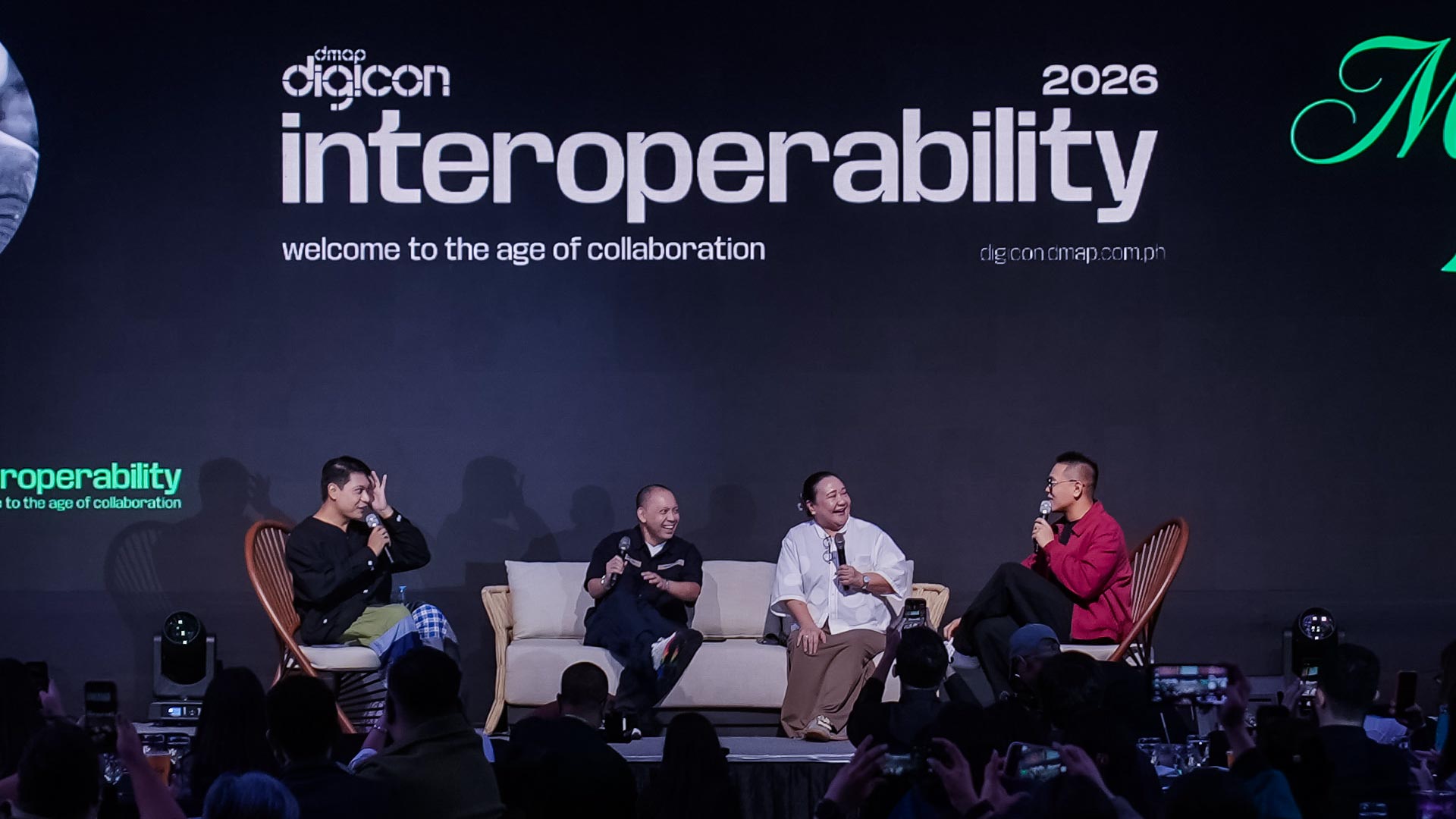
The concept of 'interoperability' is introduced as a more structured form of collaboration, emphasizing cross-industry partnerships and the integration of technology and human creativity. The event showcased how interoperability fosters community building and collaboration in pop culture, illustrating its potential to inspire collective action and creativity in the face of challenges. This is AI-generated. Read the article for full context. Report any errors. Editor’s note: This content is sponsored by Digital Marketing Association of the Philippines (DMAP) and was handled by BrandRap, the sales and marketing arm of Rappler. No member of the news and editorial team participated in the publishing of this piece. The word “collaboration” has been frequently thrown around in the past years – rising influencers joining forces with brands on a series of social media postings, vloggers coming together on their individual channels, and online creators of entirely different disciplines linking for passion projects to fill in each other’s “gaps” or introduce new areas for exploration for each other’s audiences. While it’s cool to witness these many forms of collaboration, sometimes I couldn’t help but wonder if this level of saturation makes it difficult to stand out. How can a joint creation be unique in the age of fast-paced consumption and online fatigue? How effective can partnerships be in the future? When I attended the recent DigiCon 2026, I discovered that there’s another word for collaboration, but with a richer and clearer structure: Interoperability. At “Interoperability: Welcome to the Age of Collaboration,” the flagship program by the Digital Marketing Association of the Philippines, 2,000 leaders and professionals from the marketing, business, technology, and media industries learned about how this multilayered term means cross-industry collaboration as we tinker with new technologies. Moreover, it happens by bringing out the best in human creativity alongside benefiting from the continuous evolution of AI – not as a replacement, but a collaborator. Integrated into human life One of the speakers, “Connect the Dots” author Dr. Christian Busch, offered an example of this through his talk on serendipity. According to him, the difference between serendipity and luck is that the former is about having agency in what’s going to happen next. CHANCE ENCOUNTERS. Dr. Christian Busch talked about the value of unexpected ideas in cultivating effective collaborations We can study serendipity through interoperability, as we find the unknown connections that can bring us to fruitful situations – and this can be achieved through placing “hooks”. Simply put, these can start with the kind of questions we ask people, like, “What are you currently curious about?” or “What are you currently working on?” DigiCon co-chair Raymund Sison described interoperability as “one of the most natural things in the world.” ALL HANDS ON DECK. DigiCon co-chair Raymund Sison emphasized the need for collective integration in the rise of AI in the digital space “The earliest forms of large-scale digital interoperability weren’t built for business or entertainment – they were forged by the military and early researchers to ensure that critical data wouldn’t get trapped in a single silo during a crisis. It’s about survival,” he said. “To build a resilient digital economy, we must move beyond individual capabilities and focus on collective integration.” Empowering people’s potential is important in the event, as DigiCon co-chair Shayne Madamba acknowledges the risk of AI’s takeover of our lives. “Looking at marketing today, paradoxically speaking, as we enter the height of AI where algorithms can hyper-personalize, automate, and even segment faster than ever. Our country, our industry, everyone in this room – we’re actually becoming more fragmented.” CRITICAL MINDS. DigiCon co-chair Shayne Madamba grounded the audience by reminding them on the risks of AI’s takeover in the marketing industry She added, “If we allow it further, AI can build walls of data silos, isolating us, our tools, our channels, and our whole humanity. This is why interoperability is no longer just a buzzword. It is a marketing imperative.” This year’s two-day DigiCon was divided into Innovation, Integrated, Impact, Immersive, and Interactive tracks. We got to listen to how various companies and brands define interoperability through their lived experiences – some of them, quite unexpected. Scrupulous integration with technology Interoperability means integrating with technology – which is common in the workplace. Thus, it’s a must to be responsible with the use of AI. During the panel discussion, “Privacy and Data Ethics: How to Build a Culture of Responsible AI Inside Your Organization,” Don Kevin Hapal, Rappler’s Chief Data Officer, shared the importance of taking accountability in using AI. “At the end of the day, if you generated it, you’re still liable for it. Because if something goes wrong because of the content you generated, you cannot suddenly just blame the AI for it. Because at the end of the day, it was you who decided to create that content.” Hapal emphasized the weight of this in the context of responsible AI use in media. “The responsibility [and] accountability [are] higher if you choose to put it out into public. For example, on social media. You decided to post this information. Because at the end of the day, it doesn’t matter if it’s AI-generated – if you choose to put it out to the public. It’s carrying your name.” Pop culture as a local movement and global soft power During the talk of Javier Miguel “Javi” Benitez, chairperson of the House Special Committee on Creative Industries and Performing Arts, he emphasized how recent successes in our popular media often started with a “Pwede pala” (So it’s possible) thought. Think of the collaboration of previous rival networks that brought out the country’s highest-grossing film, and even the gradual worldwide rise of our underdogs SB19 and BINI. Referencing the earlier talk, he emphasized that serendipity can’t work without the proper rails, so interoperability can happen in the form of rights, money, data, talent, and stages, among other forms of support. On the topic of pop culture, DigiCon also highlighted fandoms as another example of interoperability in play. Ina Flores, founder of fandom platform Hey Roomie, emphasized how fans stay in fandoms because of the community they provide. It’s interoperability at work because what’s happening isn’t passive. Ellen Manalang, leader of OPM artist Maki’s fandom Zushis Official, cited an example: Maki encourages his fans to discuss his work with him, like building a lore together. Ultimately, interoperability brings us closer together – an important aspect to preserve in the age of AI. Frances Cabatuando of Home Buddies PH – which houses millions of active members – brought up the value of finding a “north star” for your community. This allows people to know how to utilize the space themselves; they know how to act because they see the group’s purpose. And in big communities, people also get the initiative to create smaller, closer, and more intimate communities. They move on their own. “You are one idea away from changing the world,” said Judy John, global chief creative officer at Edelman. INSPIRING ROOM. Edelman global chief creative officer Judy John, an influential leader in today’s creative industry, graced the event as a keynote speaker While we’re often hounded by the “doom and gloom” image of the future, interoperability can be one of our strengths, as this inspires mobilization. We don’t just let things unfold. We’re aware that we can still make things happen the way we want to, if we’re brave enough to operate collectively. – Rappler.com
Is ‘interoperability’ the future of marketing?
Full Article
Original Source
Read the full article at Rappler →KhanList aggregates and links to publicly available news content. We do not host full articles from third-party sources. Always verify important information with original sources.