
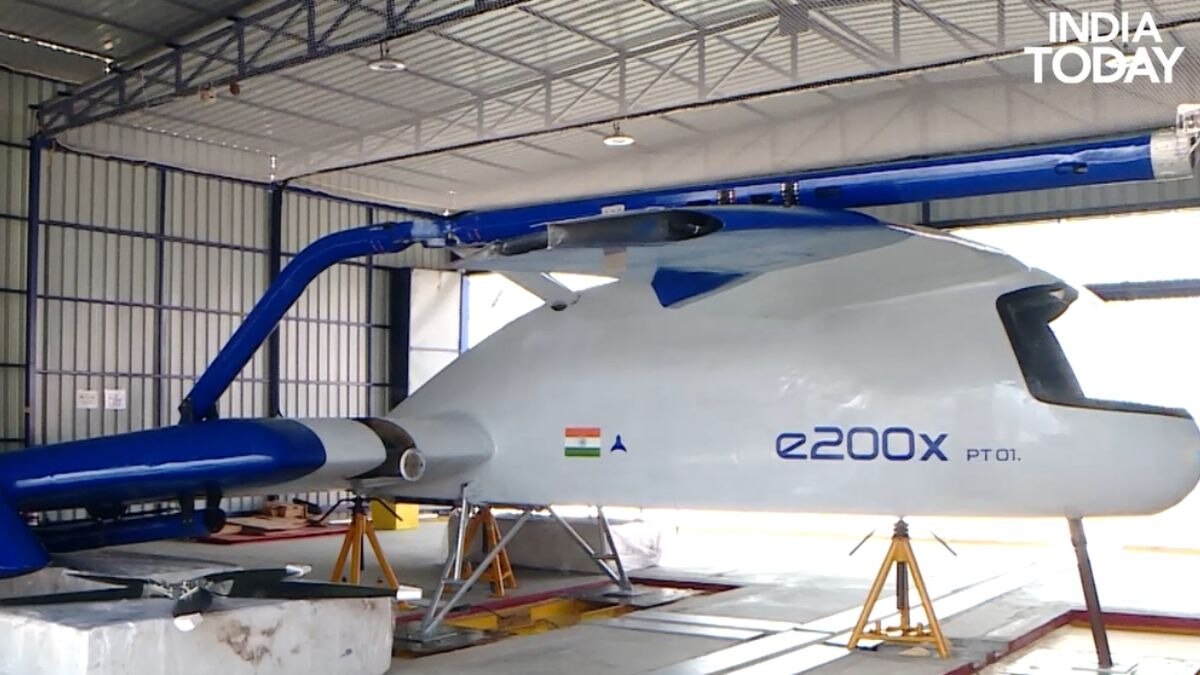
Anyone who has sat through a Mumbai, Bengaluru or Delhi traffic jam has had the same quiet thought: if only the car could rise above all this. Cinema has been selling that dream for more than four decades, from the flying cars of Blade Runner to the sky-lanes of The Fifth Element.At the Discovery Campus of IIT Madras, a team is trying to make the dream real. Their flying taxi is bigger than photographs suggest: an aircraft with 10 arms, six built to lift it off the ground and four to push it forward, each carrying a motor of its own. It is called the E200X.The real surprise comes in words, not metal. Ask its founder what happens when everything goes wrong mid-air, and he does not reach for a single safeguard. He describes a ladder.In an exclusive interview at the Discovery Campus, Professor Satya Chakravarthy of IIT Madras, who founded The ePlane Company, told India Today Digital that the E200X carries about seven layers of safety, each one a last resort for the one before it. “Take-off is optional, landing is mandatory,” Professor Chakravarthy says. “The idea here is not to let the aircraft come down like a brick.”The E200X is an eVTOL, short for electric vertical take-off and landing aircraft. It rises straight up like a helicopter, flies forward like an aeroplane and runs on batteries and electric motors instead of fuel. The company plans to fly it first as a flying ambulance, then as an air taxi over congested cities.WHY DOES INDIA’S FLYING TAXI HAVE TEN ROTORS? Because a swarm of small rotors can lose a few and still fly.A rotor is a set of spinning blades. The E200X has six vertical rotors that lift it like a helicopter and four propellers that drive it forward like a plane. Each rotor sits on its own structure, and nothing tilts. Many rival designs abroad tilt the same rotors forward mid-air, which creates a single point of failure, one part whose loss can bring the machine down. Six rotors lift the E200X and four propellers push it forward, each on its own structure, so no single part is critical. (Photo: Radifah Kabir/India Today) A helicopter, Professor Chakravarthy points out, may have several engines, yet all that power must still pass through one main rotor. The E200X, he says, has “several layers of redundancy”, which a helicopter “can’t even dream about”. Redundancy simply means a spare for every part that matters.He says his own inspiration was not the gadgets of science fiction but the winged creatures the Na’vi rode in Avatar.LAYERS ONE AND TWO: WHAT IF A MOTOR OR BATTERY FAILS?Nothing important is allowed to hang on a single wire.The first layer lives in the power train, the chain that carries electricity from battery to blade. Every motor has dual windings, two sets of coils that can each turn it, and two controllers, the electronic brains that set its speed. Every motor is wired to two battery packs, and every pack feeds two or more motors. Every motor on the E200X is wired to two battery packs, so one failed pack cannot cut its power. (Photo: Radifah Kabir/India Today) The result, Professor Chakravarthy says, is that you “never really have a total loss of lift”. A battery management system can isolate a faulty module without interrupting power.The second layer is simple arithmetic. If one of the six lifting rotors fails, the other five carry on. In forward flight, if one of the four propellers fails, three remain. Aviators call this one engine inoperative, and aerospace rules, Professor Chakravarthy says, usually stop there.LAYER THREE: WHAT IF TWO ROTORS FAIL?Then the aircraft changes the way it flies.Professor Chakravarthy does not stop at one. Blades on neighbouring rotors sit close together, he explains, and a blade that breaks away can strike another, setting off a domino effect. “If two or more rotors begin to fail, one after the other, we can just switch to a completely different mode of flight,” he says. An aircraft can stay up in two ways. Lift, the upward push that holds it in the air, can come from rotors or from wings. If the vertical rotors falter, the wings take over and the E200X lands like a conventional aeroplane, on landing gear built for both kinds of landing.If two forward propellers fail instead, the vertical rotors spin up to hold the weight, draining the battery faster while the pilot looks for a quick place to land.LAYER FOUR: WHAT IF ALL POWER IS LOST?Then the flying taxi becomes a glider.Professor Chakravarthy calls a total power cut extremely rare, and points out that the aircraft has multiple wires in any case. Assume it happens anyway. “Then we glide,” he says. The aircraft has a glide ratio of 10, meaning it can travel about 10 metres forward for every metre of height it loses.LAYERS FIVE TO SEVEN: WHAT IF EVEN GLIDING FAILS?A parachute, a tough frame and a cushion take over.Suppose a wing is damaged or the controls jam. The E200X carries parachutes and inflatables, Professor Chakravarthy says, which can allow “a feather touch”. The ePlane company's prototype air ambulance. (Photo: Radifah Kabir/India Today) If that fails too, the sixth layer is the airframe, the aircraft’s structural body. By regulation, he says, it must take a 16G impact at a set angle and speed and still stay intact. G is the pull of gravity, so 16G is a sudden force 16 times as strong.The seventh layer assumes even that is not enough. A cushion under the seat absorbs the blow before it reaches the passenger, so the airframe’s shock is not passed on. Its passenger seats also carry four-point harnesses and an energy-absorbing structure.HOW SAFE IS SAFE ENOUGH?The layers are described, but their odds have not yet been counted.Professor Chakravarthy is careful about what he has not yet proved. The layers have not been quantified, he says, which means the team has yet to calculate how likely a failure is once they are stacked together. “In the next couple of months, we should actually be able to put out numbers,” he says.Regulators set the bar in numbers. For passenger air taxis in its most demanding category, Europe’s aviation regulator EASA allows catastrophic failures no more often than once in a billion flight hours. The E200X has not yet been certified to carry passengers. Professor Chakravarthy expects the air ambulance to be ready as early as the second quarter of 2028, with the air taxi to follow and the last quarter of 2028 as his target.Indian skies add their own tests. Propellers must be shown to cope with dust, rain, lightning and bird strikes. Professor Chakravarthy says his team has just put a propeller through a lightning test.In aviation, he says, pilots greet each other with a wish: happy landings. On the ground, it is a pleasantry. In the air, it is an engineering brief. Ten arms, seven layers, and one promise the E200X must still prove in the sky: that take-off may be optional, but the landing never is.- Ends
Is India's flying taxi safe? Seven layers of safety inside IIT Madras's ePlane
Full Article
Original Source
Read the full article at Indiatoday →KhanList aggregates and links to publicly available news content. We do not host full articles from third-party sources. Always verify important information with original sources.