
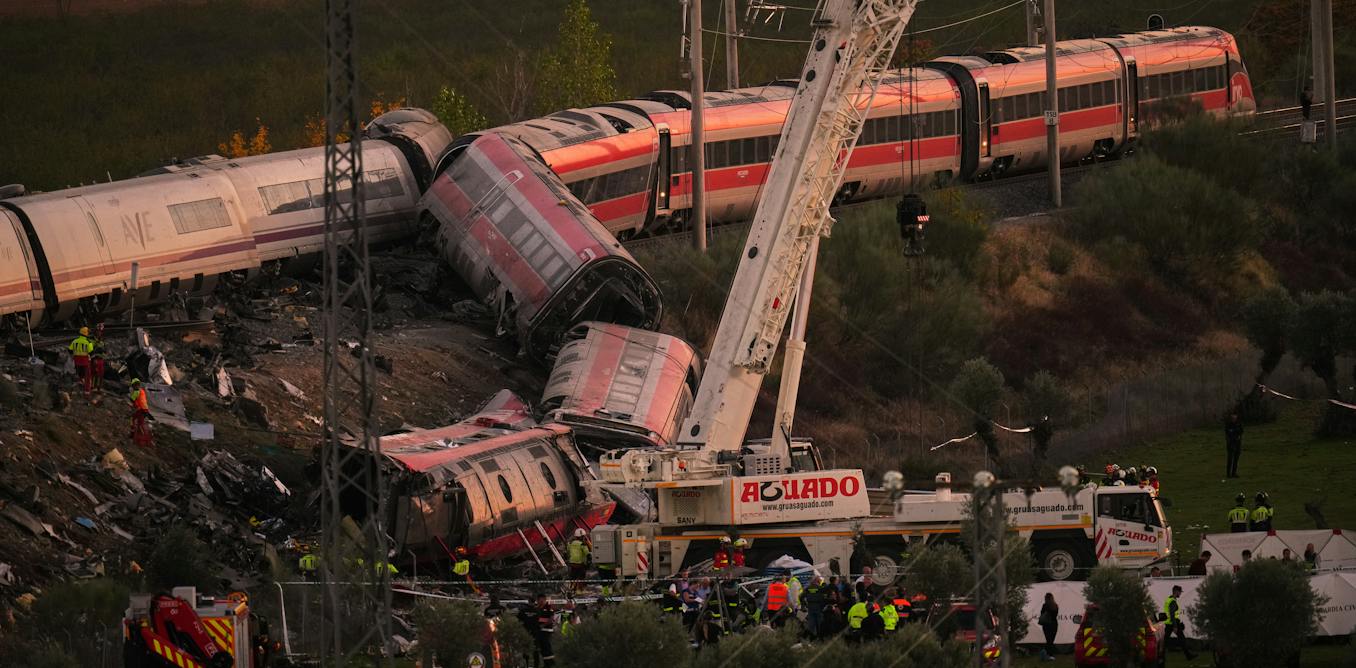
Residents in central Spain are dealing with the aftermath of a tragic collision between two high-speed trains, which has left at least 68 people dead and dozens more injured. On a rail line between the capital Madrid and the city of Seville, a train carrying 397 passengers collided at high speed with another train that was stationary on the tracks and had 147 people on board. The resulting force caused several carriages to be derailed. This is the most deadly rail disaster in Europe in more than a decade, but it’s also the second train accident that’s taken place in Spain this year. In January, 46 people were killed and 292 injured in a crash that took place on the same Madrid–Seville train line. This raises questions about rail safety. For Australia, which is developing its first higher-speed railway, the broader question is how to maintain safety, especially when equipment fails or there are other disruptions due to severe weather or maintenance. Are trains generally safe? Rail travel, including high-speed rail, generally has an excellent safety record. A good example is Japan’s Shinkansen bullet train network. According to the Central Japan Railway Company, there have not been any accidents causing death or injury to passengers on board since the network opened in 1964. The European Union Agency for Railways’ 2026 report found that, from 2014 to 2023, people travelling in cars on the road faced about 40 times the fatality risk of rail passengers travelling the same distance. Such records show what sustained safety management can achieve. Every railway must maintain its own safety through engineering, maintenance and daily operating decisions. So what caused the recent accidents in Spain? The two Spanish accidents appear to involve different failure mechanisms, although both remain under investigation. The train that derailed at Adamuz in January obstructed the adjacent track, leading to a collision with an oncoming train. Preliminary evidence points to a rail fracture before the derailment. The final report isn’t expected until next year. As for yesterday’s crash, Spain’s transport minister’s described a signalling disruption. Rail signalling refers to all the systems that control train traffic and speed. For reasons that are not yet known, one train received permission to travel on a track, while another was stopped ahead of it, leading to the collision. An older but relevant major accident occurred in Wenzhou, China, in 2011. Lightning during a storm triggered faults in the signalling system, exposing defects in its design. The system incorrectly treated an occupied track as clear and a train struck another ahead of it, killing 40 people and injuring at least 172. What can Australia learn? Australia doesn’t currently have a high-speed rail system, but plans are in place to open such a rail line between Newcastle and Sydney by 2039, with a more expanded network by 2060. When rail systems fail, they have to do so safely, rather than disastrously – it’s built into their safety management. In practice, this means Australia’s high-speed railway will be designed and tested to remain safe even when train control equipment fails or operating conditions deteriorate – this is known as degraded operation, or a “fault state”. This requires clear arrangements for recognising problems, restricting speed or service, or suspending operations and recovering safely. These responses must reflect what the railway can safely do under changed conditions – if there’s a severe thunderstorm, for example. In such changed conditions, the human involvement in managing train safety may be even more vulnerable than the technology itself. Human intervention becomes more demanding when normal operations break down. Staff may need to step in, interpret incomplete information and make unfamiliar decisions – potentially in stressful conditions under time pressures. In a fault state, the system becomes more dependent on human judgement precisely when exercising that judgement becomes harder. This needs to be anticipated in the safety design of any rail network – including Australia’s upcoming high-speed rail.
Is high-speed rail generally safe? What can Australia learn from Spain’s accident?
Full Article
Original Source
Read the full article at Theconversation →KhanList aggregates and links to publicly available news content. We do not host full articles from third-party sources. Always verify important information with original sources.