
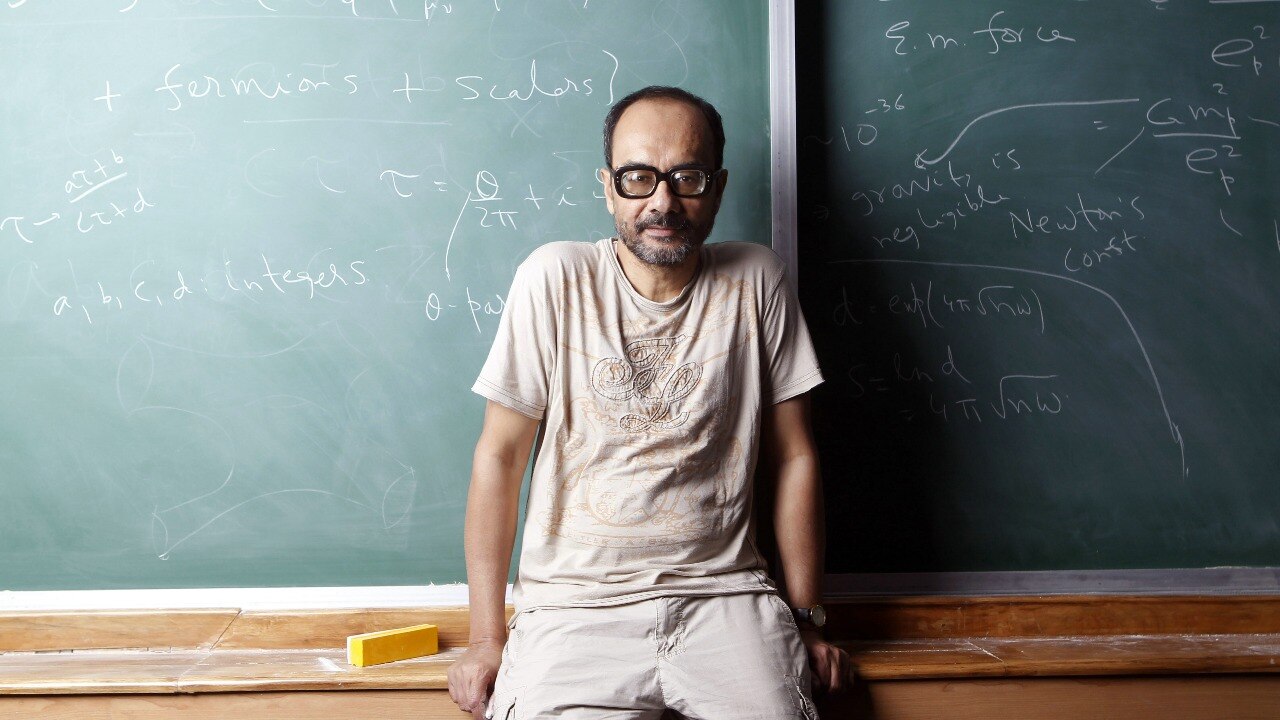
Ask most people to explain the universe, and they reach for a metaphor before they reach for the truth. Professor Ashoke Sen does the opposite. We asked him for an everyday analogy for the discovery that made his name, and he replied with five words that would make any science writer put down her pen. "There is no everyday analogy."Then, almost relenting, he offered one. "The closest I can think of is the fact that water and ice are both described by the theory of H2O molecules even though they look different."That is Professor Sen in miniature. He writes the way a good equation behaves, with nothing ornamental and every term made to earn its place. And across two rounds of interviews, one theme kept returning in his replies, stated with a candour rare among the celebrated. Again and again, one of the world's greatest living physicists told us, in effect, that this is not yet known.On October 22, the Kolkata-born string theorist delivered the 2026 Oskar Klein Memorial Lecture, titled Gravity from Strings and Strings from Gravity, at Stockholm University's AlbaNova Centre. With it came the Oskar Klein Medal, which ICTS-TIFR in Bengaluru announced made him the first Indian physicist to receive the honour. Awarded every year since 1988 by Stockholm University and the Nobel Committee for Physics of the Royal Swedish Academy of Sciences, the medal went first to the Nobel laureates Chen-Ning Yang, Steven Weinberg and Hans Bethe. Later names on its roll include Stephen Hawking and Edward Witten.There is a quiet rhyme here. In 1926, the Swedish physicist Oskar Klein suggested that the universe might hide an extra dimension, curled up too small to see. A century later, his medal has gone to a man who has spent his life inside a theory that needs six of them.WHY GRAVITY BREAKS THE MATHS Physics runs on two magnificent rulebooks that refuse to share a shelf. General relativity, Einstein's theory, describes gravity as the bending of space and time by mass, and it governs planets, stars and galaxies. Quantum mechanics describes the very small, a world of atoms and particles that moves in jumps and probabilities. A theory uniting the two, called quantum gravity, is the missing chapter of modern science.The trouble begins with points. Physicists have long treated the smallest particles as dots with no size at all. "In a theory of point particles, the effect of gravitational force is so strong that it gives infinite answers to sensible questions," Professor Sen told India Today. Ask how two particles bounce off each other through gravity, and the arithmetic returns infinity. In physics, that is not an answer. It is an alarm bell.String theory swaps the dot for a tiny vibrating strand of energy, far smaller than anything a machine can see. "In string theory the interaction spreads out over the string and we get sensible answers to sensible questions," he wrote.Think of a tanpura. A single string can sound many tones depending on how it vibrates. In string theory, each pattern of vibration appears to us as a different particle, with its own mass and charge, and one of those notes behaves exactly like the graviton, the particle that would carry gravity. A dot cannot hum. A string can, and its humming smooths the infinities away.WATER, ICE AND A THEORY IN DISGUISEBorn on July 15, 1956, Professor Sen studied at Presidency College, Kolkata, then at IIT Kanpur, before earning a PhD at Stony Brook University in the United States. After years at Fermilab and the SLAC accelerator centre in California, he returned to the Tata Institute of Fundamental Research (TIFR) in Mumbai. There, in the early 1990s, he built the case for S-duality.The name is forbidding, but it comes apart into two plain ideas. Coupling is simply how strongly particles tug on one another. When the tug is weak, physicists can calculate by adding small corrections, much as you estimate a restaurant bill by rounding. When the tug is strong, the maths becomes hopeless. S-duality, short for strong-weak duality, proposes that a theory with a strong tug is secretly the same as another with a weak one, so the hopeless calculation can be traded for an easy one. In his 1994 paper, Professor Sen gave evidence that this swap turns electrically charged particles into magnetically charged ones.Few believed it at first. "This happened gradually, and since the evidence for the symmetry was thin not many people believed in it," he recalled. "This is the way science works; all radical ideas have to be met with skepticism and only those that pass the stringent tests should be accepted."His idea passed. In 1995, Edward Witten argued that five rival versions of string theory were faces of one deeper structure, soon called M-theory, sparking what physicists call the second superstring revolution. In 2012, the inaugural Breakthrough Prize in Fundamental Physics honoured Professor Sen for opening the path to that realisation. Water and ice, after all. His other honours include the 2014 Dirac Medal, Fellowship of the Royal Society, the Padma Bhushan, and, in April 2026, election to the American Academy of Arts and Sciences.THE SECRETS A BLACK HOLE KEEPSA black hole is a region where gravity is so fierce that nothing, not even light, escapes. In the 1970s, Jacob Bekenstein and Stephen Hawking showed that it nonetheless has entropy, a measure of how many hidden internal arrangements could produce the same outward appearance. A shuffled deck of cards still looks like a deck. Its entropy counts the orderings you cannot see.But entropy needs something to count, and a black hole seemed to have nothing inside. In 1996, Andrew Strominger and Cumrun Vafa used string theory to count the hidden states of certain black holes, and the number matched Hawking's formula exactly. Professor Sen spent years sharpening that counting to remarkable precision."String theory provides a description of a certain class of black holes that allows us to count the number of states and reproduce the result for the entropy that we get from geometry," he explained, much as statistical mechanics, the physics of counting jostling molecules, explains heat and temperature.Yet here lies the first great unknown. Hawking showed that black holes slowly leak radiation and evaporate. Does everything that fell in vanish for ever? That question is the information paradox. Counting the states, Professor Sen said, is "a strong evidence that black holes are like ordinary quantum systems," and for some simple black holes, physicists can watch the information emerge. But "a full solution will require an explanation of how information emerges for all black holes in all solutions of string theory. This has not been done."His Stockholm lecture went a step further. In a June 2026 paper, he showed that calculations for certain black holes in supergravity, a theory blending Einstein's gravity with a proposed symmetry of nature, stay consistent only if gravity changes at the size of a string. "This suggests that string theory is a natural framework for taming the problems in quantum gravity," he said, before adding the scientist's caveat. "I would not claim anything more than this."SIX DIMENSIONS WE CANNOT SEEWe live in three dimensions of space, length, breadth and height, plus one of time. Superstring theory needs nine of space. The extra six, it says, are curled up out of sight, the way a garden hose looks like a line from far away but is a tube up close.Could we ever catch them? "It depends on the size of the extra dimensions," Professor Sen said. In some versions of the theory, he explained, they are large enough to show up in the next generation of particle accelerators, the giant machines that smash particles together at nearly the speed of light. In others, they are far smaller than anything we can probe in the near future. Searches at CERN's Large Hadron Collider have hunted for gravity leaking into hidden dimensions, and found no sign of it so far.A UNIVERSE STILL LOOKING FOR ITS ADDRESSWhy, then, is string theory so hard to test? "Even though string theory is a unique theory, it has many solutions," Professor Sen explained. Each solution is a possible universe, and together they form what physicists call the string landscape. Think of a raga, a single grammar that gives rise to countless melodies. Only a small part of these solutions has been found, he noted, and until we find the one that describes our world, a direct experimental prediction remains out of reach.The night sky may yet offer clues. Dark energy is the unseen push that makes the universe expand faster and faster. The Dark Energy Spectroscopic Instrument, or DESI, a vast survey mapping millions of galaxies, has hinted that this push may be weakening over time. The signal sits at about three sigma, a measure of how unlikely a result is to be a fluke, still short of the five sigma physicists demand for a discovery.Professor Sen sees opportunity rather than threat. "String theory has many different types of solutions, including solutions where the dark energy varies with time," he wrote. "So any new information that we gather about our universe is a possible guide to finding the right solution."WHAT A MACHINE MIGHT FINDProfessor Sen has said that he would be very happy if AI solved quantum gravity. Could a machine one day have his kind of insight? "It is certainly possible." Does he use it now? "I use AI and have gotten many useful results."On India's place in this rarefied field, he was characteristically brief. "Since theoretical physics requires limited resources, India has thrived in this subject." The year bears him out. In August, his ICTS colleague Deepak Dhar became only the second scientist working in India to win the Dirac Medal. The first was Professor Sen.THE QUESTION HE WOULD ASK NATUREWould he still choose string theory if he knew our universe's solution would not be found in his lifetime? He rejected the premise. "The very nature of research tells us that it is not possible to know 'for certain' that it will not be found in our lifetime. But I think that is not relevant. If we only work on things for which we are certain to get results then no genuine progress can be made."Are space and time themselves fundamental, or built from something deeper? "I can only answer this after we have a concrete understanding." And if nature granted him one guaranteed true answer? "What is the theory that describes all the elementary constituents of matter and their interactions including gravity."There is no metaphor in that either. Only the plain question, still waiting, like water that has not yet decided to become ice.- Ends
Is everything made of tiny strings? Oskar Klein medallist Ashoke Sen on what we still don't know
Full Article
Original Source
Read the full article at Indiatoday →KhanList aggregates and links to publicly available news content. We do not host full articles from third-party sources. Always verify important information with original sources.