
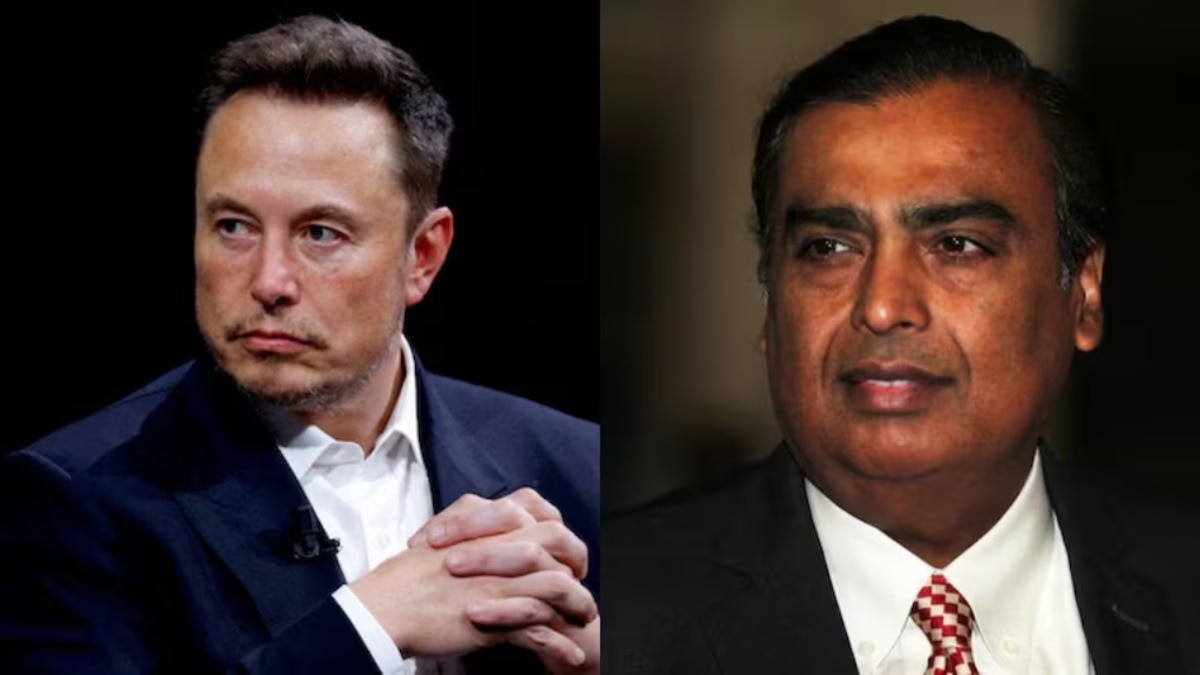
Elon Musk's war of words over Starlink's delayed India launch is getting more interesting, and the timing raises an important question - is the world's richest tech entrepreneur getting increasingly impatient because every month of waiting could give Mukesh Ambani’s Reliance Jio more time to prepare for the satellite internet race?Musk has accused unnamed business interests of trying to block Starlink to protect their dominance in India. He has even questioned Ambani's influence, asking on X whether the Reliance Industries chairman is the "real boss of India." But beyond the public confrontation lies a bigger commercial battle - Musk wants to bring Starlink to India, while Jio is preparing to take its telecom network into space.The timing is hard to ignore. Just as Musk has turned up the pressure over pending approvals, Jio has unveiled plans for a constellation of around 1,600 satellites and 23 ground stations across India. The proposed network is still some way from becoming a commercial reality, but it gives India's biggest telecom players another reason to compete for the future of connectivity.Could Musk's frustration be partly about losing precious time to a potential domestic rival?Whether the delay ultimately benefits Jio remains uncertain, but analysts say an early entry could give Starlink a valuable head start. Welcome to India, Elon. Wait till you discover the other guy.— Rahul Gandhi (@RahulGandhi) October 8, 2026 Why Musk may be in a hurry to beat AmbaniStarlink’s first-mover advantage could be particularly important in India, where reaching customers, getting the pricing right and building trust will take time. The opportunity is not limited to rural households. Businesses, government departments and organisations operating in remote locations could also become potential customers.“First-mover advantage is obviously important for any business,” Siddhant Cally, a senior research analyst, told India Today Tech. "An early entry allows Starlink to build its customer base, gather market feedback and refine its pricing and go-to-market strategy before scaling up,” he stated. Cally added that affordability and distribution would be crucial, particularly in rural India, where consumers are price-sensitive and already familiar with domestic telecom brands such as Jio and Airtel.Pravin Kaushal, program director for Eastern India at WHEELS Global Foundation, believes the advantage could extend beyond winning individual subscribers.“Every month of delay narrows that lead,” he told India Today Tech, explaining that Starlink would want to sign up defence, state government and enterprise customers before competing services become available. Such customers, he added, rarely switch once they are locked in.Kaushal also questioned the way Starlink has framed its complaint against Indian regulators. “Calling a security clearance process ‘a crime against the people of India’ is pressure dressed up as concern for villagers who cannot afford the service anyway,” he said.His assessment points to the commercial stakes behind Musk’s public campaign. Starlink is not simply waiting to sell satellite internet; it could also lose valuable time establishing relationships with customers before domestic alternatives are ready.Can Ambani's satellite plans spoil Starlink's head start?Jio’s proposed constellation could complicate Starlink’s plans over the longer term. Unlike a new entrant that must build its customer relationships from scratch, Jio can potentially combine satellite connectivity with its existing mobile and fibre networks.Prabhu Ram, Vice President of the Industry Research Group at CyberMedia Research, told India Today Tech that Jio’s proposed 1,600-satellite network is a long-term undertaking but could give the company a satellite layer that integrates with its terrestrial services. He said Jio and Airtel have substantial advantages through their telecom infrastructure, customer base and distribution.“The advantage will therefore come less from satellite capacity than from how well each player combines it with terrestrial networks, spectrum and customer relationships,” Ram told India Today Tech.However, Jio’s announcement does not mean it is ready to compete with Starlink commercially. Its constellation remains proposed, and deployment will take time.Cally similarly cautioned that Jio’s plans do not pose an immediate threat to Starlink because of the timelines involved. But the domestic network could change the competitive equation once it becomes operational.Kaushal put the significance of the announcement more bluntly: “The strongest thing Starlink could say was that India had no alternative. That is no longer true.”He also warned against replacing dependence on one powerful businessman with dependence on another, arguing that the terms of satellite connectivity must remain under Indian regulatory control.Why the delay is not necessarily about AmbaniThere is an important distinction between the commercial advantage Starlink could lose and Musk’s allegation that business interests are obstructing its entry. The available evidence does not establish that Ambani or Jio is responsible for the delay.The Ministry of Communications has rejected claims of discrimination, saying security assessments are underway for Starlink, Jio Satellite Communications and Bharti-backed Eutelsat OneWeb. It has said all three are at broadly the same regulatory stage.Faisal Kawoosa, founder and chief analyst at techARC, told India Today Tech that India must be careful about satellite communications because of the need to retain control over its telecommunications infrastructure.He argued that Indian businesses are increasingly focused on building domestic technology capabilities rather than relying blindly on foreign partners. While India welcomes international companies, he said, it should decide where foreign participation is appropriate and where it can develop its own capabilities.- Ends
Is Elon Musk taking on Ambani to win Starlink race in India before Jio catches up?
Full Article
Original Source
Read the full article at Indiatoday →KhanList aggregates and links to publicly available news content. We do not host full articles from third-party sources. Always verify important information with original sources.