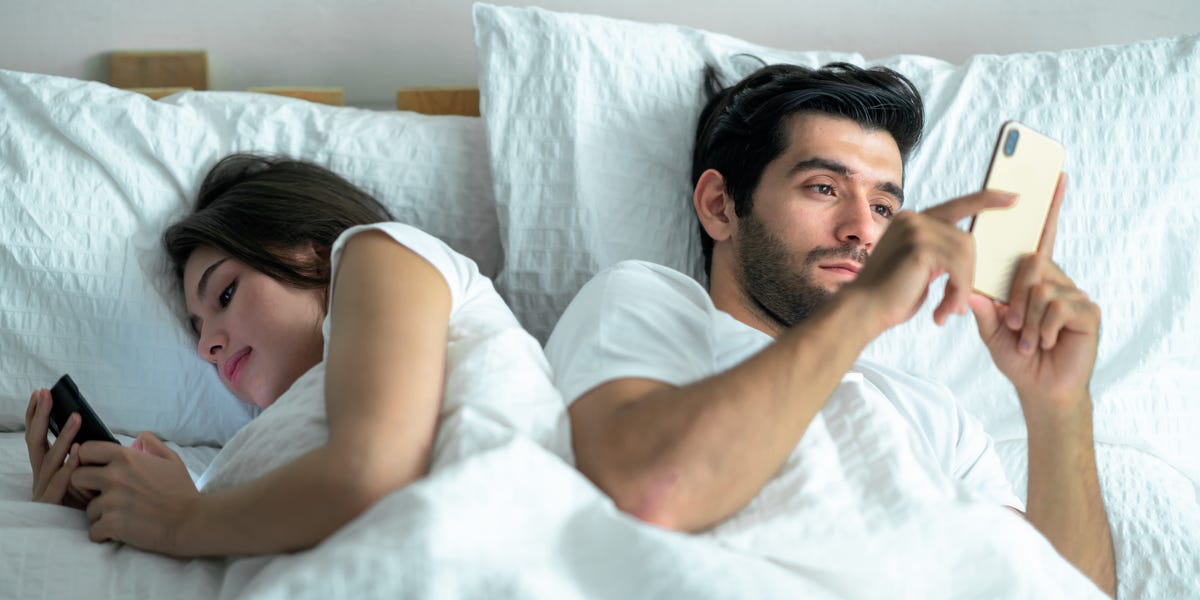
They say that perhaps the ultimate digital expression of true love is Beyoncé and Jay-Z, who, on Instagram, are each other's only follow. Though their relationship has had some public and private trials, at least now she doesn't have to keep count every time her husband follows someone new. Many people, however, do—constantly and compulsively—more than you might think. They monitor their partner's every move on social media, from likes and comments to new followers and who they’ve followed. Some even go so far as to going into their DMs to read their significant other’s chats. These are the new digital jealousies, small obsessions fueled by social media and technology. A "like" given to a certain person, an ambiguous comment, a suspicious follow, or even simply appearing online without replying to a text or call, can become a source of conflict and insecurity.“They are often signals with no objective meaning,” confirms Veronica Rossi, clinical psychologist and sexologist. “They are ambiguous but the mind interprets them by looking for confirmation of its own fears and sometimes building real scripts around them.”What is digital jealousy?According to Rossi, digital jealousy is a construct fueled by devices that are increasingly an extension of ourselves. “It does not arise so much from what the other [person] does, but from the enormous amount of interpretation that technology invites us to make,” she explains. “And the risk is ending up living more inside the story we tell ourselves on the screen than inside the real relationship. Also because we always interpret the world based on who we are, and not on who the other person is.”Social media, then, amplifies uncertainty because it seems to open up an infinite world of possibilities—of people to meet, lifestyles to embrace, personalities to build. “This can fuel the fear of being replaceable and turn the relationship into a permanent comparison,” Rossi adds. “In fact, social media offers us a great deal of information, but very few explanations. We can see what our partner does, but not why they do it. And so anxiety increases exponentially. In this empty space, our mind projects our insecurities and therefore fills up with fears, comparisons, interpretations, assumptions, and catastrophic scenarios. And even a Like dating back to 2019 can be seen as a threat.”It is precisely having a lot of information, knowing that that information is there within reach, that gives us an illusion of control that, in reality, leads to greater fear. “This is because loving also means accepting that the other person will never be completely controllable, readable, or possessable,” says Rossi. “Love is by definition a risk. And trust begins precisely here: not when we know everything, but when we are able to remain with uncertainty too.”An impossible controlTechnology and control are therefore tightly bound together. A bit like when we ask our partner to share their location, today we have endless tools to peek into other people's lives. But as Rossi explains, “Not everything that is visible is also understandable. We can see what a person does, not what they fee. We can observe a gesture, but not the intention that generated it. And yet our brain struggles to live with what it does not know, so it turns those small signals into stories, often built more on our fears than on reality.”Add Cosmopolitan as a preferred source in your Google search results.Use your Google account to add this to your settings.We end up clinging to the data we can collect, from blue checks to locations, all the way to the time of the last login. We make assumptions, cross-check details, look for clues, and talk about them with friends. And yet, when we find relief along with the proof of fidelity we were looking for, it is always an illusory relief.“This constant tracking does not reduce jealousy, it makes it chronic,” notes Rossi. “It feeds hypervigilance and increases worry, creating a compulsive cycle in which control only calls for more control. It is a mechanism similar to anxiety: control offers momentary relief, but ends up fueling the problem, making the person increasingly dependent on the need to check. In this case, control makes you lose control.”When does digital jealousy become a problem?All of this can, in many cases, end up weighing on the relationship itself. “Where surveillance prevails, intimacy and trust are lost, which are in fact the elements that make it possible to remain in a relationship even without having access to everything. In love, a portion of the other person’s freedom is not a threat: it is the very condition for trust to have meaning,” Rossi says.Hyper-control can reach worrying levels: when it becomes automatic, constant, compulsive, when it affects mood and replaces dialogue, when it becomes the only action we need in order to feel reassured. According to Rossi, to intervene, it is necessary to work on two fronts. On the one hand, “building trust in your partner, also learning to tolerate a degree of uncertainty because, after all, a relationship is built by looking each other in the eye, not by checking the last login,” she says. On the other, “Trying to turn the gaze toward oneself, seeking to understand the meaning of jealousy, because it often has more to do with our own personal experience than with ambiguous behavior by the Other. Jealousy, in fact, often communicates a need to feel seen, safe, and chosen.”In fact, once again, limiting digital jealousy means coming up against the great obstacle of modern love: loosening control by tolerating uncertainty without needing to act or find information and solutions. “A relationship does not become secure when we know everything about the other, but when we do not need to know everything in order to feel loved,” concludes Dr. Rossi. “Deep down, jealousy also arises from the impossible attempt to eliminate the mystery of the Other. Technology deludes us into thinking we can do this, offering us a continuous stream of traces. But a trace is not a truth.”
Is “Digital Jealousy” Impacting Your Relationship?
Full Article
Original Source
Read the full article at Cosmopolitan →KhanList aggregates and links to publicly available news content. We do not host full articles from third-party sources. Always verify important information with original sources.