
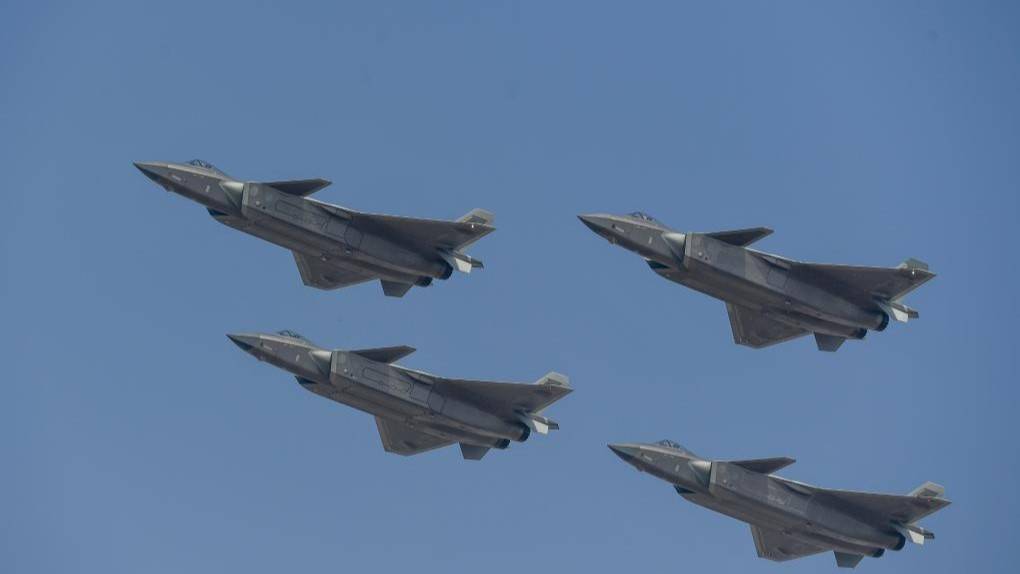
Published Oct 3, 2026, 10:00 AM EDT Aaron is an aviation enthusiast and world traveler with a deep interest in aerospace history and technology. He has traveled around the world numerous times, often incorporating visits to aviation museums and historic aircraft collections into his journeys. A native of New Zealand, he is an expert in aviation and maintains a broad interest in a variety of other subjects. Over the last generation, the balance of power between Russia and China has shifted dramatically. For years, Russia has retained technological and quantitative advantages over China in some military sectors, such as jet engines and noise-reducing technology for submarines. But those gaps have either closed or are narrowing, with China overtaking Russia technologically in many respects. One of the most dramatic transformations is the fighter jet fleet. Some Western aerospace companies like Dassault, Lockheed Martin, and Boeing publish very precise numbers of fighter jets they deliver, while government documents show how many their militaries are purchasing and have in inventory. For example, Dassault reported delivering 26 Rafales, Boeing reported delivering 23 F-15s and F/A-18s, and Lockheed delivered 191 F-35s and 16 F-16s in 2025. But these numbers are not available for China and Russia, so they must be estimated. Russia's Existing Fighter Jet Fleet Credit: UAC Some online websites like WDMMA list the Russian Air Force as having around 1,000 fighter jets of various types, including a total of 1,320 combat/attack aircraft, plus more in the navy. However, this likely oversells the size of the Russian Air Force's tactical fleet. These numbers are typically the best estimates based on open data, like counting airframes visible parked at airbases in satellite imagery. Russia does not release its inventory numbers (unlike the United States). A percentage of these airframes have likely come to the end of their useful lives and are essentially in storage, abandoned, or cannibalized for parts. Russia does not have a neat boneyard like the USAF's Davis-Monthan Air Force Base where it stores its retired airframes. It is also questionable how useful it is to count Russia's fleets of aging combat aircraft like the Su-25, Su-24, MiG-29, and Su-27. These are now of limited usefulness and are rarely seen on the front lines in Ukraine. An article by RUSI's Justin Bronks points out that Russia has likely been able to maintain and possibly grow its core fleet of modernized Flankers, Su-57s, and MiG-31s over the last five years. That said, his numbers may be somewhat conservative and may not include non-combat wear-and-tear losses. Even so, Russia can't replace its older fleet of fighters, while China can. This means the number of modern Russian fighters is staying relatively constant, while China's is growing rapidly. Russia's Fighter Jet Production Numbers Credit: UAC Currently, the country most comparable to Russia in terms of fighter jet production is France with its Rafale. The United States and China are a league of their own. Since the conflict broke out, Russia is estimated to have produced around 20 to 40+ fighter jets annually. For the five-year period from 2020-2025, Justin Bronk estimated the Russian Air Force received around 147-165 fighter jets (Flanker series and Falcons), or an average of 30 to 33 units a year. Russian industry produced somewhat more than this, as a limited number were exported. According to posts by OSINT account John Hardie, as of the time of writing (September 2026), Russia has received three batches of Su-35Ss, one batch of Su-30SM2, one batch of Su-34s, and one batch of Su-57s so far in 2026. Russia does not say how many aircraft are in each batch, but industry photos from UAC typically show two. The Su-57 batch may have been larger, as it was described as a large batch, so four is plausible. This would mean the Russian Air Force and Navy have received around 14 aircraft in the first nine months. Incidentally, by the OSINT account, The Military Watch has counted around eight Russian modern fighter losses in 2026, along with two likely damaged and another two likely destroyed, but lacking convincing evidence. That brings the total to 14 observed modern fighter losses for Russia in 2026 (excluding older MiG-29s, etc.). How Many Fighter Jets Russia Has Credit: UAC In January 2026, the think tank RUSI published an article by Justin Bronk. He estimated Russia's effective fighter jet fleet (including the Navy) at the end of 2025 was made up of 135-140 Su-35S air superiority fighters, 140-145 multirole Su-30s, around 20 low-observable Su-57s, around 125 Su-34 fighter bombers, and around 125-130 upgraded MiG-31 interceptors. This gives Russia an estimated effective fleet of 545-560 modern fighter jets. Bronk may have been conservative in his count, as he appears to have used estimated deliveries minus observed losses. This does not appear to include non-confirmed losses and non-reported mishaps. Modern airframes (e.g., Su-34s, Su-30s) can be observed parked in mini boneyards at air force bases like Russia's Lipetsk Air Base. Russia & China's modern fighter jet fleet and production (per RUSI, OSINT accounts) Russia (Air Force and Navy) China (PLAAF and PLANAF) Total modern fighter jet fleet start 2026 (per RUSI) 545-560 (475+ per Oryx) 1,400–1,600 Exports Limited Limited Fifth-generation fighter jets 20-30 Approx. 500 Estimated 2025 production Up to 40 (approx. 25 in shoulder years) 200-250 This is not the only noteworthy analysis of Russia's effective fighter jet fleet. Noted OSINT analyst Jakub Janovsky (who manages the Oryx blog) wrote for Fronts.co that Russia had 625+ total likely operational fighter jets, of which 475+ are likely relevant to NATO. That latter number excludes around 50 MiG-29s and 100 Su-27s. He also estimated Russia had around 100 Su-25s and 75 Su-24s, but listed those as strike and CAS aircraft, also not relevant to NATO. China's Production Numbers Credit: DingYi1122 l Shutterstock Like Russia, China does not report its inventory sizes or its deliveries. Estimates come from a range of open sources, including satellite footage, some industry information, and serial numbers. In the same RUSI piece, Justin Bronk estimates that China's 2025 J-10 production was around 0–40 airframes, around 80-100 for its J-16 series (derived from the Flanker), around 20 to 30 for its naval J-15 carrier-based Flanker derivative, and around 120 for the J-20 fifth-generation fighter. That totals 220 to 290 modern fighter jets, up from an estimated 110 produced in 2020. However, some China watchers dispute these figures, although it doesn't change the overall takeaway. Both China-watching OSINT accounts, Hurin and RupprechtDeino, agreed that Chinese deliveries areover 200 per year. In a January 2026 post replying to the RUSI article, Hurin estimated China had delivered 20–30 J-35s, around 12 J-10s, around 60 J-16s, around 30 J-15s, and 100 J-20s, for a total of around 200 new fighter jets for the PLAAF and 50 for the PLANAF. This is as much as 10 times Russia's deliveries, although perhaps closer to 8 times. China's Modern Fighter Jet Fleet Credit: Fasttailwind l Shutterstock China doesn't list which aircraft it has in inventory and which are retired, so these also need to be estimated. Justin Bronk estimated that China (air force and navy) had around 550 J-10s, 450 J-16s, 80-100 J-15s, and around 320-350 J-20s in service by the end of 2025. That is a total of 1,400-1,450 modern fighter jets. This too could be an undercount. Hurin estimated in mid-2025 that China had over 400 J-20s in service, while RupprechtDeino estimated the total could be more than 500. It is unclear what their estimates are for the other fourth-generation fighter jets and the J-35 carrier-based fifth-generation fighter jet. This makes the RUSI estimate one of the best for Chinese fighter jets of other types. Assuming China has not retired any of these fourth-generation jets and if production has continued from 2025 numbers into 2026, it is plausible China could have around 1,600+ modern fourth- and fifth-generation fighter jets in service by around September 2026. China is also believed to have considerable fleets of older aircraft in service, like the Shenyang J-8, Xi'an JH-7, and the Su-27 in service. These are being phased out, so the total number of Chinese fighters in service may not be growing dramatically, but the modern share of the fleet is. China Could Be Producing 10 Times More Fighters Credit: FOTO JOURNEY l Shutterstock For the first nine months of 2026, it appears Russia may have received around 14 new fighter jets. This may be enough to offset direct losses, but not to replace aging fleets of fighter jets or those reaching the end of their lives through wear and tear. For Russia, retiring its old Su-24s, MiG-29s, Su-27s, etc., essentially means dramatically shrinking the paper size of the fleet to the Flanker series plus some limited-use MiG-31s and maturing Su-57s. Put another way, Russia has largely maintained its core fighter jet fleet centered on the Flanker series during the last almost five years of conflict, but much of the rest of the fleet continues to age out. China can deliver 200+ fighter jets annually, enabling it to retire aging fighters and rapidly transform its fleet into a modern force. While the production numbers are not officially disclosed and are only estimated within a range, it is plausible that Russia's air force and navy will receive around 25 new fighters in 2026, depending on how many late deliveries there are. China could deliver 250 new fighters in 2026. That would be ten times more than Russia. Based on OSINT reporting, China's current fighter jet production rate is reasonably estimated at 7 to 10+ times that of Russia.
Is China Really Producing Nearly 10 Times As Many Fighter Jets As Russia?
Full Article
Original Source
Read the full article at Simpleflying →KhanList aggregates and links to publicly available news content. We do not host full articles from third-party sources. Always verify important information with original sources.