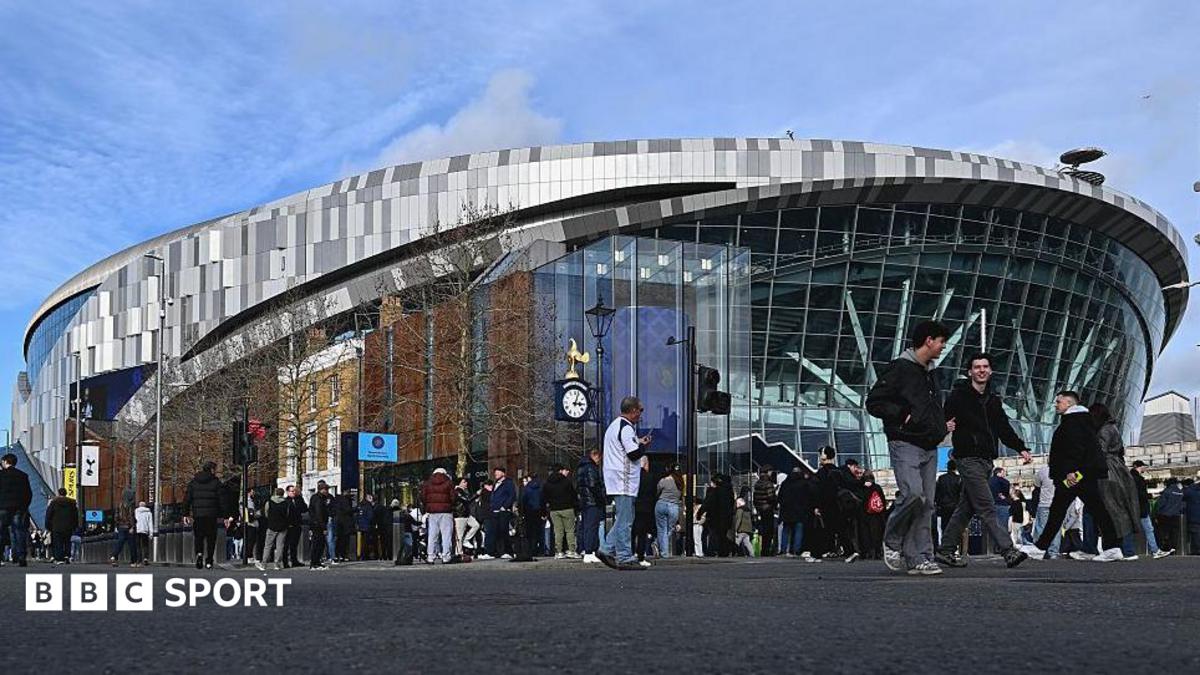
This summer the Premier League is replacing its profitability and sustainability rules (PSR) with a new financial framework centred on squad-cost ratio (SCR) and sustainability and systemic resilience (SSR).Put simply, SCR is designed to cap a club's total spending on its playing squad as a direct percentage of its overall revenue.Club costs like player wages, transfer amortisation - spreading a transfer fee across the length of a player's contract for accounting purposes - and agent fees all get taken into account.Crucially though, stadium infrastructure costs are not included in the SCR calculation. "In the case of Spurs, their infrastructure costs are around £70m a year - but those are excluded." says Maguire. "Any money that you invest in stadiums is completely ring-fenced and excluded from your ability to invest in players."There's a separate issue in that stadiums do cost a lot of money. But Spurs borrowed from banks at spectacularly cheap interest rates."In other words, for Spurs the pluses of building a new expensive stadium far outweigh the negatives, at least from a financial perspective.Image gallerySkip image galleryImage source, Manchester United F.C.Image caption, Manchester United unveiled plans to build a 100,000-seater stadium in 2025 at an estimated cost of £2bnSlide 1 of 4, Computer generated image showing Manchester United's proposed new 100,000-seater stadium., Manchester United unveiled plans to build a 100,000-seater stadium in 2025 at an estimated cost of £2bnIt is clear Sir Jim Ratcliffe wants a new stadium to be the statement around his involvement at Manchester United.Yet it is equally clear a new build, with a 100,000 capacity and a significant number of corporate areas, would generate far more than United get on a matchday now, which will help drive revenues and improve the senior squad.There are other financial aspects though, which few will consider in the bigger picture.The initial plans unveiled by Ratcliffe in March 2025 featured a huge canopy. That in itself will be costly, but in theory the overhang and what is underneath it will be in United's footprint - and the club will be responsible for it. Will the expense be worth the 'look'?Construction could - in part - take place off site and be shipped in if club officials are to be believed. That is likely to cost less than doing all the work in Old Trafford.And then having a new build where it is, down the road from their current ground, deals with the potentially thorny problem about where United would play if Old Trafford was closed for a period. None of Manchester City, Liverpool or Everton's grounds are ideal from a security perspective. All have a lower capacity than Old Trafford and all would cost a lot to hire, even if it was desirable. United's current plans mean they can simply move from one stadium to another.For Newcastle, a club which this summer has effectively had to sell some of its best players in order to stay within the financial rules, the argument over moving to a new purpose-built stadium is compelling. Back to some number crunching:"For the 2024-25 season Newcastle's matchday income was £52m. Manchester United's was £160m, Arsenal's £154m, Spurs' was £126m. "If you're £100m behind your competitors, the only way to address that is either to be super smart or to charge more money for the product."How can Newcastle increase the yield per fan and still be loyal to the Gallowgate hardcore? You need to be able to offer a different product and St James' Park wasn't built for a corporate audience."Will the fans back a move though? Newcastle supporter Charlotte Robson has mixed feelings."I think we can host gigs at St James' Park but probably not on the scale of Spurs or West Ham's London Stadium. "I don't think it would be stupid to move from the ground but I think there is so much identity for Newcastle fans who are attached to St James' Park that it would break a lot of hearts to move the ground in any significant way."Along with increased matchday revenue, clubs weighing up whether to move will also hope to make more commercial revenue - but Maguire is cautious."Spurs have got the advantage that they're in London - a huge tourist trap. They are also a club with a global fanbase, so it works there. "Is that going to work elsewhere in the country where you've got a more localised fanbase and where there is resistance to putting up prices for tickets? Then it becomes more challenging."We have seen a substantial increase in the costs of putting stadiums together, but there still seems to be an appetite for it."
Is building a new stadium a way around spending rules?
Full Article
Original Source
Read the full article at Bbc →KhanList aggregates and links to publicly available news content. We do not host full articles from third-party sources. Always verify important information with original sources.