
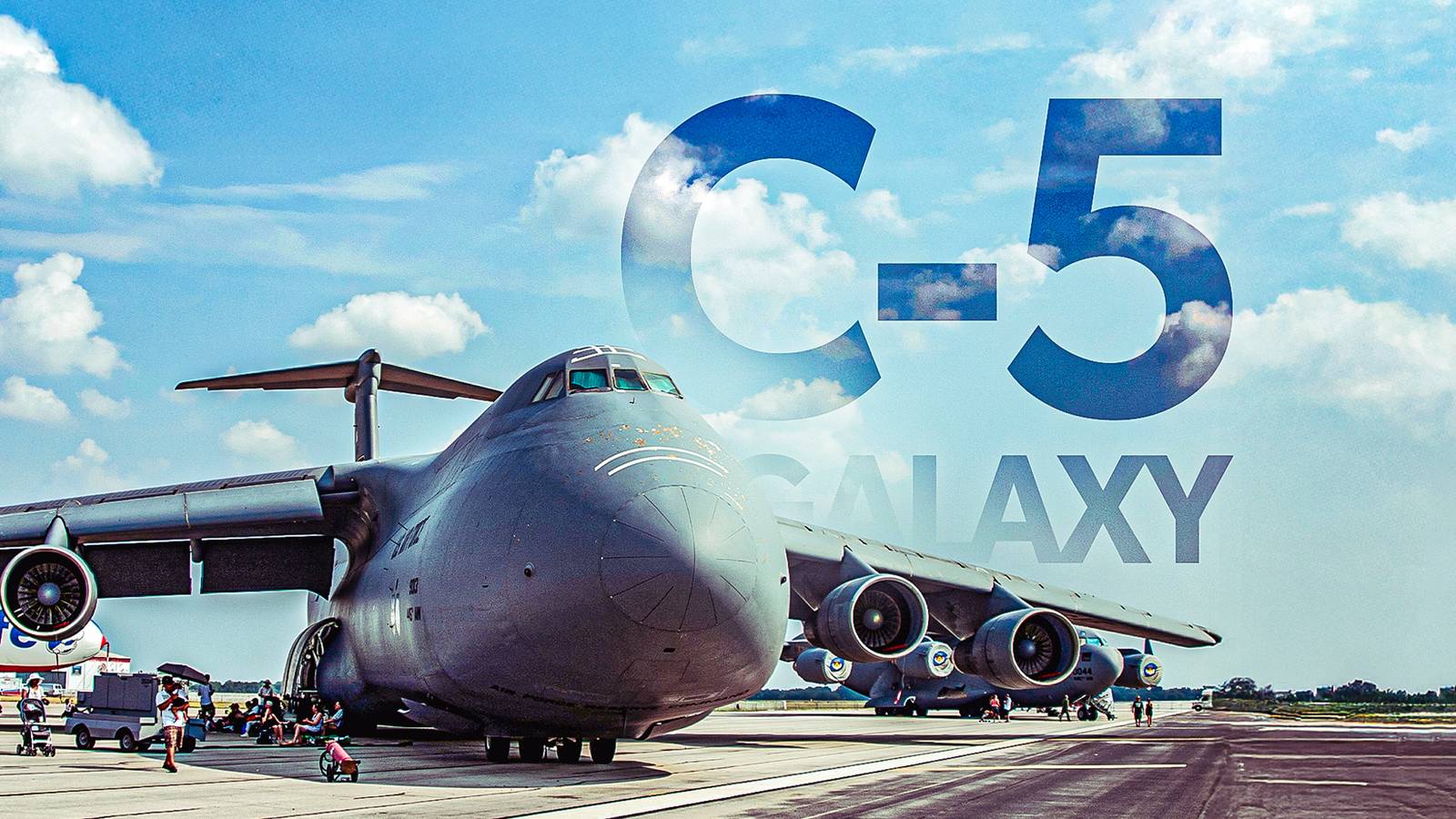
Published Oct 6, 2026, 7:18 AM EDT Aaron is an aviation enthusiast and world traveler with a deep interest in aerospace history and technology. He has traveled around the world numerous times, often incorporating visits to aviation museums and historic aircraft collections into his journeys. A native of New Zealand, he is an expert in aviation and maintains a broad interest in a variety of other subjects. The Lockheed C-5 Galaxy/C-5M Super Galaxy is the largest transport aircraft built for the United States Air Force, while the double-decked Airbus A380 is the largest passenger aircraft ever built. The C-5 Galaxy hails from a time when the Air Force thought progress and enhanced capacities meant progressively larger aircraft. However, after the Galaxy, the Air Force went on to procure the smaller C-17 Globemaster III and is now looking for an even smaller next-generation airlifter. The Airbus A380 was also built at a time when the industry thought aircraft would get larger and larger to move huge numbers of people large distances between megahubs. That proved to be a poor take as the smaller twin-engined Boeing 787 and A350 aircraft proved to be more popular and doomed the A380. So which of these giants is bigger? The largest American transport or the largest passenger jet? The Common Origin Of C-5 Galaxy & Boeing 747 Credit: Shutterstock The C-5M Super Galaxy is the United States' modernized variant of the Lockheed C-5 Galaxy. It is the largest strategic airlifter in US service, although not the largest in the world. The Soviet/Ukrainian Antonov An-124 Ruslan is larger, as was the Antonov An-225 Myria before its destruction in 2022. The roots of the C-5 Galaxy share a common origin story with Boeing's early work on what would become the Boeing 747. In the early 1960s, airplane makers, Boeing, Douglas, General Dynamics, Lockheed, and Martin Marietta all competed for the USAF's "Heavy Logistics System" (CX-HLS) program. Lockheed won the contract and went on to power it with pioneering General Electric's TF39 turbofans. Meanwhile, Boeing took some aspects of its rejected design and partnered with Pratt & Whitney to develop the 747 as the first turbofan-powered civilian airliner. While the Air Force liked Boeing's design, and even thought it was superior to Lockheed's, it selected Lockheed's solution partly because it was cheaper. The first Galaxy flew in 1968 and entered service in 1970. A total of 131 examples were built. This means the C-5 is a similar age to the Jumbo and around four decades older than the A380 Superjumbo. Dimensions Of The C-5M Super Galaxy & A380 Credit: Shutterstock Looking at the dimensions, the Lockheed C-5M Super Galaxy is larger than the Superjumbo in length. Whereas the A380 measures 239.5 feet in length, the C-5 measures 8.3 feet longer at 247.8 feet in length. However, the A380 Superjumbo exceeds the Galaxy in wingspan (261.8 feet vs 247.8 feet), height (79.1 feet vs 65.0 feet), and fuselage width. Comparing the fuselage widths is a little tricky, but the A380's external width is 23.5 feet, while the Galaxy's internal width is 19.0 feet. The A380's wider fuselage is better suited to its role of carrying passengers, while the Galaxy's narrower fuselage is better suited to carrying outsized cargo. When it comes to commercial aircraft, wingspans have grown longer over time as manufacturers have sought to improve fuel efficiency by optimizing the aircraft's aerodynamic performance. Airbus A380: Lockheed C-5M Super Galaxy Length: 239.5 feet 261.8 feet Wingspan: 261.8 feet 247.8 feet Height: 79.1 feet 65.0 feet Fuselage width: 23.5 feet 19.0 feet When it comes to cargo space volume, the C-5M boasts more than five times the volume of the A380 with 34,000 cubic feet vis the A380's 6,190 cubic feet. However, the A380 is configured for carrying passengers, and cargo space is limited to the belly cargo holds. The proposed A380F would have had three decks and around 40,000 cubic feet of volume. Payloads Of The C-5M Super Galaxy & A380 Credit: Shutterstock When it comes to the payload, the Airbus A380 has a maximum payload of around 185,000 lbs, much smaller than the C-5M Super Galaxy's 280,000 lbs maximum payload. This enables the Super Galaxy to haul as many as two M1 Abrams main battle tanks, six AH-64 Apache attack helicopters, or other large and outsized cargo. That said, there is more to the story as the A380's cargo carrying capability is a secondary function, not the primary function of the Galaxy. The original Galaxies were designed with a maximum payload of 270,000 lbs, but they suffered from some structural issues like wing cracks. During peacetime missions in the 1970s, they were sometimes limited to payloads as low as 50,000 lbs. The 185,000-lb A380 payload is also somewhat misleading, as it is only configured as a passenger aircraft. The proposed freighter variant of the A380, the A380F, was planned to have a maximum payload of 330,000 lbs. However, it was never built. A380 & C-5M payloads & MTOWs Airbus A380 max payload: 185,000 lbs Airbus A380F planned max payload: 330,000 lbs C-5M Super Galaxy max payload: 280,000 lbs Airbus A380 MTOW: 1,268,000 lbs C-5M Super Galaxy MTOW: 840,000 lbs (wartime) The Airbus A380 has a significantly higher Maximum Take-off Weight (MTOW) of 1,268,000 lbs. The MTOW of the Super Galaxy is listed as 840,000 lbs during wartime. During peacetime, the Air Force wants to preserve the aircraft and manage the stress on the airframe, and so will typically operate it with lower loaded weight. While C-5M can haul two tanks at once, the Air Force may instead choose to carry one if the mission isn't so urgent, or just send them by ship and train if time permits. Range Of The C-5M Super Galaxy & A380 Credit: Shutterstock While the range of these aircraft varies depending on payload, the Airbus A380 is the clear winner. The Superjumbo's range carrying 525 passengers is around 8,000 nautical miles, making it one of the longest-ranged commercial aircraft in the world. Meanwhile, the Super Galaxy has a range of only around 2,300 nautical miles when operating with its maximum load. The A380 even beats the Super Galaxy in range when comparing the A380 at full load and the Super Galaxy flying without cargo. Without cargo, the Super Galaxy's maximum range is around 7,000 nautical miles. The Super Galaxy does have one ace up its sleeve in that it is capable of in-air refueling, which essentially gives it almost unlimited range. The longest-range passenger airline in service now is the Airbus A350-900 (Ultra Long Range) airline specially developed for Singapore Airlines. According to Airbus, the A350-900ULR comes with a range of 9,700 nautical miles, and the upcoming A350-1000ULR Airbus is building for Qantas is likely to have a similar range. Looking at the Air Force's other strategic airlifter, the C-17 Globemaster III has an empty range of around 5,200 nautical miles and a range of 2,420 nautical miles when carrying 157,000 lbs of payload. Thrust Of The C-5M Super Galaxy & A380 Credit: Shutterstock Both the C-5M Super Galaxy and the Airbus A380 come with four engines. As the original Lockheed Galaxy was built in the 1960s using an early generation of turbofans, its engines were less efficient and powerful compared to those used today. The Galaxy's General Electric TR-39-GE-1C turbofans were each able to produce around 43,000 lbf, or around 172,000 lbf in total. The C-5M upgrade saw those engines replaced with more powerful General Electric F138-GE-100s. These engines provide the Super Galaxy with 51,000 lbf each or around 204,000 lbf in total, which is around 22% more than the older variant. The Airbus A380 is either powered by Rolls-Royce Trent 900 or Engine Alliance GP7200 turbofans. These are able to generate up to around 78,000 lbf each, giving the Superjumbo some 312,000 lbf. That is the equivalent thrust of a Super Galaxy with six engines. F138 is the US military designation of the General Electric CF6, the world's most popular large high-bypass turbofan. Variants of that family of engines can be found on the A300, A330, variants of the Boeing 747, McDonnell Douglas DC-10/MD-11, and the Kawasaki C-2. Boeing is still using them for new build-Boeing 767 freighters. However, they will no longer meet incoming standards. Consequently, the final orders have been placed, and Boeing will stop delivering new freighter 767s in 2027. Airbus A380 Superjumbo Is Bigger Credit: Photo: Minh K Tran | Shutterstock The Airbus A380 is the largest aircraft by almost every measure except for length. Otherwise, the A380 has a wider wingspan, wider fuselage, is taller, has a larger MTOW, has a longer range, and has more thrust. The Superjumbo is clearly the larger aircraft of the two giants. As the Super Galaxy is primarily configured for carrying outsized cargo, it has a greater payload and valuable storage space than the Superjumbo. However, even that would flip to the Superjumbo's favor if it were redeveloped as the A350F. Of the 131 Galaxies built, 50 were upgraded to the C-5M Super Galaxy variant. Over 50 of the old variants can be found parked at the Davis-Monthan Air Force Base boneyard. Still, for the Super Galaxy, the A380 seems fleeting. The C-5 first entered service in 1968, while the first A380 didn't enter service until 39 years later in 2007. Some A380s have already been retired and scrapped, with more airlines (like Lufthansa, Korean Air, and Qatar Airways) itching to retire them as soon as replacement aircraft arrive. The A380 is likely to continue in Emirates service until the mid-2030s, while the Super Galaxy is not expected to retire until the 2040s.
Is A Lockheed C-5 Galaxy Bigger Than An Airbus A380?
Full Article
Original Source
Read the full article at Simpleflying →KhanList aggregates and links to publicly available news content. We do not host full articles from third-party sources. Always verify important information with original sources.