
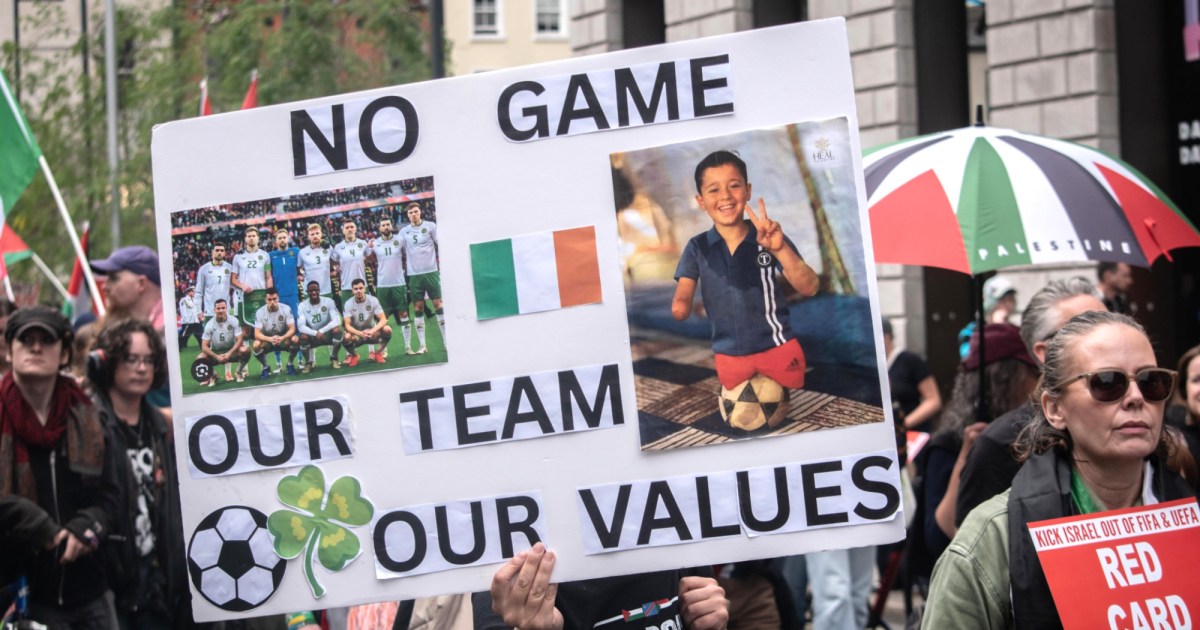
Protesters in Dublin demand the cancellation of two Ireland-Israel football matches over Israel's killing of Palestinians.Nadia Caimi/JNA Press/Cover Images/AP Get your news from a source that’s not owned and controlled by oligarchs. Sign up for the free Mother Jones Daily. On Sunday afternoon, Ireland is set to play a soccer match against Israel amid widespread public calls and protests in the country to boycott the game due to Israel’s violent conduct in Gaza, which a UN report found to be a genocide. The match will take place at Nagyerdei Stadium in Debrecen, Hungary, an alternative venue for Israel’s “home” match as Union of European Football Associations, the international governing football body in Europe, has not permitted games in Israel since October 2023 due to security concerns. Ireland’s football association declined any tickets for the match from UEFA, while Israel is expected to have no more than 100 supporters, with tickets mostly bought by supporters living in Hungary. Nagyerdei Stadium has a capacity of around 20,000. Ireland’s “home” match against Israel is scheduled for October 4 at TSC Arena in Bačka Topola, Serbia. It will be played behind closed doors with no supporters in attendance. “I don’t think the game obviously should be going ahead but it is going ahead.” Ireland has long held some of the highest public support for Palestinians. In 1980, the country became the first member of the European Union to call for Palestinian statehood. Recent polls suggest that about two-thirds of Ireland residents don’t want the match to take place. Ireland has also boycotted international events in the past due to Israel, including this year’s Eurovision singing competition. They announced earlier this month they will continue this boycott next year. Despite this, a significant majority of Irish national team players voted on Saturday to go ahead with the game following a four-hour discussion among players, coaching staff, and Irish soccer executives. The two fixtures affect whether both teams will qualify for future international tournaments—including the 2028 UEFA European Football Championship, which Ireland will co-host. Ireland’s soccer chief said on Saturday that the national team players will wear black armbands during the game “in recognition of all the lives lost in the conflict” and would not participate in “elements of the pre-match ceremony,” including the customary pre-match handshake and exchange of team pennants. There is no fixed UEFA rule for refusing to play a match in the Nations League, the competition that features the Israel-Ireland game. But officials at Bohemian FC, a professional soccer team in Ireland, pointed to previous penalties when Lithuania, Latvia, and Estonia forfeited their matches against Belarus—3-0 defeats and, in one case, a minor fine of 5,000 euros. “The FAI [Ireland’s soccer federation] exaggerated the potential consequences to force their delegates to vote in favour of proceeding with fulfilling these fixtures,” Luke O’Riordan, the team’s communications director, told Al Jazeera. “It is not acceptable to put a price on standing up for what is right and in solidarity with the Palestinian people.” “I don’t think the game obviously should be going ahead but it is going ahead,” Ireland midfielder Jason Knight said after a match against Kosovo on Thursday. “I’ll try and focus on the football as much as I can. I’ll give my view and my thoughts on it [the Israel games] when I see fit.” Goalkeeper Gavin Bazunu left the Ireland squad following the decision to play the match. “My decision is based purely upon my personal belief that the killing of innocent people is wrong,” the goalkeeper wrote on Instagram on Saturday. “It is important to note that my stance is not in opposition of the Israeli people or the Jewish community but against the atrocities in the region.” “There are few times where you get a chance in life to stand up for something bigger and I strongly believe that is one of them,” he continued. On Monday evening, more than 100 people protested outside the team’s hotel in Dublin, and about 160 Irish sportspeople signed an open letter pushing the Irish soccer association to reconsider moving forward with the match: “With this moment you have an opportunity to do the right thing.” “It’s unconscionable that the Israel men’s football team will participate in the UEFA Nations League this autumn despite clear evidence that Israel’s football association continues to support illegal settlements,” Steve Cockburn, Amnesty International’s Regional Director for Europe said. In the lead-up to Sunday’s match, Ireland’s football manager, Heimir Hallgrímsson said, “We’re not playing with genocide, we’re playing against genocide. We’re playing against Israel, we’re not playing with Israel.” Israel’s soccer association called Hallgrímsson’s comments as “hypocrisy and stupidity.” “We have contributed to the world and humanity in countless fields, earning an impressive number of Nobel Prizes along the way,” it continued in its social media post last Monday. But as Defector pointed out last week, Israel’s soccer association was founded in the 1920s as the Palestine Football Association. While the Ireland Prime Minister Micheál Martin, a conservative, supported the decision to eventually move forward with the match, citing that “sport is an area that can be challenging when it crosses into the realm of politics, Ruth Coppinger, a member of the lower house of the Irish and long-standing member of the Socialist Party in the country, criticized the decision: “You can’t play against genocide; the best statement against genocide is not playing.” There is precedent for soccer and global politics being intertwined. As my colleague Tim Murphy wrote in 2022, “oligarchs, private-equity moguls, and petro states took over the sport” through political and economic relationships. FIFA, the international soccer governing body that runs the World Cup, and UEFA have suspended Russia from participating in their competitions since February 2022 due to the country’s invasion of Ukraine.
Irish Soccer Fans Call for Boycotting Matches With Israel
Full Article
Original Source
Read the full article at Motherjones →KhanList aggregates and links to publicly available news content. We do not host full articles from third-party sources. Always verify important information with original sources.