
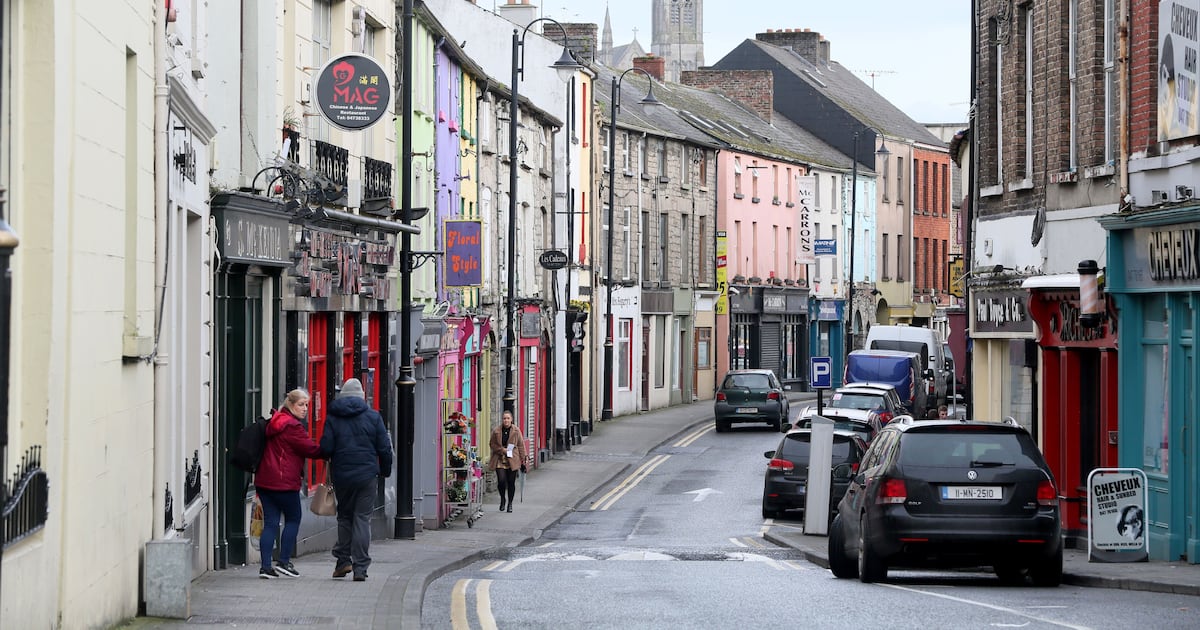
Mass dereliction and vacancy blights almost all Irish market towns. You’ve seen it for yourself: once bustling commercial centres are lifeless, hollowed out by dilapidation and urban neglect. As shopping places, most towns are barely hanging on and the more we insist that ground floors be reserved for retail space, the more widespread the sense of abandonment will become. The future of shops is not the main street, but that doesn’t mean the main street has no future, it just has one that looks different. Shopping in the 21st century is not like shopping in the 20th or 19th centuries when most of our market towns were built. According to Eurostat, 96 per cent of Irish internet users made online purchases in 2024, the highest share in the European Union. We are rejecting the idea of the local town as a retail destination but people still want to live, socialise and hang out in towns. Is there a way to achieve this and the attendant footfall, without forcing all ground floors to be shops? What about abandoning the notion that shops should be at street level? This week, the State nudged its way towards this by announcing a new plan that will encourage businesses to move into vacant shopfronts in towns. Rolled out across 26 designated town centres, the initiative will target empty retail properties. Rather than shops, the new plan envisages that businesses or services might move in instead. Welcome as this is, it is not enough and probably has more to do with the fact that business rates pay a chunk of county council revenue, which councils want more than innovative new town planning. [ A small town in Co Kerry and a formula for rejuvenating rural IrelandOpens in new window ]Most towns in Europe were originally derived from medieval constructs, built around commercial fairs where farmers bought and sold their produce. Around such markets, basic urban life, with artisans, money lenders, churches and taverns eventually developed. Commerce was geographically centred – the town was the locus of commerce. Urban evolution was determined by commerce. As agricultural productivity grew and fewer workers were required on the land, the urban population expanded. If you were an artisan and lived in an urban environment, your existence and life experience were quite distinct from that of your ancestors, farm labourers on the land who were beholden to some hereditary knight or feudal baron. In the town you were more free, leading to the German expression “stadtluft macht frei” (“urban air makes you free”). Floating in the air of the city were radical ideas of individual sovereignty, encouraging for the dissenter or outsider. The word ‘bourgeois’ comes from these newly commercial people who lived in the ‘burgh’ or the town.READ MOREOf course, the economic history of towns and small cities predates medieval times. For example, the Greek empire was made up of many dozens of free, self-governing city states. To organise this new type of society, a new idea emerged: the polis. By the sixth century BC, the polis – or the town – was firmly established as the foundation of all Greek civilisation. Obviously the word politics derives from it. The polis was the civic, social, economic, military and political cornerstone of ancient Greece and the rules of the polis outlined citizens’ rights and obligations. The Greek polis was organised around the agora, the marketplace, a space not just for the exchange of goods but for ideas and sedition too. This is a crisis. Maybe it is time to phase out the requirement that properties in urban centres must be commercial, whether business or retailToday, commerce and the market for ideas has moved from our towns to our phones, from the street to online. These trends are not absolute, but they are sufficient to have changed the way we rest, work and play. Possibly the biggest change has been the inability of local or provincial retailing to compete with out-of-town supermarkets, big city retail and, of course, online shopping, not to mention working from home, which naturally takes people away from commercial centres. Last year, 990,600 Irish people worked from home, nearly 30 per cent of the total workforce. Urban commerce is feeling the pinch. GeoDirectory data shows the retail and wholesale sector in Ireland lost 434 occupied commercial units, a bigger fall than any other sector. Meanwhile, retail insolvencies continue to rise, jumping 35 per cent in the first six months of this year. [ David McWilliams: Ireland will not have any political peace until we fix housingOpens in new window ]Urban planning struggles to catch up. For example, despite the fact that retail commerce is leaving our towns, one of the State’s main answers to urban neglect, the Department of Housing’s €95,000-€135,000 vacant-above-the-shop grant still clings to the notion that people are shopping in town. The grant applies only where “the ground-floor commercial use continues”. The pressure that empties shopfronts is met by a grant that requires them to stay open. If the shop can’t survive there is no grant to do up the property, and the property therefore remains empty. The effect of this grant means the fortune of urban repopulation is tethered to shops, which are a symptom of the problem rather than the solution. Meanwhile, the housing shortage is in its second decade and our vacant towns – with their existing connection to utilities and the heritage of the buildings – remain idle. [ Reviving small Irish towns: ‘They are exactly the same as some of the finest European towns. They can become vibrant communities again’Opens in new window ]According to the GeoDirectory commercial report there are 30,611 vacant commercial units in Irish towns. The national number conceals a disparity. The highest vacancy rates are to be found in towns in Donegal (20.7 per cent), Sligo (20.2 per cent) and Galway (18.6 per cent), while the lowest rates of urban vacancy are in Meath (9.9 per cent), Wexford (11.2 per cent) and Westmeath (12 per cent). Meanwhile, the most boarded-up town in Ireland is Shannon in Co Clare with 34.9 per cent vacancy. Of all commercial properties vacant, Carrigaline, Co Cork, had the lowest at 5.1 per cent. Above the shop, things are worse: the Heritage Council cites upper-floor vacancy of about 80 per cent in historic town centres. Meanwhile, ground-floor retail vacancy is about 20 per cent in many towns – well above the European average of 5 per cent.This is a crisis. Maybe it is time to phase out the requirement that properties in urban centres must be commercial, whether business or retail. Dutch towns, for example, have deliberately shrunk their shopping areas, concentrating shops in a compact core and converting the fringe streets to homes: 9,000–10,000 homes are being created from vacant shops. As Ireland’s market towns wither away, it is time to realise that we are facing massive global shifts in the way we live, and these shifts demand immediate remedial action, rather than incremental small measures. Our towns offer part of the solution to the housing crisis. We should seize it now.
Ireland’s towns offer part of the solution to the housing crisis. We should seize it now
Full Article
Original Source
Read the full article at Irishtimes →KhanList aggregates and links to publicly available news content. We do not host full articles from third-party sources. Always verify important information with original sources.