
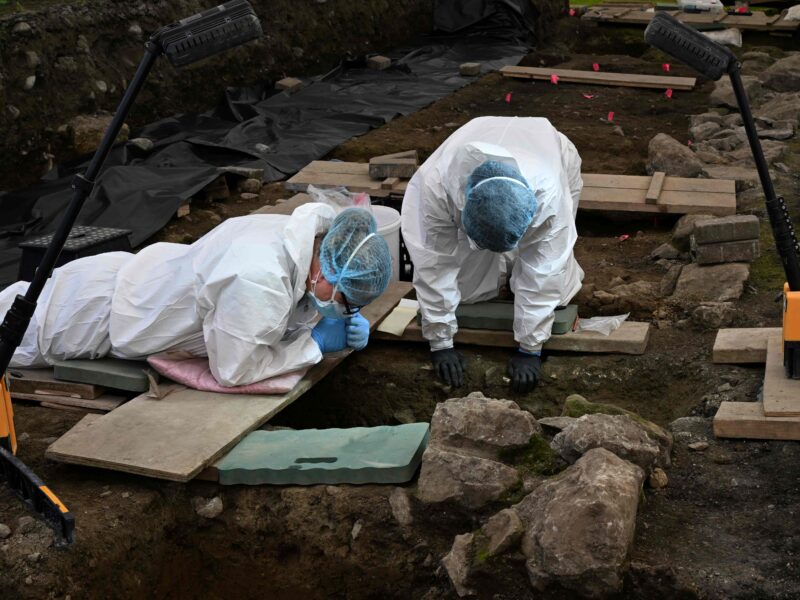
In Tuam, a sleepy Irish town, forensic specialists are finding the skeletons of babies buried inside a sewer system of a Catholic institution for unwed pregnant girls and their babies.(CN) — After a year of digging, forensic scientists have confirmed Roman Catholic nuns buried babies inside the sewer system of a long-defunct home for pregnant unwed mothers and their babies in western Ireland.For the past year, state-appointed archaeologists and forensic specialists have dug up parts of a playground and parking area laid atop the old septic chambers of the St. Mary’s Mother and Baby Home in Tuam, a rural town in County Galway. The home ran from 1925 to 1961.So far, the remains of 99 infants have been identified and removed from two separate sites, the excavation team told Courthouse News. The first baby remains were discovered last fall.Likely hundreds of more remains will be found. A forensics facility was opened to study the skeletons and match DNA with living relatives.Thousands of pregnant girls, expelled by their families, went through St. Mary’s doors and hundreds of their babies died prematurely, likely due to mistreatment and lack of nourishment.Ireland’s Parliament authorized the excavation without a deadline, but the work is expected to take about two years.In 2021, the Irish government issued an official apology for the horrors of the nation’s church-and-state-run system of mother and baby homes. In recent decades, Ireland has confronted the harsh and abusive practices allowed by its church-dominated state.In Tuam, the painful process of identification has only just begun.“We cannot yet comment on the cause or circumstances of death,” said Louise Walsh, a spokeswoman for the excavation team. “We cannot comment yet on the ages of the human remains that have been recovered.”Specialists are cleaning, drying and examining the human remains with the goal of reconstructing details of their lives and deaths, she said.Hopefully that will lead to “a picture of each deceased person’s life, potentially including their sex and their age at the time of death,” Walsh said.A forensic excavation team member working inside an underground vaulted structure at the former site of the St. Mary's Mother and Baby Home in Tuam, Ireland, included in a July 2026 report. (Office of the Director of Authorised Intervention)Their work has been complicated by the discovery of human remains buried at the same site when the building in Tuam served as a workhouse between 1841 and 1918. Before becoming a mother and baby home, the building was used by the military between 1918 and 1925.Criminal charges are unlikely to be filed against anyone involved in the scandal because nearly all the nuns and officials who ran the home are no longer alive.The grisly truth about St. Mary’s was uncovered by Catherine Corless, a local historian who figured out what had taken place while researching her own mother’s connections to St. Mary’s.She found the names of 796 babies whose deaths at St. Mary’s were not officially recorded.Her story and investigation are the subject of a new feature film produced by Liam Neeson called “The Lost Children of Tuam.” The film, directed by Frank Berry, is set for release.The St. Mary’s home was one of several inhumane institutions run jointly by the state and Catholic Church where unwed mothers and their babies were corralled.In predominantly Catholic Ireland, it was customary for families to permanently banish girls who got pregnant before marriage by giving them over to the church.Since Corless’ research was published in 2014, there has been a judicial inquiry and numerous stories in the media.Children at the Tuam home were separated from their mothers; if they survived beyond a few years they were often sent to live in slave-like conditions with other families as foster children.A quarter or more of the children sent to the home died. Nuns with the Sisters of Bon Secours ran the home and reportedly treated babies and children so badly many died from disease, neglect and malnutrition.In Tuam, investigators believe most of the children were put into an underground chamber that was part of a sewage system at the back of the former home, according to a government report.The excavation area is sealed off to the public. A housing estate was built in the spot where the St. Mary’s home once stood.Courthouse News reporter Cain Burdeau is based in the European Union.Subscribe to our free newslettersOur weekly newsletter Closing Arguments offers the latest about ongoing trials, major litigation and rulings in courthouses around the U.S. and the world, while the monthly Under the Lights dishes the legal dirt from Hollywood, sports, Big Tech and the arts.Additional Reads
Ireland’s painful reckoning: 99 infants unearthed so far at site of Catholic mother and baby home
Full Article
Original Source
Read the full article at Courthousenews →KhanList aggregates and links to publicly available news content. We do not host full articles from third-party sources. Always verify important information with original sources.