
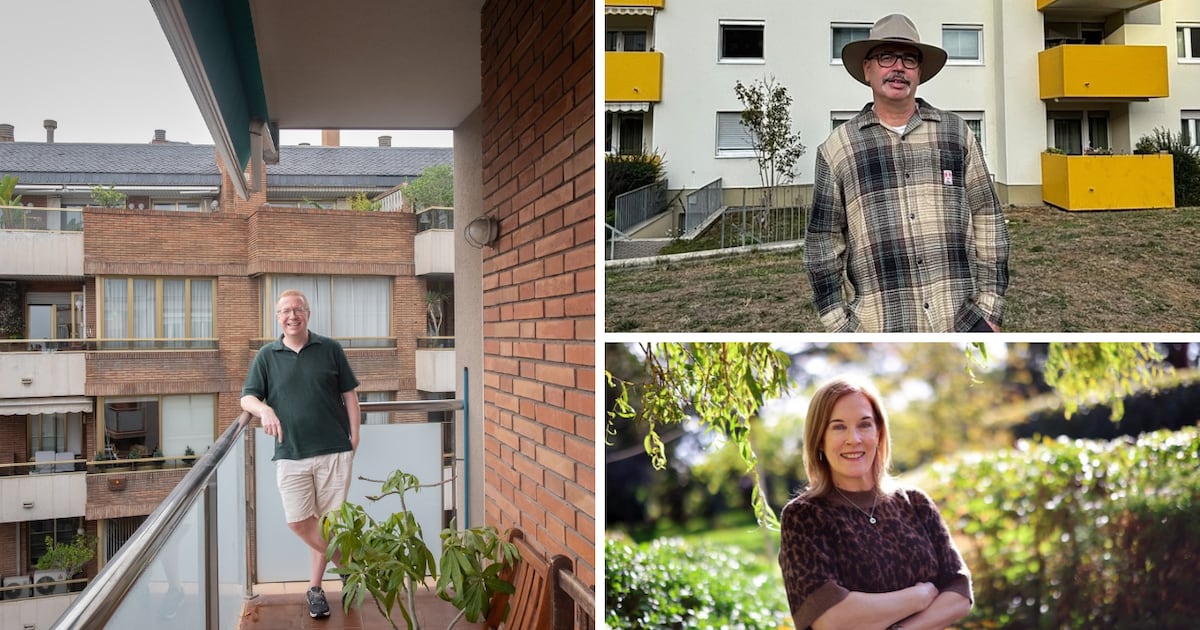
Barcelona, Spain“You can’t raise kids in apartments.” Donal Quinn recalls someone in Ireland telling him this, unaware that his son, along with most of Barcelona’s children, was growing up in such a dwelling.“I looked at her and said, ‘Actually you can’,” recalls the Co Galway man, whose son is now 12. “World Cup winners: they all probably grew up in apartments,” he adds.Spain and Ireland are at opposite end of the housing-type spectrums: Spain has the highest proportion of apartment-dwellers in the EU (65.3 per cent), Ireland has the lowest (9.7 per cent), Eurostat Data shows. Across the EU it’s the reality for almost half (48 per cent) of households. So why are Irish people so out of sync with many of their European counterparts? This question was recently considered in an opinion piece by housing policy analyst Lorcan Sirr, who pointed to how the size, facilities, location and design of Irish apartments are among reasons many prefer houses. READ MOREBut what’s the experience of Irish people living in apartments in continental Europe? Is resistance simply down to Ireland’s mix of housing stock and poorer-quality apartments, or is there something ingrained deep within us that makes the appeal of our own front door so immovable? Quinn concedes that a back garden would have been nice for his son to run around when he was about five. But close to their apartment there are enough playgrounds, parks and tree-lined street for any child. This density of living gives his son increasing freedom, he says: “It’s a short distance to his school, to his grandparents.” It also makes daily life easier, not just regarding Quinn’s short commute. “There’s eight-storey apartments all around here. The density of people brings the density of everything else. So there’s always life ... When you go to the dentist or the doctor, it’s just 100m away.” As the teenage years approach, Quinn believes his son will be much better off here than in one-off housing in rural Ireland where he would have to be driven everywhere. Like most of his neighbours, Quinn is there for the long term, having lived in the same apartment in Barcelona since moving 17 years ago. Property ownership levels in Spain are broadly similar to Ireland (73 versus 69 per cent). Donal Quinn, pictured at his apartment in Barcelona, Spain. Photograph: Cathy Loughran for The Irish Times “There’s much less of a sense that you are on the property ladder. That you’ll move on. So this means you’ve a longer-term relationship with your neighbours,” he says. This helps when dealing with problems like noise, a concern raised by Irish apartment dwellers in studies. “Barcelona apartments are designed so the sittingrooms are on the street and the bedrooms face each other [in an inner courtyard] at the back,” he says. If a party occasionally gets a bit loud “the cops are quick to turn up if it goes past midnight”. [ Irish people don’t want to live in ‘mostly awful’ apartments. Here are five ways to fix themOpens in new window ]Having rented an “extremely dark” apartment in Smithfield, Dublin, before moving to the Catalan capital, having good light is a big factor for Quinn. Most apartments in his area are dual aspect, and his is south facing, getting light all day – though hot in summer, he concedes.Nice, FranceJulie-Ann Wall, who lives in Nice, France. Photograph: Dara Mac Dónaill Julie-Ann Wall lived in apartments in Dublin city centre for 10 years before moving to Nice in France for work two decades ago. “I never knew any of my neighbours [in Dublin] ... They don’t have a lot of communal areas ... In France it’s very different.”Wall’s experience is that apartment residents are “invested” and building management meetings “can be quite emotional”. In her previous Dublin apartment, “nobody went to the management meetings”.[ Irish people who live where we holiday abroad: ‘My only regret, I didn’t move sooner’Opens in new window ]Wall lives in a large one-bed apartment in a 1960s building with plenty of storage. But the mix of apartment types is key to this sense of community, with three- and four-bedroom apartments accommodating different types of people and families.“The age groups go from people in their 20s to someone who is almost 100.” The different generations of neighbours in her apartment building all interact. “This gives it a nicer atmosphere.” “It feels like people are here for the long term rather than seeing it as a temporary home,” she says.For Wall, the two concierges, who have worked at the block for more than 30 years, are key to this atmosphere. “They just see everything, and know everything that’s going on. So they do a bit of cleaning, co-ordinating plumbers, and so on, and that really makes a big difference.” The concierges in her building also help to “bring everyone together” by organising social events. When she returns to Co Offaly, Wall encounters people who struggle with the concept of not having “their own front door”. But for her the apartment firmly feels like home. Orla Hegarty of UCD “Standards are a factor in Irish attitudes,” says Orla Hegarty, assistant professor at UCD’s School of Architecture, Planning and Environmental Policy.She notes how Ireland has “had this steady deterioration of standards”. Space is one of the key declines in the latest apartment planning guidelines, introduced last year. Allowing a 32sq m studio is the equivalent of “two parking spaces with a bathroom and a wardrobe ... so small you need air conditioning to ventilate it”, says Hegarty. The guidelines’ provision for fewer balconies and outdoor spaces will have an impact on “mental health” and where people actually want to live, says Hegarty. She bemoans the “continuous picking away” at Irish apartment standards.The change in guidelines also allows for one lift on long corridors with many apartments, Hegarty says. While hotels with long corridors are monitored, in such blocks you won’t know your neighbours and it can feel unsafe if there’s no security, she says. [ ‘I grew up in an apartment in another country. I bought an apartment in Dublin and had to get out after a year’Opens in new window ]She notes how concierges are commonplace in apartments in other countries. They “keep the peace and security” and help to “build community and give people a reason to behave well”. A strong mix of socio-demographics is also important to building community, she says. Unlike countries such as France, Ireland was slow to purpose-build apartment blocks. Historically in Ireland flats were converted buildings of a poor standard and were seen as a short-term measure, says Hegarty. “We only got going [building apartments] in the 1990s, and apartments in Dublin were generally built to a poor standard – with long corridors, no soundproofing or storage.” Dublin City Council worked hard to improve standards in the 1990s, with decent balconies and proper storage, she says. After the recession it emerged just how poor many of the Celtic Tiger apartment standards were, she says. The changes in apartment building standards that followed the recession were “really detrimental” and “ill-conceived”, she says.Frankfurt, Germany Damien Lynch in Frankfurt Damien Lynch lives in a suburb of Frankfurt, Germany where he has raised two (now young adult) children in a three-bedroom apartment.But returning to visit the semidetached house in Swords, Co Dublin, where he was raised, it’s the noise there that often strikes him. “The amount of noise that travels between the houses is actually unbelievable.” In his apartment block with 250 units, he has “never had a complaint about noise”. “Sometimes my son will have a little party here and the neighbours won’t know because they are so well insulated.” “It amazes me how well-designed and thought-out it was, though built in 1972.” He notes that his apartment, at 110sq m, is the same size as his parent’s semidetached house. Alongside that it has good-size balcony, a private locked cellar, communal laundry rooms, bike storage and a full time live-in caretaker. And this density of living means Lynch is just a three-minute walk from the train station, where he can be in the centre of Frankfurt in 20 minutes. He doesn’t mind the lack of a back garden: “We have a green space and playground attached to the complex, and within a few minutes there are three other playgrounds.”When he bought the apartment first, some in Ireland assumed it was a “starter home”. “There’s definitely a bit of a snobbish attitude in Ireland towards apartment living ... but when family come over and see the size of our apartment, our balcony, the cleanliness of the common areas ... this is not what they envisioned.” [ What has happened to the cowboys who built defective apartments? Absolutely nothingOpens in new window ]In Germany almost 60 per cent of people live in apartments and, with strong tenant protections, long-term rental is the norm. More than half of households (53 per cent) are rental (compared with 30 per cent in Ireland).And this long-term nature of tenancy improves the experience of living there (“we leave keys with our neighbours”) and it means there is no stigma attached to not being in a house, he says. For Lynch the lower quality of apartments in Ireland reinforces the idea that they are intermediary rather than long-term housing solutions.Ann McKiernan and her husband got their first taste of apartment living during the Celtic Tiger, albeit in Canada, where they had moved from Ireland. “We looked at each other and said, ‘Oh my God, an apartment, what are we going to do about this?’ But we moved in and we took to it, like a duck to water.” A quarter of a century later and now retired, McKiernan is a firm convert to the benefits of apartment living. The couple split their time between their apartments near Murcia on Spain’s Costa Cálida and Meath. In her experience “there is no comparison” between standards in Ireland and Spain. “They have taken a more realistic approach to real long-term living requirements for all types of family sizes. They recognise that apartment dwellers have the same requirements as house dwellers.” McKiernan’s three-bedroom apartment in the Spanish block, which is full of retirees, has a utility room, a generous livingroom and a large kitchen. It’s close to the sea and amenities, with parks nearby and a roof terrace. Her biggest concern – noise – turned out to not be an issue. “There seems to be a recognition that this is communal living and we all respect each other.”Although the couple encountered scepticism when buying an apartment in Meath, having sold a house in Ireland, it made sense for McKiernan: “We didn’t want a garden, or to be locking up a house.”Her Irish apartment experience is positive, but she puts this down to buying a high-end place in a very small development. “It’s a good way to live if you can get the right management company and the right co-operation between people who live in apartments.”However, she believes Ireland needs to change in the culture of communal living. Issues such as shared bins: “Things get dumped in all three [organic, recycling, waste] willy-nilly.” Parking can be a source of tension, with drivers “taking anybody’s space”, something she has never encountered in Spain. “We have a lot to learn about the realities of apartment living in Ireland,” she says.
Ireland vs Europe apartment living: ‘In France it’s different’
Full Article
Original Source
Read the full article at Irishtimes →KhanList aggregates and links to publicly available news content. We do not host full articles from third-party sources. Always verify important information with original sources.