
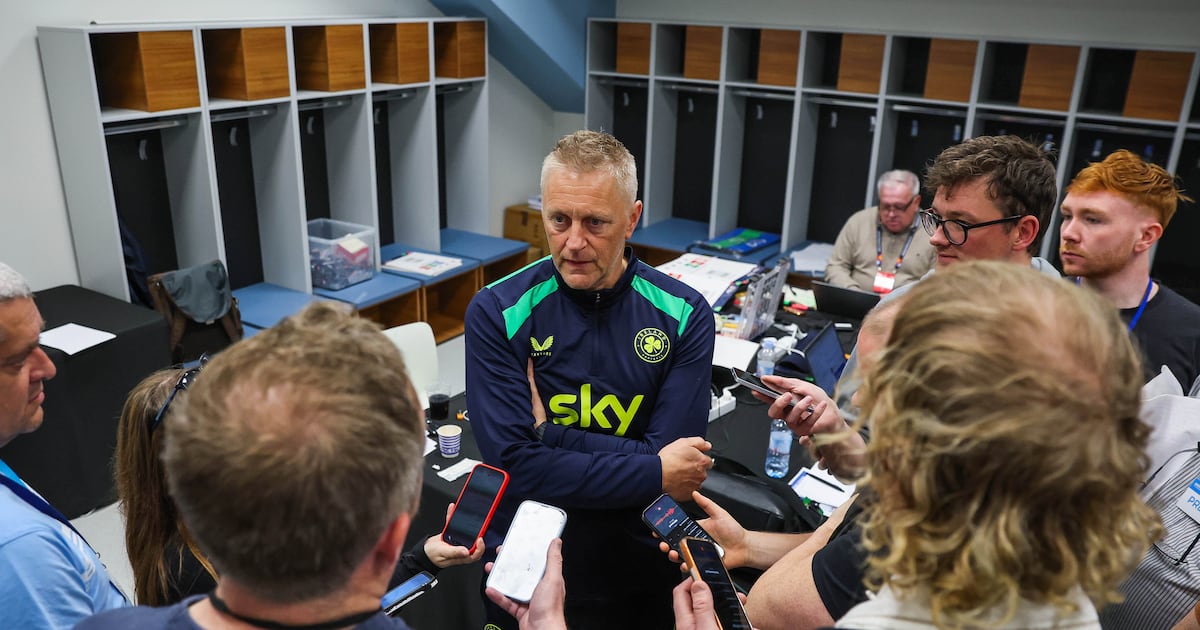
War is peace, freedom is slavery, and football doesn’t mix with politics.We began this international window about eight years ago in Kosovo, where Ireland manager Heimir Hallgrímsson expressed gratitude to the Taoiseach for defending him and his use of the word “genocide” while talking to reporters at the United Nations General Assembly. Each night in Pristina, was scored to the sounds of protesters demanding the release of four former leaders of the Kosovo Liberation Army (KLA), recently sentenced to prison for war crimes committed during the war of independence from Serbia. Stalls lined the boulevard to Mother Teresa Square, selling KLA-branded hats and t-shirts along with Kosovo football scarves. The same KLA merch was sold duty free at Pristina airport. The match against Kosovo was a party political broadcast: the stands were a patchwork of red KLA flags, the Kosovan fans continually chanted for the KLA and when Vedat Muriqi scored the only goal he held up a T-shirt in support of the jailed leaders. READ MOREKosovo supporters with banners in support of jailed former Kosovo Liberation Army leaders during the Nations League game against Ireland at Fadil Vokrri Stadium in Pristina, Kosovo, on September 24th. Photograph: Ben McShane/Sportsfile via Getty Images The following day we stopped in Munich on our way to Debrecen, where an Israeli TV journalist approached us in the airport. His greeting came with a slap on the back so firm it still stung as he began talking. He asked us about rumours the Irish team were going to cancel their press conference, then offered to trade some team news and told us where both teams were staying in Debrecen. It was at this moment The Irish Times learned we were going to be checking into the Israeli team hotel. We arrived at the hotel as the Israeli FA were unloading their gear. This inelegant piece of scripting around a baggage-laden fixture had us stepping over Israeli kit bags to get inside the front door. The eight Irish journalists staying in the hotel were all given rooms beside one another in a corner of the third floor, while armed, plain-clothes security personnel kept a round-the-clock watch on the lobby and the hotel restaurant. This sense of being watched extended to the Irish team hotel, where FAI security couldn’t help but notice the regular presence of a burly man in the lobby. They saw him check out shortly after the Irish team left. There were also some Irish fans staying in the Israeli team hotel and when their tickets were cancelled a couple of hours before the game, they wound up watching the game in that hotel. Saturday in Debrecen was an extraordinary day, and not just because of the story we were covering. The principal drama was taking place at the Irish team hotel, but there was a feeling of covering it from a theatrical stage, onto which Irish journalists had been unwittingly cast as actors in the production. It felt as if we were being constantly watched and filmed, and when we gathered outside the Irish team hotel after the squad missed their training session, we were persistently photographed by an Israeli press photographer. Another journalist took videos of us on her phone and whenever an Irish TV reporter did a piece to camera, she filmed the entirety of the report. This was a strangely dissociating experience: trying to report on what you are seeing and hearing while also feeling watched in some way. Ireland head coach Heimir Hallgrímsson was asked by an Israeli journalist about an unfounded accusation during last Saturday's pre-match press conference in Backa Topola, Serbia. Photograph: Ryan Byrne/Inpho Earlier, at the stadium, two Israeli journalists had approached me to talk about the horrors of the October 7th, 2023 attacks. They segued into telling me that the Irish people did not understand the truth because they are being presented with an “alternate reality”. Several Irish colleagues had the same experience. These approaches were conducted behind a veneer of friendliness that quickly wore thin. While I was frantically filing news of Gavin Bazunu’s withdrawal from the squad on Saturday morning, an Israeli journalist stormed up to me, haranguing me over a comment on X I had supposedly posted minutes earlier describing the two national flags hanging in the stadium as surreal. The thrust of her argument was that the use of the word “surreal” was another attempt to delegitimise Israel’s presence. An Israeli colleague filmed the confrontation on his phone, as I finally persuaded them that this was a case of mistaken identity. They left the room, returned a minute later to abashedly apologise, and then marched across the room to find the Irish journalist who had actually posted the comment. Again she harangued him, and again her colleague filmed it on his phone.The atmosphere in the press room chilled and an Israeli TV journalist did a piece to camera, during which he said: “My gut feeling is the Irish journalists don’t really like us.” The line of Israeli questioning at last Saturday's press conference led the Ireland delegation, including manager Heimir Hallgrímsson, to walk out and field questions in another part of TSC Arena in Backa Topola, Serbia. Photograph: Ryan Byrne/Inpho Which is not to say there was no collegiality at all, for it was an Israeli journalist who told us outside the team hotel that the Irish squad had confirmed they would be going to train at the stadium. Another regular refrain from the Israeli media was, “Wow, your FA really doesn’t tell you anything”. If the ambition here was to drive a wedge between the Irish press and the FAI, both parties would bleakly laugh, knowing we have never needed any help in that regard. Amid the head-spinning tumult of it all, I took a call from TalkSport outside the Irish team hotel to do a quick piece on air to explain what was happening. Once I hung up, a friend from home sent me a screengrab of the image they had used of me during the call. It was a screengrab from a spoof social media video I did with a former employer 10 years ago, in which I wore a novelty hat and a garish green blazer embossed with shamrocks. Standing in front of Israeli photographers, this was a suboptimal time to be outed as some sort of Irish partisan. I had an attack of self-regard and complained to TalkSport about the use of the image. They told me they found it on Instagram, assumed I was simply a “wacky dresser” and assured me they didn’t think the begorrahness of it all undermined my authority on this diplomatic firestorm. By the time Ireland’s former minister for justice Alan Shatter walked into the press box on Sunday, accredited to write a match report for the Jerusalem Post, the general reaction from the Irish press was the collective shrug of a group of people deeply weary of surprise. Amid the hyperreality to which the game belonged, the Irish players created a resonant image of their own, bowing their heads for the Israeli national anthem. Some Kosovo players would re-enact the picture against Israel a few days later. As Ireland cruised to victory in Debrecen, there was another moment of choreography in the stands – a telegenic Israel fan recording himself leading supporters in chants for the IDF. He wore a T-shirt bearing a giant QR code beneath a slogan stating, “Hallgrímsson, this is a genocide”. In Serbia, ahead of the second meeting between the teams, Israel’s head of communications did not condemn the chanting as he rejected the notion that the IDF is a political entity. FAI Appear Before The House of the Oireachtas, The House of the Oireachtas, Dublin 30/9/2026 FAI president Paul Cooke (left), FAI CEO David Courell and communications director Eadaoin Keane after their appearance at an Oireachtas committee in Dublin last Wednesday. Photograph: Ben Brady/Inpho Before the trip to Serbia, though, we had returned to Dublin for our more traditional blend of politics and football at an Oireachtas Committee. In this setting, the FAI were subject to the usual staccato blend of forensic questioning and scattergun grandstanding. Meanwhile, the Irish football writers who had covered the game in Debrecen had become besieged by anonymous social media accounts attempting to further distort reality. The faceless accounts argued that the playing of the game in Hungary, and the subsequent muted protests against Austria in Dublin, proved the whole Israel controversy was the latest concoction by hysterical left-wing activists posing as sports journalists. Backa Topola proved a fittingly alien stage for the fortnight’s final act, with Saturday’s pre-match press conference going viral across the world. The FAI assertively shut down the press conference after an Israeli TV journalist accused the Irish players of calling the Israel players “monkeys” a week earlier. He insisted he was asking a question, but the FAI had found no evidence for the accusation when they looked into it as it was not included in the referee’s report. The Israel FA subsequently confirmed they had not yet made a complaint to Uefa about the allegation. As the FAI press officer took the microphone from the journalist’s hand, an Israeli colleague was filming the incident on their phone. This footage was briskly posted online and quickly condemned in Israel as another episode of Irish censoriousness and hypocrisy. “They respect freedom of the press provided you only ask the questions they find comfortable to answer,” posted Israel’s ambassador to the EU. The FAI employee in the video was subsequently subjected to appalling online abuse. Referee Juan Martínez Munuera speaks with Israel's Yarden Shua and Ireland's Jimmy Dunne during Sunday's Nations League match at TSC Arena, Backa Topola, Serbia. Photograph: Ryan Byrne/Inpho This spectacle caused Uefa to intervene, and they excluded the Israeli journalist and a female colleague from the post-match press conferences on Sunday. The latter journalist tried to access the press room nonetheless, and spent several minutes in a standoff with security guards at the door, one of whom checked our passes to allow us to slip quietly inside. A Uefa media relations official was scrambled to the match on Sunday, and he began both press conferences with a disclaimer warning not to ask any political questions. This felt, at the very final moment, a sort of vindication: this was not Uefa telling us that football and politics do not mix, but that they should not mix. Uefa’s unspoken subtext, of course, was that both had been mingling to the point of indistinction and they now had to do something about it. Their intervention came two weeks too late.
Ireland v Israel was no ordinary work assignment. Irish journalists were being watched
Full Article
Original Source
Read the full article at Irishtimes →KhanList aggregates and links to publicly available news content. We do not host full articles from third-party sources. Always verify important information with original sources.