
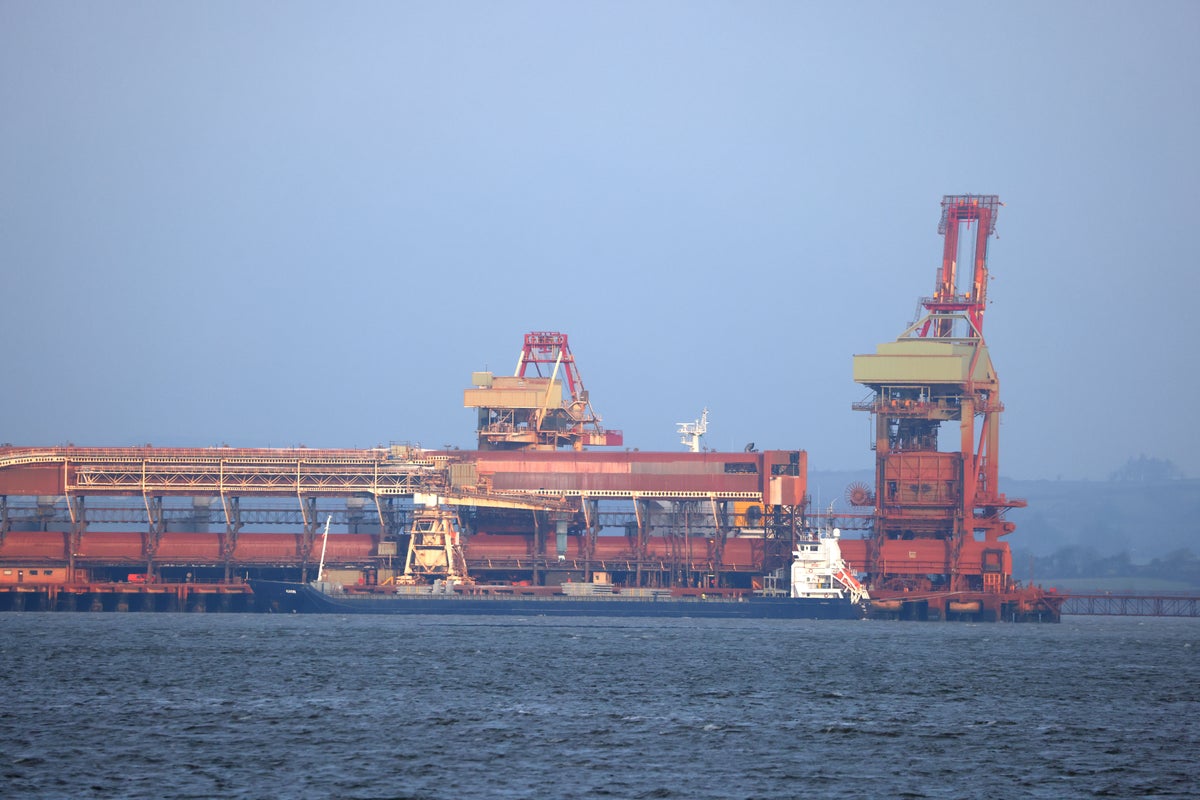
After being moored along Ireland’s boggy River Shannon estuary this week, the 120-metre-long (400-foot-long) cargo ship Karin set sail for Russia. The vessel was laden with a bulk cargo of white powder that can be forged into weapons which are vital to Moscow’s war on Ukraine.Alumina, a key ingredient in aluminium, goes into products from toothpaste and lipstick to missiles and drones. A Russian-owned plant in southern Ireland operates as Europe’s biggest alumina refinery, regularly sending shiploads of the substance directly to St Petersburg and other Russian ports.Almost five years into Moscow’s full-scale invasion of Ukraine, alumina has escaped European sanctions intended to hobble Russia’s economy. That leaves the refinery in Aughinish free to send its product to Russia, where experts say some ends up in weapons.“The material is clearly ending up in military supplies," said Irish politician Ivana Bacik, who leads the opposition Labour Party. “It would be unthinkable for Ireland to be contributing, even in that indirect way, to Putin’s war machine.”The Karin cargo ship, bound for Russia, at a jetty at Aughinish refinery (AP)Ireland faces mounting calls to halt the shipments as dozens of European leaders gather in Dublin this week to discuss support for Ukraine. A summit of the 47-nation European Political Community on Thursday is being followed by a meeting of European Union leaders.Irish government minister Niall Collins said that "there’s absolutely no evidence" the material is ending up in military supply chains, though the government has declined to publish the findings of its investigation into the alumina shipments.Aughinish Alumina said in a statement its product “has no connection to the Russian military supply chain” and that it hired an independent company to provide monthly audits to Irish authorities for “enhanced traceability.”What is alumina?Alumina is a chemical compound refined from bauxite, a red ore mined primarily in Guinea, Australia and China. The chalky white substance can be smelted into aluminum, which is then forged with other, rarer elements to make strong, heat-resistant and flexible alloys used in missiles and aircraft; aluminum is also used in the manufacture of rocket fuel and explosives.The Aughinish plant in County Limerick was built in the 1970s and bought in 2007 by Rusal, a Russian aluminum producer. The company was founded, and is still part-owned, by Oleg Deripaska, a sanctioned oligarch with ties to Russian President Vladimir Putin. Rusal makes virtually all of Russia's aluminum, according to the US and Australian governments.While many cargo ships leave Aughinish bound for Europe and beyond, a steady stream of them heads straight to the port of St. Petersburg, according to data from MarineTraffic.The activist group Alumina 22, which is lobbying to sanction the trade in alumina to Russia, estimated that between March and October some 491,307 metric tons of alumina from Ireland was shipped to Russia. This satellite image provided by Airbus DS 2026 taken over Aughinish Alumina in County Limerick, Ireland, on May 26, 2026, shows the cargo ship ALTO at the refinery's port (Airbus DS 2026)These shipments have grown in importance. Since Russia’s full-scale invasion of Ukraine in 2022, two alumina factories – one in Australia, the other in Ukraine – stopped exporting to Russia, crimping its supplies by about 40 per cent, according to a 2026 report by the Economic Security Council of Ukraine, or ESCU.Roughly 17 per cent of Rusal's alumina supply now comes from Ireland, according to ESCU.An investigation by the Organised Crime and Corruption Reporting Project and the Irish Times, published earlier this year, found that alumina from Aughinish is smelted in Russia into aluminum, with some of it sold to a metals trading company that supplies Russian defense contractors.“Virtually everything that comes from Rusal is with a high probability ending up in the hands of Russian military enterprises,” said Olena Yurchenko, director of analytics, research and investigations at the ESCU. Ukraine calls for sanctions on alumina exportsStanding next to Irish President Micheál Martin in Dublin in June, Ukraine’s President Volodymyr Zelensky said: “Unfortunately, there are companies in Europe that are owned or effectively controlled by Russia and its sanctioned oligarchs. They keep supplying the aggressor with essential materials, even now.”Mr Martin acknowledged that “we do not want to be in a position where material emanating from a plant in Ireland goes to support the Russian war machine.”Ireland has not found evidence that is happening — but also no proof it is not, said Enterprise Minister Peter Burke, who is in charge of the country's sanctions enforcement. He said in July it had been impossible to prove Rusal’s assertion that alumina from Ireland is only used to make aluminum for export from Russia.The Irish government has not published its findings, but it handed them to the European Commission, which drafts EU sanctions packages.The Aughinish refinery in Aughinish, Ireland (AP)EU sanctions envoy David O’Sullivan said there is little doubt that “the alumina goes to smelters in Russia who produce stuff which undoubtedly goes at least in part to the military-industrial complex”.“I’ve read the government report. Personally, I think there’s no doubt the investigative journalists got it right,” he said in October in Dublin at a meeting organized by the Institute of International and European Affairs.The European Parliament in July passed a non-binding motion calling for a ban on alumina exports to Russia. But alumina was not included in the EU’s 21st sanctions package against Russia that month. The EU’s executive European Commission, which draws up sanctions packages, is now sounding out member nations about the Irish alumina exports. Sanctions must be agreed upon unanimously by the bloc's 27 countries.A commission spokesperson said in July that the bloc’s sanctions policy was “a delicate balance” between thwarting Russia’s war effort and limiting “negative impacts” on EU member nations, “especially considering that alumina is a critical raw material”. Debate about alumina plant jobsSupporters of the plant point to the hundreds of jobs it provides, and to its role as a key source of alumina for European countries. Keeping supply lines open is especially important because of the chokehold on cargo traffic through the Strait of Hormuz caused by the U.S.-Israeli war with Iran.Mr Collins, who represents County Limerick in Ireland's parliament, said Ireland has been "hugely resolute in our support for the Ukrainians, and Ukraine hasn’t provided any evidence that Aughinish is doing anything adverse”.Opposition politicians remain skeptical. Ms Bacik's left-of-center Labour Party supports a temporary nationalisation of the refinery, similar to when Ireland seized banks in the wake of the 2008 financial crisis. She says the refinery can ban exports to Russia and find other eager customers in Europe.“We need to see much stronger action being taken on this from other EU countries if the Irish government isn’t willing to do the right thing here,” she said.In Foynes, the wind-swept port town beside the plant, many work at Aughinish or know someone who does. But some locals have mixed feelings.“It's too big a business for them to close it down,” said retired docker Joe Hanlon. “Too much employment for the government to get involved.”But he said “of course they should”, if Ireland wants “to stop the war on Ukraine”.
Ireland under pressure to stop sending Russia an ingredient vital to its war on Ukraine
Full Article
Original Source
Read the full article at Independent →KhanList aggregates and links to publicly available news content. We do not host full articles from third-party sources. Always verify important information with original sources.