
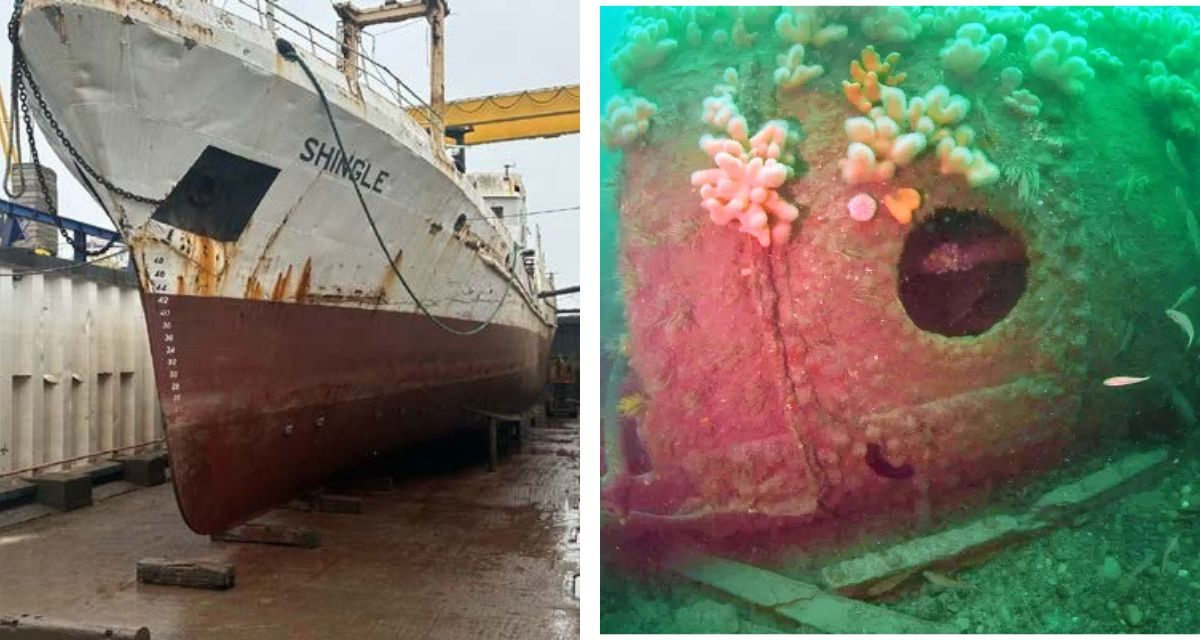
In the summer of 2014, Irish customs officers seized a smuggling ship with 32 million illegal cigarettes on board. While the 9,900-ish pounds of tobacco were siezed, the vessel remained untouched in Dublin Port for three years as legal proceedings took place. Then, rust and asbestos found on the ship left it unsellable for reuse. Scrapping the whole thing also proved too costly. And so, the 197-foot MV Shingle remained tied up at Dublin Port for roughly nine years, racking up the equivalent of approximately $2.24 million. That is, until it met a much more noble fate than it started out with. Once a criminal ship, now a beloved home In 2024, the Shingle was donated to a local environmental program called Killala Bay Ships 2 Reef. The program ethically sunk the ship 2.5 miles off the west coast of Ireland. Thus creating an artificial reef to attract new marine life. According to the 2024 annual report of Ireland’s Revenue Commissioners, marine plants and creatures almost immediately “colonised” the wreck-turned-reef. The report said this showed the vessel was fit to “support a new marine ecosystem.” Underwater footage shows the vessel teeming with barnacles, sponges, sea squirts and fish. “It’s quite impressive to be honest,” Dr. Jose Maria Fariñas-Franco, a marine ecologist at Atlantic Technological University, told RTÉ News. “I could see … a lot of growth for the time period that the wreck has been in the water.” And this kind of transformation is exactly what artificial reefs are designed to encourage. Research has even found that artificial reefs can actually host more fish than natural reefs. One study comparing artificial and natural reefs off the coast of North Carolina found that artificial reefs supported higher fish densities. This included larger predators, such as sharks and barracudas, that gather in the water column above the reef. Shipwrecks make for thriving ecosystems There are already plenty of examples of this around the world. According to Smithsonian Ocean, the United States has delbirately decommissioned ships, offshore structures and even cleaned-out New York City subway cars have been deliberately sunk to create artificial reefs. Of course, sinking an old ship isn’t as simple as dropping it into the ocean and hoping for the best. Artificial reef projects require extensive cleaning and decontamination. Materials such as toxic paint, asbestos, and other pollutants can harm marine ecosystems. Scientists are also still studying whether artificial reefs actually increase fish populations. Or if they simply draw fish away from nearby natural habitats. And that’s not the only creative approach scientists are trying In Australia’s Great Barrier Reef, researchers have used recordings of healthy reef sounds, aka “acoustic enrichment,” to lure fish back to damaged areas, helping bring it back to life. After six weeks, these audibly enhanced reefs had twice as many juvenile fish and 50% greater species richness than reefs without the recordings. Meanwhile, in Grenada, researchers placed pyramids made from concrete cinder blocks along a barren stretch of ocean. Within just three months, the structures were attracting algae, sponges, invertebrates, and juvenile fish. Over time, corals joined the growing community, and the project has since expanded to 100 pyramids. In a perfect world, humans wouldn’t have damaged these ecosystems in the first place, and fish wouldn’t need artificial homes like these. But if these new habitats are giving marine life a place to thrive, that feels like a pretty good place to start.
Ireland seized a ship carrying 32 million cigarettes. Now it’s home to a growing reef.
Full Article
Original Source
Read the full article at Upworthy →KhanList aggregates and links to publicly available news content. We do not host full articles from third-party sources. Always verify important information with original sources.