
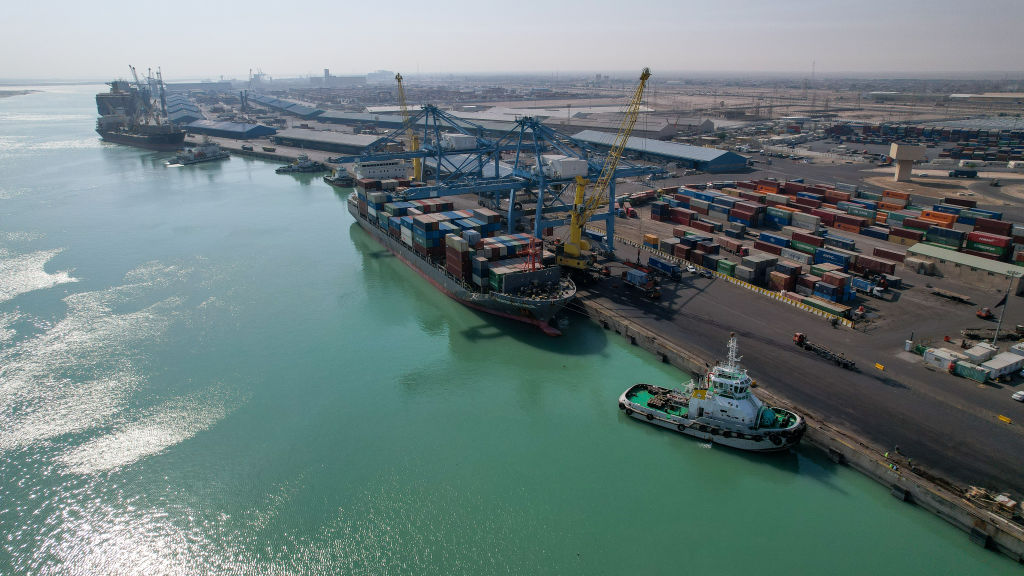
Basra, Iraq’s oil export hub perched on the Persian Gulf, is busier than it has been since conflict between the United States and Iran began in February. According to Bloomberg, satellite imagery showed seven tankers, which can hold about 13 million barrels of oil combined, at Basra on August 24. In previous weeks, only one or two tankers were visible at their berths through satellite imagery. The Abu Dhabi National Oil Company reportedly offered to shuttle Iraqi oil through the Omani side of the Strait of Hormuz earlier in the month. Beginning in September, Iraq’s State Oil Marketing Organization (SOMO) is offering oil for pick-up outside of Hormuz, indicating increased confidence that it can move oil through the Gulf. However, Iraqi President Nizar Amedi said on August 22 that Tehran had facilitated some Iraqi ships transiting the strait, indicating possible use of the Iranian side. Iraq desperately needs a return of Basra exports, but unmonitored, it could profit Iran’s regime either by smuggling illicit Iranian oil or by imposing tolls on Iraqi exports. Iraq Relies on Southern Exports Roughly 90 percent of Iraq’s energy production is in its southern fields. These must be exported via Basra, as the country lacks the pipeline infrastructure to send the product north. Prior to the recent conflict, Basra accounted for 94 percent of Iraq’s oil exports, which provide more than 90 percent of the country’s budget, with roughly 3.3 million barrels per day (bpd) exported from the port. As of August 26, an average of 1.9 million bpd loaded at Basra for export, according to TankerTrackers.com. This is a significant improvement from May’s 100,000 bpd, but still a far cry from pre-conflict numbers. The collapsed exports have already led to a financial crisis in Baghdad. Iran Smuggles Oil Through Basra Iraq’s southern export terminal has not only been used for Iraqi product. Numerous designation packages from the U.S. Treasury have outlined Iranian schemes to smuggle oil through Iraq — principally through Basra. The primary method involves blending Iranian and Iraqi oil and then taking the product to market as Iraqi only. Blending obscures the illicit origin of the product, enabling it to evade U.S. sanctions on Iranian oil. It also enables Tehran to sell the oil at market price. On occasion, the Iraqi oil for blending is provided by government bodies, at a subsidized price, to Iranian partners in the country under the guise of a legitimate business allocation. This shortchanges the Iraqi people by providing federal subsidies on a national resource to Iran’s Iraqi terror partners, who turn a profit of more than $1 billion annually. These smuggling networks rely on false Iraqi paperwork. Treasury has targeted Iraqis involved in Iranian oil smuggling, including Deputy Minister of Oil Ali Maarij, who allegedly provided access to Iraqi oil and false documents for a major Iranian oil smuggling network. Washington Should Not Let Legitimate Iraqi Exports Turn a Profit for Iran Basra is irreplaceable for Iraq, but that does not mean every vessel should get a free pass. Washington should monitor vessels loading at Basra and communicate with trusted Iraqi officials to ensure the oil is entirely a legal Iraqi product. If U.S. Central Command (CENTCOM) or U.S. intelligence organizations have suspicions about a vessel, it should not be permitted past the blockade until it can confirm its cargo is Iraqi. The Trump administration should also seek clarity on the terms of Iran’s permission for Iraq to export via Hormuz. Neither country has provided details on the agreement. If it includes payment — which Iran is seeking for transits facilitated by the Islamic Republic — that would be in violation of U.S. sanctions. It also contradicts the newly announced Operation Economic Outcast, the Trump administration’s campaign to financially isolate Tehran. Iraq cannot be exempt from repercussions for financial support to the Islamic Republic. Bridget Toomey is a research analyst at the Foundation for Defense of Democracies (FDD). For more analysis from Bridget and FDD, please subscribe HERE. Follow Bridget on X @BridgetKToomey. Follow FDD on X @FDD. FDD is a Washington, DC-based, nonpartisan research institute focusing on national security and foreign policy.
Iraq’s Growing Oil Exports Through Basra Should Not Become an Asset for Iran
Full Article
Original Source
Read the full article at Fdd →KhanList aggregates and links to publicly available news content. We do not host full articles from third-party sources. Always verify important information with original sources.