
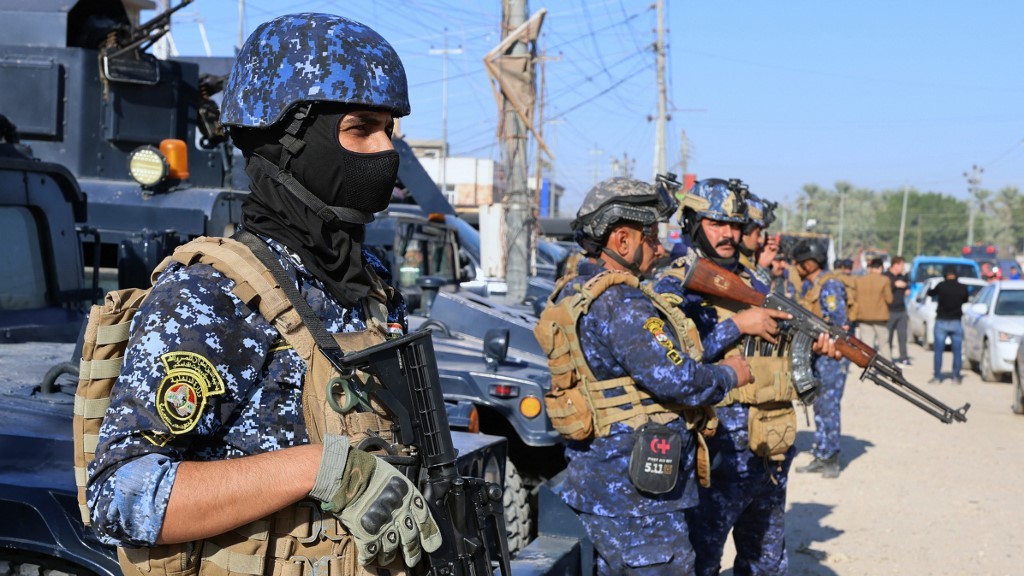
Despite the agreement with Baghdad, many still see a risk of open conflict with Iran-backed groups Members of the Iraqi Federal Police deploy in Jurf al-Sakhar, Babil governorate, south of Baghdad, on 20 November 2026 (Ahmad al-Rubaye/AFP) Published date: 20 November 2026 15:52 GMT | Last update: 7 sec ago Iraq's security services entered Kataeb Hezbollah's stronghold on Friday following a deal with the powerful Iran-backed paramilitary that narrowly avoided open conflict. Local journalists reported police forces passing through checkpoints manned by Kataeb Hezbollah in Jurf al-Sakhar, south of Baghdad. "Joint Iraqi forces began entering the [Jurf al-Sakhar] area to redeploy there," state media reported. Kataeb Hezbollah had been given until Friday to hand over control of the area. Prime Minister Ali al-Zaidi had stationed security forces on its outskirts, ready to enter by force. Officials had accused Kataeb Hezbollah of running a smuggling ring from Jurf al-Sakhar that siphoned off hundreds of millions of dollars' worth of state-owned oil. New MEE newsletter: Jerusalem Dispatch Sign up to get the latest insights and analysis on Israel-Palestine, alongside Turkey Unpacked and other MEE newsletters However, three senior security officials told Reuters on Thursday that a deal had been reached to allow government forces to enter the town on Friday. The deal was brokered by senior Shia political leaders. Esmail Qaani, commander of Iran's elite Quds Force, also arrived in Baghdad late on Monday to help defuse the situation. Lieutenant-General Saad Maan, head of Iraq's Security Media Cell, said the armed group's forces would move to other areas and a new headquarters reporting to the federal police would begin operating in Jurf al-Sakhar. As the US pulls its forces out of Iraq, what happens to Iran-backed armed groups? Read More » He told state TV on Friday that there had so far been "very good cooperation" with Kataeb Hezbollah brigades within the Hashd al-Shaabi, also known as Popular Mobilisation Forces (PMF), an umbrella group nominally answerable to Baghdad. The move comes as pressure has mounted on the prime minister to rein in and disarm the powerful armed groups that have dominated much of the country since the overthrow of Saddam Hussein in 2003. Zaidi said in a brief message broadcast on state TV on Friday that he was "not waging a war" against Kataeb Hezbollah, a group the US designated a terrorist organisation in 2009. "Everyone present there is your brother... the sons of this nation, and their blood is our blood," he said. However, a Kataeb Hezbollah source also told AFP on Friday that while his group had "allowed the government a way out of the predicament it created", they would not be leaving Jurf al-Sakhar. Risk of open conflict Observers had feared that had no compromise been reached, Iraq would have tipped over into civil conflict. Hayder al-Shakeri, a research fellow with the Middle East and North Africa programme at Chatham House, told Middle East Eye that all sides had strong incentives to avoid conflict over Jurf al-Sakhar. "But the risk was still there if Zaidi kept pushing for a change on the ground while Kataeb Hezbollah refused to shift its position. In that scenario, even a limited clash around Jurf could have escalated quickly, especially if other factions saw it as the start of a broader move against them," he said. "The deal mattered because it gave both sides a way to step back without either appearing to fully surrender." Zaidi previously set a deadline of 30 June 2027 for armed groups in Iraq to disarm, come under direct state control, or both. But the most powerful of these groups - Kataeb Hezbollah, Harakat Hezbollah al-Nujaba and Kataeb Sayyid al-Shuhada - have already said they are unwilling to do so. During the US-led occupation and the war against the Islamic State group, these groups were responsible for killing, kidnapping and torturing thousands of Iraqis. They also helped suppress the pro-democracy Tishreen movement that erupted in 2019. In recent years, several have also joined forces under the banner of the Islamic Resistance in Iraq to target Israeli and US assets over the ongoing genocide in Gaza. Middle East Eye delivers independent and unrivalled coverage and analysis of the Middle East, North Africa and beyond. To learn more about republishing this content and the associated fees, please fill out this form. More about MEE can be found here.
Iraq security forces deploy in Kataeb Hezbollah stronghold following 'compromise' deal
Full Article
Original Source
Read the full article at Middleeasteye →KhanList aggregates and links to publicly available news content. We do not host full articles from third-party sources. Always verify important information with original sources.