
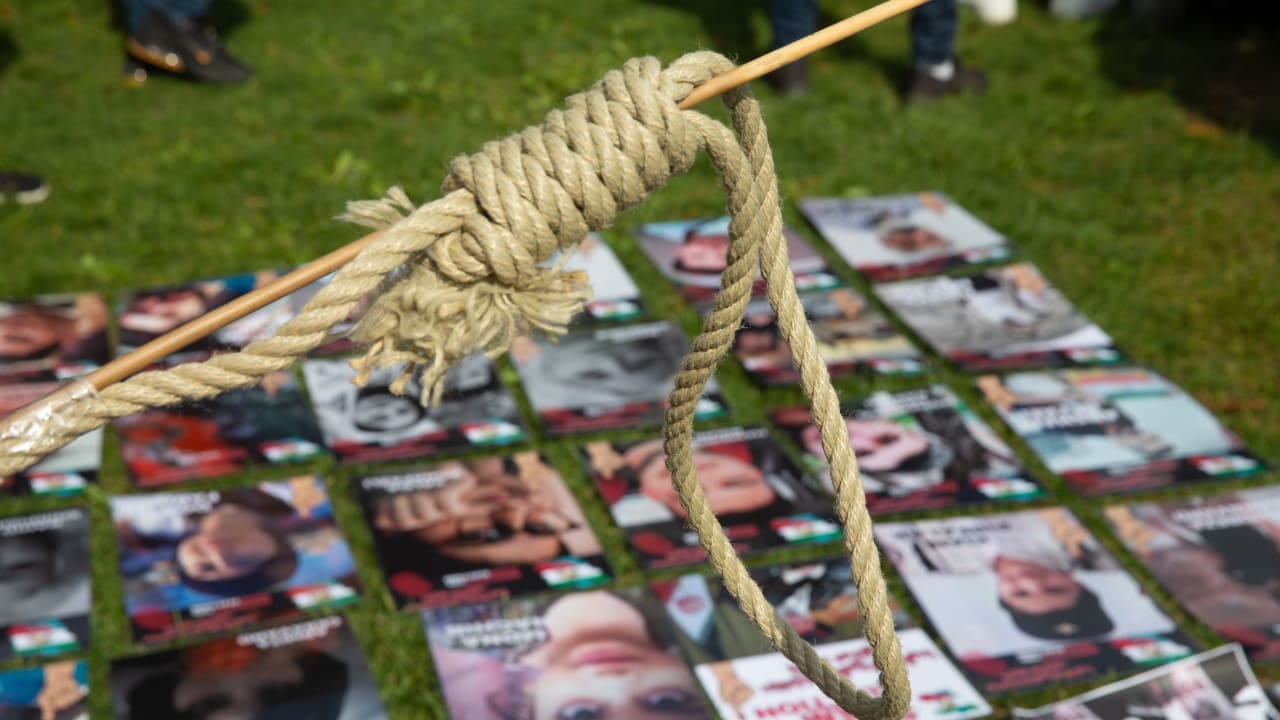
AUGUST 29, 2026 09:56Early Sunday morning, the Islamic Republic executed Shahram Sadeghi, who had been arrested in connection with the nationwide protests that erupted in January. His death came just one day after an anniversary that, for my family, has marked the brutality of this regime for nearly half a century.On August 15, 1980, the regime executed my grandfather, Yousef Khoshkish. He had spent decades serving Iran as the head of the country’s largest commercial bank, Bank Melli, and later as the last Pahlavi-era governor of the Central Bank of Iran, building institutions meant to serve generations of Iranians. I never had the chance to know him, but his execution has been part of my family’s story for as long as I can remember, and part of Iran’s story for even longer.Forty-six years separate those two days, and almost nothing separates the logic behind them. From its earliest days, the Islamic Republic has relied on the gallows as its language of rule. It has spent nearly five decades at war with the Iranian people, directing its anger inward whenever it emerges bruised from its foreign adventurism or fractured within.How Iran cracks down on mass uprisingsThe response to a mass uprising is always the same: arrests, torture, forced “confessions,” closed-door sham trials, and executions. These are less acts of revenge than instruments of political survival, intended to convince a population with its sights set on freedom that challenging the state is futile.As of August 18, at least 932 people have been executed in Iran since the beginning of 2026, and the true number is likely far higher. More than 100 others face death on bogus national security charges.A demonstrator holds a placard during a protest against the Iranian government held by supporters of the Iranian royal family in exile, who marched through central London past the Iranian embassy to the Israeli embassy, in London, Britain, March 8, 2026 (credit: REUTERS/YANN TESSIER)On July 19, Erfan Esfandiari and Gol-Mohammad Mohammadi were hanged for sheltering protesters fleeing security forces that were trying to kill them, two of 12 men sentenced to death in a single trial. Nine days later, Amir Hossein Safari and Abolfazl Sepahi were publicly hanged in Isfahan’s Alikhani Square.This location was chosen to convey a message, because thousands had gathered there during January protests. Security forces surrounded the execution site and fired into crowds of locals who had gathered in an attempt to stop the state-sanctioned killing.On August 1, authorities hanged 20-year-old Arvin Kheirkhah, convicted by a Revolutionary Court on charges including moharebeh, or “waging war against Allah.” His family had gathered outside the prison the night before, hoping the execution could still be stopped.Charges such as moharebeh, “spreading corruption on earth,” and “collaboration with hostile states” reduce Iran’s judiciary to an instrument of ideology. The last is used to dress up its conspiratorial claims of connections between Iranian protesters and the United States, Israel, or other foreign powers. These accusations are designed to deny an obvious reality: Opposition to the Islamic Republic is organic and homegrown.Eighteen-year-old Shervin Bagherian is one of the countless Iranians who remain at risk of execution. Security forces raided his home in the dead of night, beat him, and took him to an undisclosed location. Interrogators reportedly placed a noose around his neck and staged mock executions to force a confession for state television.This wave of executions coincides with rising concern among the regime’s Basij and IRGC over the possibility of renewed protests. In a recently leaked internal meeting, officials discussed preparations for another round of unrest and ordered personnel to identify and track Iranians posting anti-regime content online.The aim is to raise the cost of the next uprising before it begins. For a regime that claims to embody the Iranian nation, conceding that millions of Iranians reject it would be politically fatal. So protesters become “spies,” and critics online become “saboteurs.”Meanwhile, the state cannot reliably provide electricity, water, or economic stability, yet its machinery of repression remains remarkably organized. That contrast is a statement of priorities, and it should shape how democratic governments approach the Islamic Republic.The West treats nuclear negotiations, terrorism, regional militias, and human rights violations as separate policy files. To the Islamic Republic, they are a single file: survival. Which is why concessions purchased at the expense of Iranian lives purchase nothing durable.No serious Iran policy can treat the Iranian people as an afterthought. They are the central strategic question, and they are the country’s engine of change. Millions have defied guns and bullets, detention and torture, internet blackouts and executions, and they will not stop until they reclaim their motherland and their future.The Islamic Republic understands this better than many foreign governments do. It knows where the greatest threat to its survival resides. As champion wrestler and protester Navid Afkari said before his execution in 2020, as long as this regime remains in power, it will keep “searching for necks to hang from its gallows.” My grandfather’s was one. More than a hundred Iranians are waiting to learn whether they are next.The author is deputy communications director at the National Union for Democracy in Iran.Follow us on Google
Iran’s regime is at war with its own people - and executions are its weapon - opinion
Full Article
Original Source
Read the full article at Jpost →KhanList aggregates and links to publicly available news content. We do not host full articles from third-party sources. Always verify important information with original sources.