
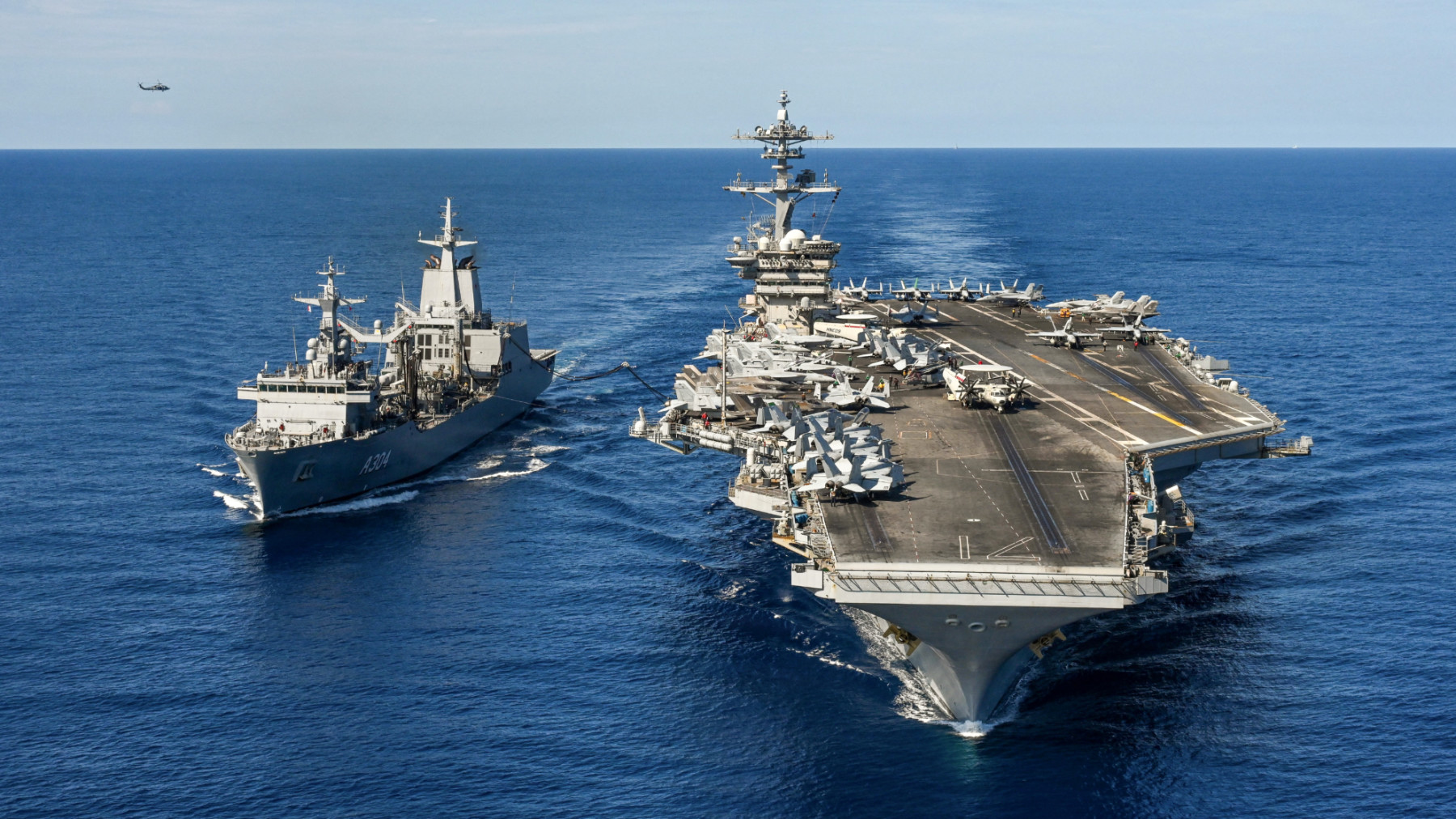
MP calls for pre-emptive strike on US warships An Iranian MP has called for a pre-emptive strike on US aircraft carriers deployed east of the Strait of Hormuz, describing an attack as essential to breaking the current “neither war nor peace” deadlock between Tehran and Washington. Amir Hayat-Moqaddam, a member of parliament's National Security Commission, told the 7 Sobh daily that “a pre-emptive attack on American warships is an absolute necessity”. He said Iran should strike vessels stationed 700 to 800km east of the strait, “damage them and drive them out of the region”. Hayat-Moqaddam is one of several Iranian officials to have called for pre-emptive attacks, as debate continues over how Tehran should respond to the threat of renewed US-Israel military attacks. New MEE newsletter: Jerusalem Dispatch Sign up to get the latest insights and analysis on Israel-Palestine, alongside Turkey Unpacked and other MEE newsletters These officials argue that demonstrating Iran's military strength is necessary to deter another US attack. Washington, Hayat-Moqaddam said, must understand that it would suffer greater losses in any renewed conflict, adding Iran "should already have carried out such attacks". He also dismissed the prospect of productive negotiations with Washington, saying talks were necessary mainly to convince domestic and international public opinion that Tehran was not seeking war. “Negotiations with America are fruitless,” he said, pointing to two occasions when Iran was attacked during negotiations. Water scientist denounces NYT linking dams to missile programme A New York Times report suggesting that Iran’s dams may have been built partly to support underground missile facilities has drawn sharp criticism, including from a prominent Iranian scientist who was among those quoted in the article. Kaveh Madani, director of the United Nations University Institute for Water, Environment and Health, wrote on X: “Speculation is not evidence. Spatial proximity is not causality. Even those who attacked Iran have not made such claims linking dams to missiles!” US builds up forces around Iran, but can it sustain another war? Read More » He added: “This reductionist, sensational narrative is irresponsible journalism with potentially dangerous consequences for civilian water infrastructure.” Madani, a vocal critic of Iran’s environmental policies, is a highly respected international figure. He also wrote a response in Forbes, arguing that geographical proximity does not establish a military purpose for civilian water projects. Parliament Speaker Mohammad Baqer Ghalibaf also criticised the report, saying Iran would apply the same logic to dams, ports and power plants near US or Israeli military bases, treating them as dual-use facilities. Meanwhile, BBC journalist Shabnam Shabani drew a parallel with the Iraq War, sharing a 2004 Guardian report on the New York Times's admission that its pre-invasion reporting on Iraq's alleged weapons of mass destruction had been flawed. 'IAEA espionage' claims fuel tensions over nuclear inspections The conservative daily Jam-e Jam has accused the International Atomic Energy Agency (IAEA) director general Rafael Grossi of facilitating US and Israeli espionage in Iran, claiming that the agency's inspectors are used to gather intelligence on the country's nuclear facilities. The accusation comes in response to the IAEA's latest confidential report, circulated to member states on Friday, which raised concerns over inspectors' lack of access to Iran's nuclear facilities, particularly the Isfahan enrichment site. The agency's report also stressed its inability to verify the country's enriched uranium stockpiles. In an article headlined “No to IAEA Espionage”, Jam-e Jam's political desk editor Abdolreza Hadi-Zadeh Naeini linked the report to what he described as a political manoeuvre designed to facilitate espionage. “This political game has been designed to facilitate the presence of spies in Iran under the cover of IAEA inspectors,” he wrote. Naeini argued that the IAEA's report ignores the US and Israeli first round of war on Iran, which began on 13 June 2025 and prevented a planned inspection of the Isfahan facility. Jam-e Jam added that Washington was using IAEA inspectors to obtain “information about Iran’s enriched uranium and the latest situation at the country’s nuclear sites”. The daily also urged Tehran to withdraw from the Non-Proliferation Treaty and change its nuclear doctrine, amid growing calls for such steps among conservative politicians. Threats of targeting Europe continue The conservative daily Farhikhtegan has continued warnings that a new round of war with the US and Israel could extend to European countries, arguing that Tehran is increasingly moving towards a conflict without geographical restrictions. Farhikhtegan quoted the head of the Supreme National Security Council, Mohsen Rezaei, who said Iran would attack “any point from which aggression against Iran originates”, a warning it said specifically included Europe. Where does Iran get its weapons, and can the US really stop the flow? Read More » The daily identified RAF Fairford in Britain and Akrotiri in Cyprus as bases involved in direct operations against Iran, while listing facilities in Portugal, Germany, France, Italy and Greece that provided logistical and military support. Farhikhtegan suggested that European countries that refused to facilitate US and Israeli military operations against Iran might not be targeted. It cited Spain, which repeatedly spoke out against the conflict and faced threats from US President Donald Trump, and Bulgaria, where the government's approval of US military deployments was met with opposition from local residents and the press. The latest warning follows repeated statements by Iranian officials that any renewed war would not be confined to the Middle East. Last week, Hamshahri and Kayhan also identified US military bases across Europe as potential targets, with Kayhan warning that the conflict could reach “the heart of Europe”.
Iranian press review: Pre-emptive strikes on US warships proposed to prevent another war
Full Article
Original Source
Read the full article at Middleeasteye →KhanList aggregates and links to publicly available news content. We do not host full articles from third-party sources. Always verify important information with original sources.