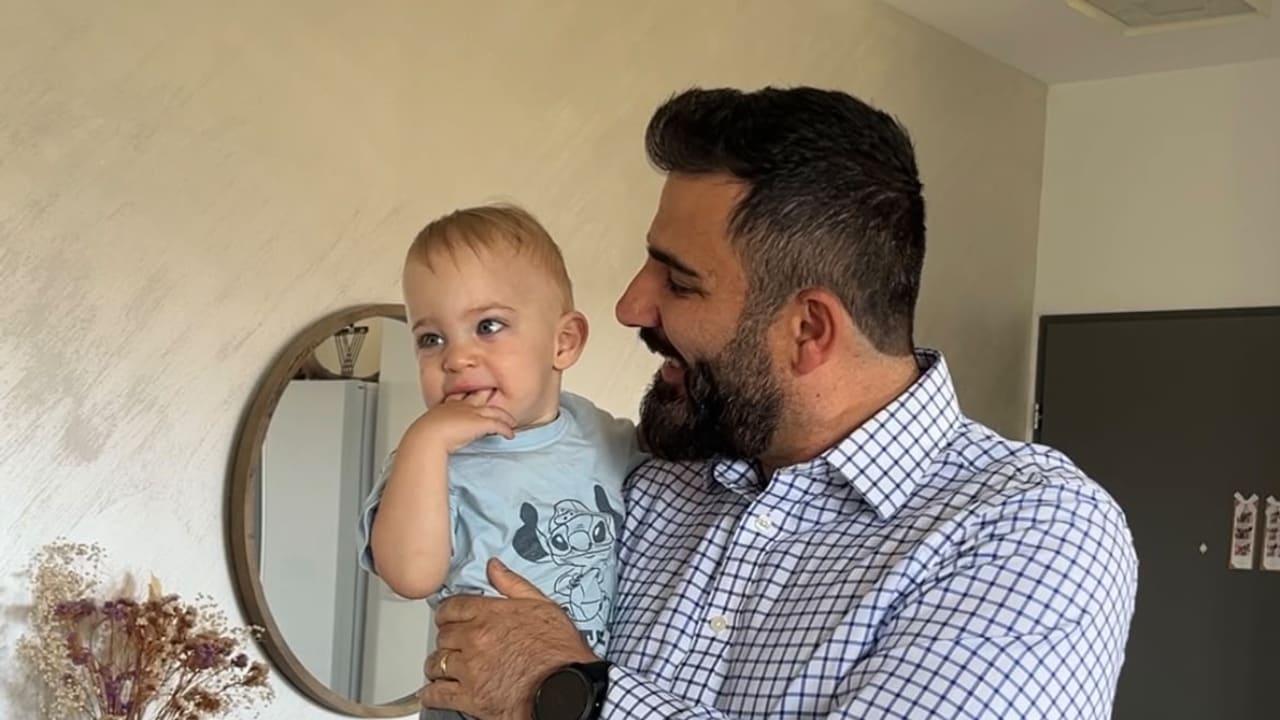
ByDANIELLE GREYMAN-KENNARDJULY 30, 2026 17:37Updated: JULY 30, 2026 17:51Ramin Parsa has lived in Israel since early 2023, where he has built a life with his wife and year-old baby and created a vibrant community through volunteer work advocating for Israel and supporting those displaced by October 7 and the wars that followed.However, he has now been told by the Interior Ministry that he must leave the country because he was born in Iran, he told The Jerusalem Post on Thursday.Parsa has faced years of uncertainty since moving to the Jewish state with his wife, a messianic Israeli of Jewish heritage, but that has done little to temper his love for Israel.Far different from what he was brought up to consider normal, Parsa explained that much of his love for Israel stemmed from the stark contrast between the two countries. In Israel, cranes represent construction, building new homes and businesses, while in his country of birth, they were used to intimidate the population into silence.From childhood, he told The Post that he remembered seeing the bodies of men, some still kicking as they struggled, hanging from those cranes after being accused of working with Mossad, the United States, or other demonized foreign powers.Ramin Parsa sits with his wife and child in their house (credit: SAM HALPERN)"The first time I saw an execution, I was eight or nine years old. I was walking to school when I saw a large crane and a crowd gathering around it. There was a noose hanging from the crane. Then they brought out a man. His eyes were covered with a blindfold; he was dressed in black, and they hanged him,” Parsa recounted.“I remember watching his legs kick as he died. I was completely traumatized seeing someone killed in front of me. They completely normalized it. They devalued human life."Denied Israeli citizenship and facing deportationParsa first applied for citizenship in 2024 but was denied a year and a half after submitting his application. The official reason given was that he was born in an enemy state.A court later ruled that the Interior Ministry should reconsider the case, but on July 13 he received the outcome of that reassessment: that he must either leave his wife and child behind or uproot them from their family.The family has one final opportunity to appeal on August 27, and if unsuccessful, Parsa will be deported.The decision, in Parsa’s view, has little to do with his being considered a national security threat, especially given his long history of advocating for Israel and his volunteer efforts following October 7. Rather, he believes it is connected to his faith and reflects a government that is increasingly prioritizing religious considerations over the rights and security of the Israeli people.Israel's relationship with Evangelical ChristiansThe decision is “because we're Christians, and they're afraid, and the Ministry of Interior is run by the Shas party, they’re religious, and they're very anti-Messianic, anti-Christian,” he said.“They're afraid of Christians; they're afraid of the messianics, afraid they may want to convert them.”Parsa argued that if his goal had been to convert people, there were far more potential converts in the United States than in Israel, and he has American citizenship, so it would be far easier.He also recalled that many evangelical volunteers faced significant obstacles from the Interior Ministry when they tried to enter Israel to assist in the aftermath of the October 7 massacre in 2023.With Palestinians barred from working in Israel, foreign workers leaving because of the war, and communities along the borders devastated by the Hamas invasion and Hezbollah attacks, many farmers came to rely on foreign volunteers to harvest crops and help sustain Israel’s agricultural sector.Parsa took on the role of cooking thousands of meals for the displaced, and used his platform to advocate for Israel at a time when many were outraged by the war in Gaza."Right now, Israel's strongest supporters are evangelical Christians. By doing this, they're damaging Israel's reputation and giving more ammunition to anti-Israel activists and antisemites, who will say, 'See? We told you. Look at what they're doing to Christians.' We don't want that,” he said.“We don't want Israel to be attacked or demonized. We know this doesn't represent all of Israel. It's a very small group, whether it's certain religious figures or people within the Interior Ministry making these kinds of decisions."Since moving to Israel, Parsa has been unable to work or travel, including to events where he had been invited to advocate for Israel, and has had to live under the constant weight of uncertainty.A spokesperson for the Interior Ministry only told The Post that they don’t comment on individual cases when approached for comment.Moving to Israel after fleeing IranExplaining how he came to live in a country he had been taught to view as the "Little Satan," Parsa described the violence and near-constant antisemitic and anti-Israel indoctrination that shaped his upbringing.He said he was taught that Jews hunted Muslim children for their blood to make matza, shown staged images of Israeli soldiers aiming their weapons at Muslim children, and required to attend rallies where chants of "Death to America, death to Israel" were a condition for passing his classes.The same brutality the Islamic Republic accused Israel of committing was what Parsa witnessed in the streets of Iran. Public hangings, floggings, and mutilations for the crime of stealing food were commonplace and widely accepted as normal.Even so, he said the regime's tight control over information left many believing they were fortunate, while the rest of the world was living in hellish conditions. Parsa was one of those, until he was arrested at aged 16 for simply being in a car where another person was in possession of a small amount of alcohol.Being arrested at 16 changed Parsa's view of the Iranian regimeOn his way to a family wedding, Parsa was being driven by relatives when Basij paramilitary forces randomly closed the street and began inspecting every vehicle.A coachload of people were detained, including Parsa, for “crimes” such as being in a car with a member of the opposite sex who was not a family member, allowing some hair to slip out from under a hijab, or engaging in any behavior deemed to violate Sharia law.Despite being only 16, and an observant Shiite Muslim at the time who had never touched alcohol, Parsa was driven to a holding cell where he said he was stripped naked, beaten, and hosed down with cold water. He said he never appeared before a judge or was allowed to defend himself before being locked in a tiny room with other young men, where they were given only two eggs a day to eat, very little water, and two short bathroom breaks.He was only released after his family bribed the guards, he said."They were mocking and laughing at us. They made us face the wall naked and do sit-ups: up and down, up and down. After 60 or 70 repetitions, you can't do it anymore. You get muscle cramps, and if you couldn't continue, they would beat you even more.I was beaten badly, along with my friends and other people there, while they laughed at us and did it with a sense of joy,” he said. “If someone does something wrong and you punish them, you might do so because you believe they deserve it, but you don't laugh. You don't enjoy it. They were gleeful. That was when I saw the cruelty of this regime and realized how truly evil and brutal it was.""Everything inside me began to change. I started thinking: maybe the people they hung from cranes were innocent too, like us. Maybe the people whose hands they cut off or whose eyes they removed were also innocent."Converting to Christianity and moving to IsraelThe experience left Parsa rejecting all religion, though he would later become a Christian after hearing satellite radio broadcasts about Jesus Christ. His conversion led to threats against his life, including a stabbing, and two years living as a refugee after he was smuggled out of Iran and into Turkey.After becoming a US citizen in 2015, Parsa was finally able to visit Israel. He immediately began advocating for the country online, which was how he met his wife in 2020.She sent him a drawing of two hands decorated with Iranian and Israeli flags, symbolizing the love between the Iranian and Jewish peoples, and the rest was history.They met in person five months after he first messaged her online and married eight months later. After spending their first two and a half years as newlyweds in the United States, they returned home to Israel, where her parents are able to help them raise their children.Follow us on Google
Iranian Christian dissident denied right to stay in Israel with Israeli wife, child - interview
Full Article
Original Source
Read the full article at Jpost →KhanList aggregates and links to publicly available news content. We do not host full articles from third-party sources. Always verify important information with original sources.