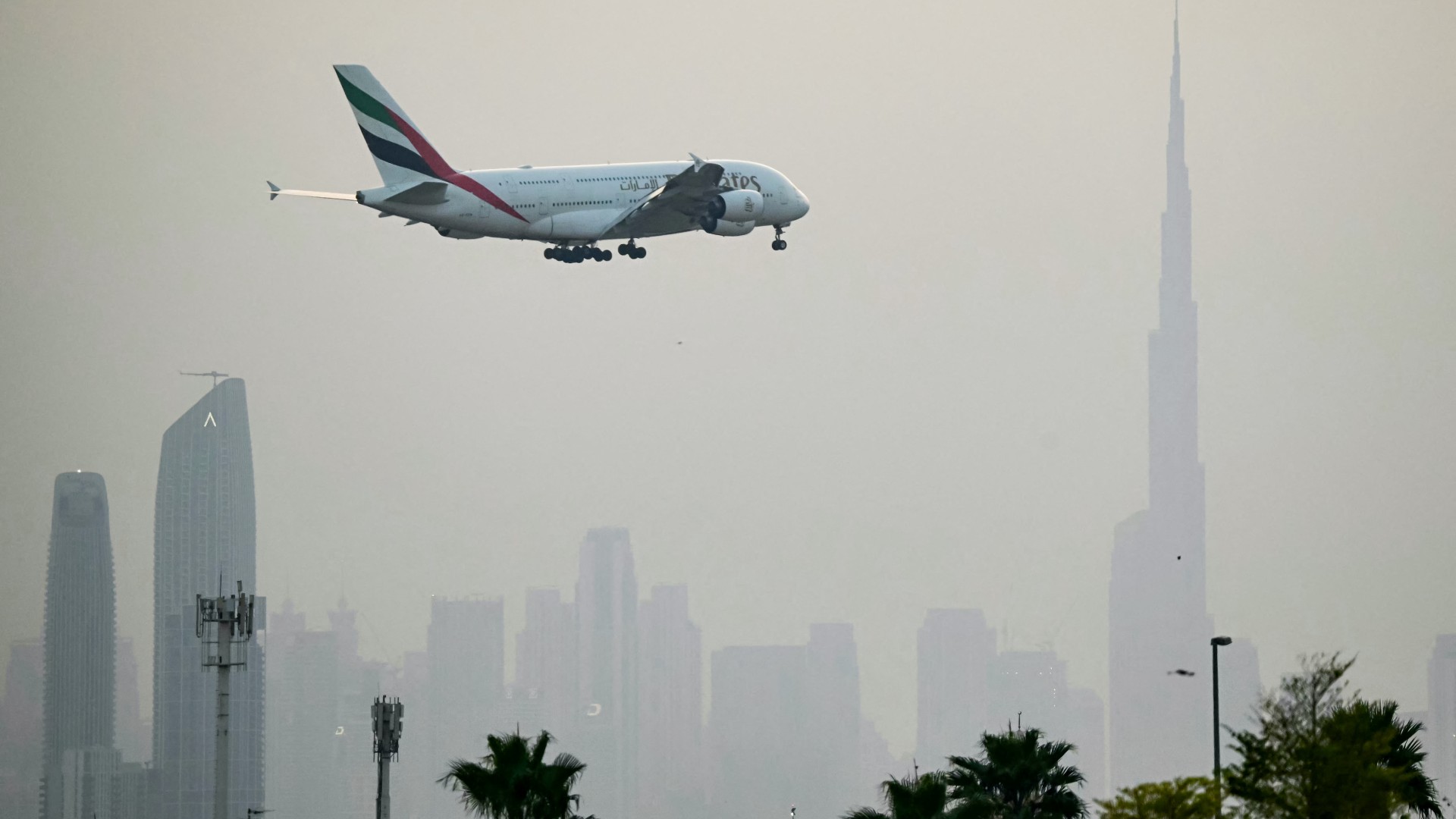
As the US and Israel launched air strikes on Iran on 28 February 2026, Iran struck back near US military installations in the Gulf, including in Qatar and the UAE. Several international airports were hit by Iranian strikes, including Dubai, the world's busiest for international passengers, as well as Abu Dhabi, Kuwait and Bahrain. The UAE, Qatar, Bahrain and Kuwait closed their airspaces due to safety concerns, gradually reopening them a week later as hostilities lessened. The war has had long-lasting consequences for regional aviation: falling passenger and cargo demand, fewer private jet flights, and global repercussions from high jet fuel prices. The International Air Transport Association's (IATA) June outlook estimated that airlines operating from the Middle East will see a $7.2bn net profit in 2025 become a $4.3bn net loss in 2026. New MEE newsletter: Jerusalem Dispatch Sign up to get the latest insights and analysis on Israel-Palestine, alongside Turkey Unpacked and other MEE newsletters Most major regional carriers have resumed operations, including Emirates, Etihad and Qatar Airways, but not at full capacity. Emirates CEO Tim Clark told the Financial Times in June his planes were flying at three-quarters capacity. Conversely, most European and Asian airlines' flights in the region remain suspended. Air France expects to resume in late August and Lufthansa in September, while British Airways, Cathay Pacific and Singapore Airlines are all targeting late October. Air Canada is not planning to resume before mid-January 2027, and many others have not announced a restart date at all. Satellite imagery shows smoke plumes billowing in the vicinity Kuwait International Airport on 25 March 2026 (European Space Agency/AFP) Regional airspaces have reopened, but are still facing intermittent closures and disruptions. The EU Aviation Safety Agency’s most recent bulletin advises operators to “avoid the airspace of Bahrain, Kuwait, Qatar, the UAE and part of the Gulf of Oman until 31 August 2026”. The result is limited choice for travellers. For a one-week round trip between the UAE and London in September, the only options are Emirates to Dubai, Etihad to Abu Dhabi, or Air Arabia to Sharjah, while to fly between Doha and Tokyo on those same dates, only Qatar Airways is available. Business under threat Gulf airlines organise their activity around a hub-and-spoke model concentrating traffic at a central base and operating flights worldwide from there. Passengers connect onward from the main hub, offering connections that are otherwise unavailable or sometimes cheaper fares than direct flights. This model has long relied on the Gulf’s strategic position between Europe and Asia, forming what analysts describe as a “bridge” between the two continents. But the war has put this model at risk. '[Gulf airlines are] connecting carriers whose economics depend on moving large volumes of passengers' -Naveed Kapadia, aviation lecturer Naveed Kapadia, an aviation lecturer at Buckinghamshire New University, told Middle East Eye that while competition for airlines such as Qatar Airways and Emirates is “greatly reduced”, allowing them to “capture market share and maintain stronger fares”, they remain “connecting carriers whose economics depend on moving large volumes of passengers efficiently through Dubai and Doha”. Kapadia said IATA’s June data showed Middle Eastern passenger demand fell 13.9 percent year-on-year, while direct traffic between Europe and Asia rose 11 percent, already revealing a strain on the Gulf carrier’s model. This leads to cost increases across the board. “Where flights must use longer or less efficient routings, airlines face higher fuel burn, longer crew duty periods and reduced aircraft utilisation,” Kapadia said. The extra fuel many now carry in case of disruption also directly limits “passenger or cargo payload that can be carried”. The hub-and-spoke model leaves airlines susceptible to disruption, as aircraft and crews can be stranded far away, causing cascading delays and cancellations across the entire schedule. Emirates innovates Emirates has been innovating to win back the customers it had before the war, as many are hesitant to book flights connecting through Dubai in case hostilities resume. One measure is an unprecedented travel insurance policy, offering comprehensive coverage even in case of conflict-related cancellation. Until now, most travel insurance voided cover in the event of war-related disruption, leaving passengers to absorb the costs themselves. The policy aims to prevent passengers from being stranded, with Emirates offering to fly them home on other airlines if needed. CEO Tim Clark told the Financial Times the aim was to guarantee “we would get you back irrespective [of whether it's] on Emirates or not”. Dubai has also been trying to reboost tourism more broadly, offering complimentary packages for visitors invited by Emirati nationals and free hotel stays for long connecting flights. An Emirates Airbus A380 aircraft prepares for landing as a smoke plume rises from an ongoing fire near Dubai International Airport in Dubai on 16 March 2026 Cargo demand lags Cargo carriers have also been impacted by regional disruptions. Kapadia said Middle East cargo demand grew roughly a third slower than the rest of the industry’s, at 5.6 percent year on year, behind the global rate of 8.5 percent. Citing IATA figures, Kapadia said traffic between Europe and the Middle East remained 41.1 percent below the previous year, while Asia-Middle East traffic was down 4.1 percent. He added that while “disruption to maritime traffic through the Strait of Hormuz is creating demand for faster alternatives, particularly for urgent, high-value and time-sensitive shipments”, this was not a "straightforward windfall" for Gulf-based cargo airlines. Middle Eastern carriers such as Qatar Airways Cargo and Emirates SkyCargo account for around 13 percent of global air cargo traffic. “The more important question,” he said, “is whether they can convert short-term urgency into sustained and profitable cargo flows.” Private jets staying Similar disruptions have also been observed in the private jet sector. Nick Koscinski, an aviation analyst at WINGX, told Middle East Eye that as of 10 August, overall private jet traffic originating in Gulf countries was down 46.5 percent since the war began. 'The vast majority of flights stayed within the Middle East region' -Nick Koscinski, aviation analyst “The vast majority of flights stayed within the Middle East region,” he said, though volumes there are “still down considerably”. Europe remains the second most common destination from Gulf origins, but Gulf-to-Europe flights are down 41.0 percent. Koscinski said Qatar Executive, one of the top Gulf-based private jet operators, had been more resilient than UAE or Saudi Arabia-based competitors. Total flights are down 6.7 percent since the war began, against 28.7 percent for a comparable UAE-based operator and 39.0 percent for a Saudi one. Koscinski said operators “likely have some ability to pass increased operating costs, like fuel spikes, through to the consumer via surcharges”, but lags in repricing and “softer demand overall” mean they will still take a financial hit. Fuel costs squeeze margins Jet fuel prices fell 20 percent in June as Gulf oil flows temporarily improved, Kapadia said, but remained “45.8% higher than a year earlier”. IATA forecasts the 2026 jet fuel price average will run 70 percent above 2025 levels. Kapadia expects “Gulf airfares to remain elevated and volatile rather than rise uniformly” because “airlines will try to recover higher fuel and disruption costs through fares to some extent, but they cannot pass on every additional cost without weakening demand, particularly among price-sensitive leisure travellers.” Low-cost carriers around the world have been particularly vulnerable to the jump in fuel cost: US-based Spirit Airlines ceased operations on 2 May 2026, while Air Baltic and Wizz Air face growing bankruptcy risk and are forced to restructure operations. A McKinsey report found that around 70 percent of jet fuel surcharges are passed directly to consumers, with airline margins recovering only briefly when fuel prices fall. It said the economic pressure will force airlines to retire older aircraft, cut less-booked routes, and further trim overhead costs. Not every carrier is equally impacted. Israel’s national airline, El Al, has recently reported record profits, more than double the previous year. Many passengers have criticised the “outrageous” fares, as the continued flight suspension by international carriers leaves the airline in a near-monopoly. Harsha Jaison, an aviation consultant at ICF, told Middle East Eye the conflict has set a precedent that will probably outlast it. “Airport investment deals, geopolitical risk is increasingly being reflected in downside scenarios, valuation assumptions and risk premiums,” she said.
Iran war pushes Middle Eastern airlines towards $4.3bn loss in 2026
Full Article
Original Source
Read the full article at Middleeasteye →KhanList aggregates and links to publicly available news content. We do not host full articles from third-party sources. Always verify important information with original sources.