
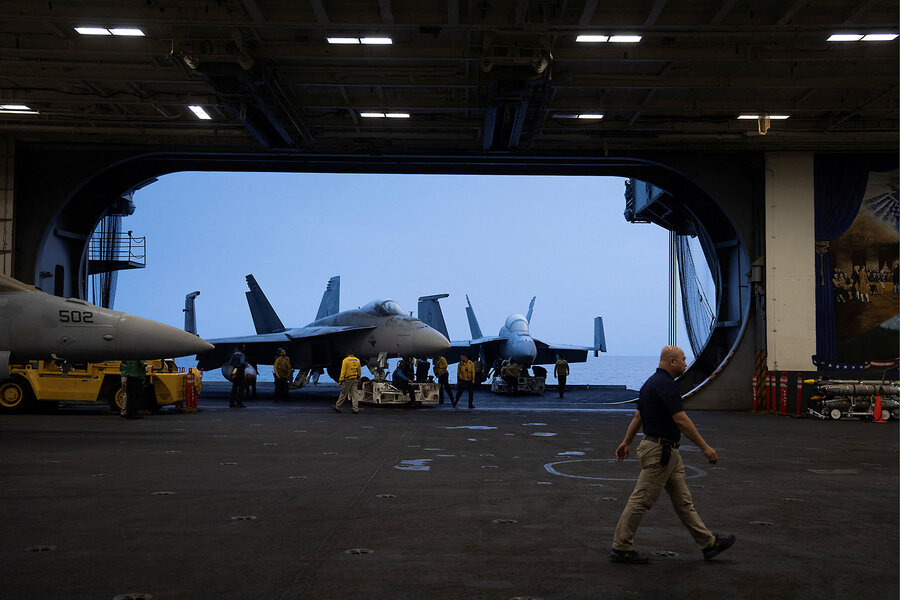
America’s war with Iran is draining Pacific military resources – siphoning off ships, weapons, and troops from U.S. forces – and raising risks, analysts warn, by potentially emboldening rivals China and North Korea.While America typically maintains a presence of two aircraft carriers in the Pacific (one in Japan and another rotating from the U.S. West Coast), the Navy now has none there. The USS George Washington, which had been operating in the Indo-Pacific, left for the Middle East in August to relieve the USS Abraham Lincoln, which had just completed a record-breaking 11-month deployment during the Iran war amid reports of crew stress and supply shortages.Aircraft carriers, though not the entirety of U.S. strength in the region, are among the most highly visible ways America projects its military power. A modern carrier is roughly three football fields long and 20 stories tall, and can accommodate up to 5,000 crew members and 90 aircraft. The gap in U.S. forces in the Pacific has raised questions about how much simultaneous demand the Pentagon can handle in the Middle East and Asia. If China decided to invade Taiwan while no U.S. aircraft carriers were in the region – a possible though unlikely scenario – the risk to U.S. troops would increase as well, analysts say.“The U.S. is not intentionally withdrawing from the region. There will be another aircraft carrier group in the Indo-Pacific sooner or later,” says Joel Linnainmäki, research fellow at the Finnish Institute of International Affairs.“But it’s also clear that the U.S. currently doesn’t have all the resources that it needs to sustain a deep and strong presence in the Indo-Pacific, Europe, and in the Middle East at the same time,” he adds. “And if I were sitting in Beijing, I would, of course, take note of this.”A question of risks and reliabilityFor months, top commanders have been pointing to the conflict’s strain on U.S. operations. Gen. Kevin Schneider, head of U.S. Pacific Air Forces, acknowledged this summer that the Middle East is currently the U.S. military’s main focus. “That’s driving conversations” among top U.S. officers about how to “manage the risks as we prioritize” efforts to fight the Iran war, General Schneider said at a think tank discussion in July. Ahn Young-joon/APA TV screen shows a file image of North Korean leader Kim Jong Un and U.S. President Donald Trump during a news program at Seoul Railway Station in Seoul, South Korea, Aug. 20, 2026. Then in August, the U.S. canceled a large, biennial military exercise with South Korean forces that was scheduled for September. A spokesman for the South Korean Marines told reporters that the cancellation was due to U.S. constraints stemming from the war in Iran.The Iran conflict has impacted relations with Asian allies in other ways, too. In a separate move in August, President Donald Trump ordered another U.S.-South Korea military exercise, Ulchi Freedom Shield, to be scaled back substantially.He intimated that it was in part because of South Korea’s lack of support for the Iran war.This prompted Elbridge Colby, the U.S. undersecretary of defense for policy and widely known for pushing the Pentagon to treat China’s military rise as America’s military priority, to reassure allies that the U.S. is in the Pacific for the long haul.“America is definitely not disengaging from Asia,” he told an audience in the Philippines in August. What many analysts “frequently misinterpret as ‘disengagement’ or ‘retrenchment’ is, in reality, a disciplined and necessary strategic prioritization.’’ He rejected as a “canard” the narrative that “America today is too unreliable to work with anymore.”Influence and lessons learnedThe perception of unreliability could affect America’s ability to influence not only its Asian allies but also its adversaries, analysts say.When Mr. Trump scaled back Ulchi Freedom Shield, he also said it was because South Korea had sent a “hostile” signal to North Korea, a country that has been “unthreatening and respectful” to the United States, the president wrote in an Aug. 16 social media post.By emphasizing his “very good relationship” with North Korean leader Kim Jong Un, Mr. Trump may be trying to exert more influence over that nuclear-armed state, particularly as Pyongyang has an estimated 10,000 troops fighting for America’s rival, Russia, in its war against Ukraine.Yet North Korea may be drawing different conclusions from the war in Iran than the U.S. intends, says Hans Horan, a strategic analyst at the Hague Center for Strategic Studies.Despite its negotiations and a signed deal with the U.S. over its nuclear infrastructure, Iran learned those “weren’t a guarantee for continued goodwill between the states,’’ Mr. Horan says. “There’s also no guarantee that the U.S. will hold to the deal and make good on its promises.’’ Statements made by Mr. Kim’s sister Kim Yo Jong also suggest that this is one of South Korea’s considerations.“She has basically said, ‘You know, it’s great the U.S. wants to talk. We want to have warm relations. But we are not going to start negotiations if the first point is denuclearization. We’re not giving it up,’” Mr. Horan adds. “So the parallels are quite clear, I think, when you look at what’s going on with the Iran war right now.” Deepen your worldviewwith Monitor Highlights.Politics with respectGet political stories with respectful analysis.There's a world of new ideas in everyBooks newsletter.There's more to life, enrich yours withCulture & Learning weekly.Follow humanity's discoveries withScience & Nature stories in your inbox.Gain a spiritual perspectivefrom the stories in your inbox.Want to understand the deeper impact of critical events? Learn the Monitor's insight.Already a subscriber? Log in to hide ads. China benefits when the U.S. and its allies stay busy outside of Asia, says Bradley Bowman, senior director of the Center on Military and Political Power at the Foundation for the Defense of Democracies. Meanwhile, Russia is giving security help to North Korea in exchange for support from North Korean soldiers. Because of this trade, Pyongyang “is more powerful than it’s been in recent memory,” says Mr. Bowman.For now, U.S. officials point to “unprecedented cooperation” among China, Iran, North Korea, and Russia, increasing the chances, Mr. Bowman adds, that the U.S. may need to fight more than one war at the same time in the near future. ALREADY A SUBSCRIBER? LoginReal news can be honest, hopeful, credible, constructive.The Christian Science Monitor was founded in 1908 to lift the standard of journalism and uplift humanity. We aim to “speak the truth in love.” Our goal is not to tell you what to think, but to give you the essential knowledge and understanding to come to your own intelligent conclusions. Join us in this mission by subscribing.
Iran war is draining U.S. military resources from Pacific and Asia
Full Article
Original Source
Read the full article at Csmonitor →KhanList aggregates and links to publicly available news content. We do not host full articles from third-party sources. Always verify important information with original sources.