
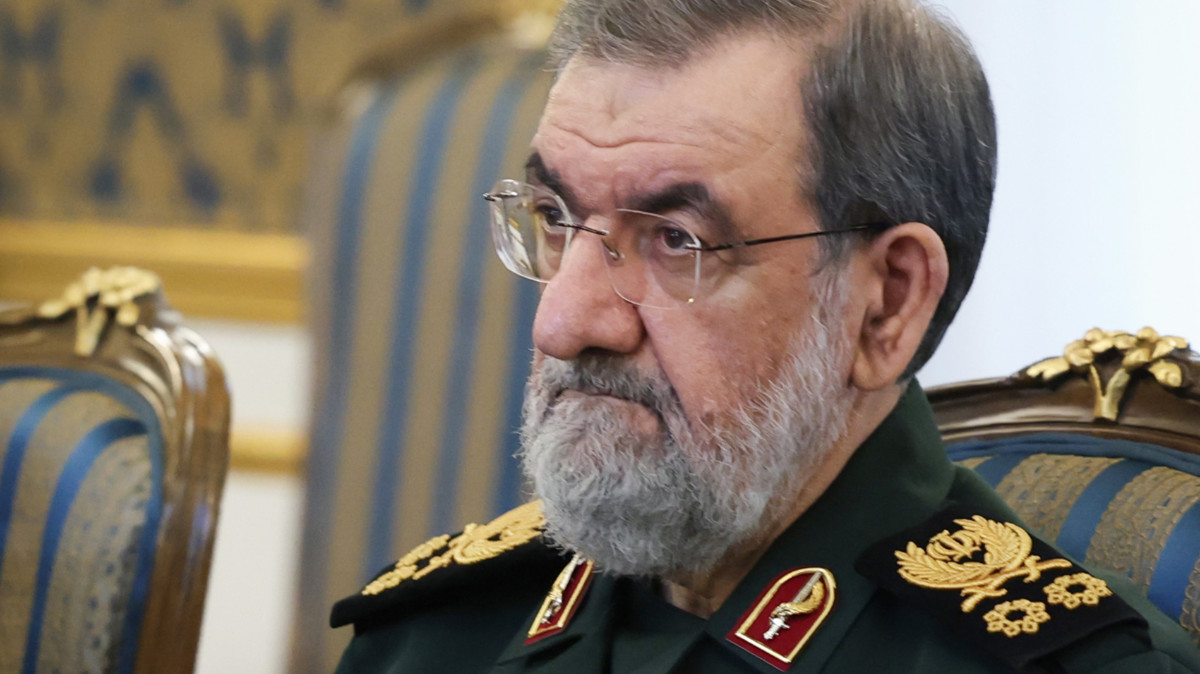
Security chief Mohsen Rezaei warns Tehran will reciprocate against any US attack emanating from Europe Secretary of Iran's Supreme National Security Council Mohsen Rezaei attends consultations with members of the Mecca Joint Defence in Tehran, Iran, on 26 October 2026 (Iranian Presidency via Zuma Press) Published date: 11 November 2026 17:57 GMT | Last update: 5 sec ago Iran has no intention of surrendering its enriched nuclear material, which it wants to use to build nuclear-powered submarines, security chief Mohsen Rezaei said on Wednesday, in an apparent rejection of US demands to give up the material for a political settlement. In an interview with Al Mayadeen TV network, Rezaei said Iran will not allow a “single speck” of enriched uranium to leave the country. "We need the enriched material to design ships and submarines that work on nuclear energy," Rezaei said, adding that Tehran has informed Moscow that its enriched nuclear material will remain in the country and "we will use it ourselves". Rezaei’s remarks come a day after US Secretary of State Marco Rubio called Iran’s terms for a political settlement “absurd” and stressed that the Trump administration believes its maritime blockade against Iran gives them the upper hand in negotiations. Rezaei, who has become more prominent in the media in recent months for explaining Iran’s terms, struck a defiant tone in his interview. New MEE newsletter: Jerusalem Dispatch Sign up to get the latest insights and analysis on Israel-Palestine, alongside Turkey Unpacked and other MEE newsletters “If American aircraft take off from an American military base, even one located in a European country or some other distant region, to bomb Iran, we will strike those bases as well," Rezaei said. He also said that Iran's response to renewed US attacks would "target America's more distant military installations - including the ones we have not yet attacked", without specifying details. "We may even strike certain islands that they assume are beyond the reach of our missiles," he added. Rezaei may be referring to Diego Garcia, the Indian Ocean island where the US has access to a military base. The US is widely believed to have used the base in its February 2026 attack and in the following months. The Trump administration has used deescalatory language since the Republican Party was badly defeated in US midterm elections on 3 November by the Democrats, who campaigned against the war and rising energy prices. While US President Donald Trump has said that the war was “effectively over” and that there was “momentum” to end the conflict, the two sides seem far apart on files including nuclear enrichment, sanctions relief and control over the Strait of Hormuz. Iranian missile capabilities While the Trump administration has characterised Iran as a defeated foe, Tehran appears to be working to recover from the US-Israeli attacks that began in February. Bloomberg reported on Tuesday that Iran is now capable of building about 50 ballistic missiles per month, or roughly half its prewar capacity, providing a substantial arsenal should the US and Israel resume attacking. US says no need for new attacks but calls Iran's peace terms 'absurd' Read More » Meanwhile, Iran unveiled on Wednesday what it characterised as a new underground "missile city", housing ballistic and cruise missiles, according to a report by Tasnim news agency. The US’s Gulf allies bore the brunt of Iran’s retaliation over the US-Israeli attack, with the UAE, Qatar, Bahrain, and Kuwait facing thousands of missile and drone strikes. While direct attacks have stopped, Iran is still striking vessels in the Strait of Hormuz, as it looks to compete with the US for control over the waterway. The Houthis, who are aligned with Iran, are also bombing Saudi Arabia, as they look to extend their territory in Yemen. On Wednesday, insurer Allianz Trade said Gulf countries face more than $200bn in damage and economic losses from the war, and the number could quadruple by 2030. "Physical damage across the region is assessed [at] just above $200bn, mostly concentrated in Hormuz-locked economies, especially in energy infrastructure," the insurer said in a report. Middle East Eye delivers independent and unrivalled coverage and analysis of the Middle East, North Africa and beyond. To learn more about republishing this content and the associated fees, please fill out this form. More about MEE can be found here.
Iran refuses to surrender enriched uranium, threatens to strike US bases in Europe if attacked
Full Article
Original Source
Read the full article at Middleeasteye →KhanList aggregates and links to publicly available news content. We do not host full articles from third-party sources. Always verify important information with original sources.