
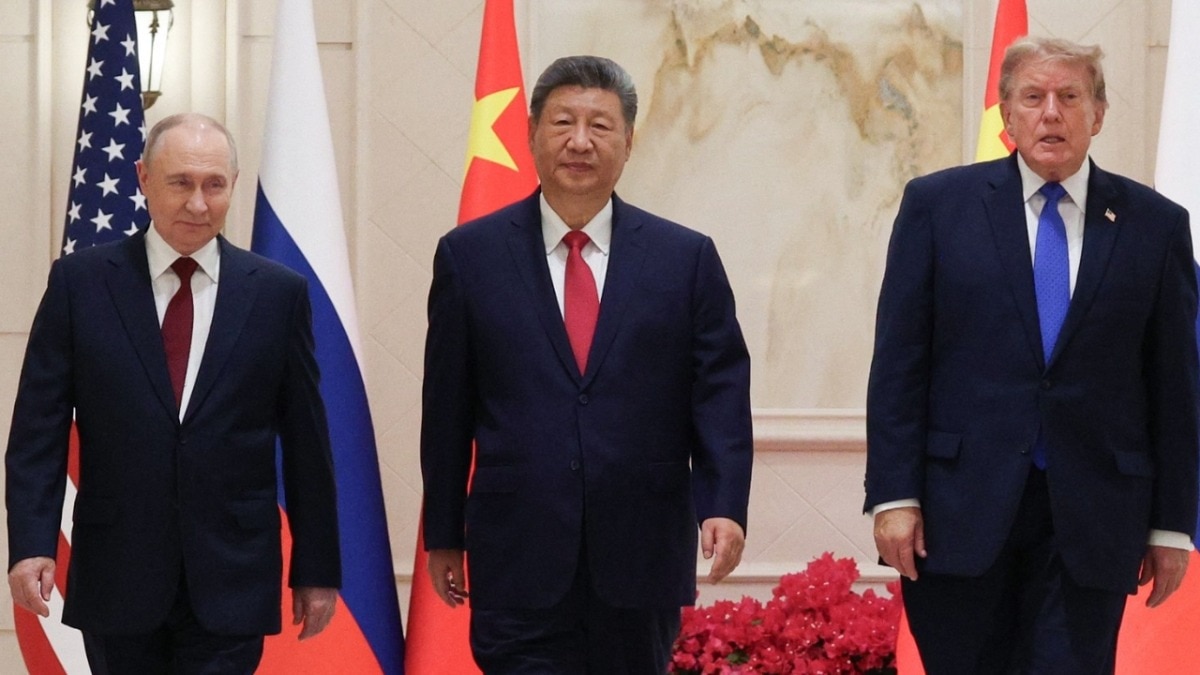
Iran has long counted China and Russia among its most important strategic allies. But, Chinese President Xi Jinping and Russian President Vladimir Putin came face to face with US President Donald Trump in China. This was the first time in history that all three leaders were seen together in public.The three leaders subsequently held a historic trilateral meeting in Shenzhen. Following the meeting, they issued a joint "Declaration toward Peace". Their meeting, which lasted around an hour and a half, covered some of the world's most pressing flashpoints, including the future of nuclear weapons. Although Iran was not named in the declaration, Trump made sure it was part of the talks.At the core of their four-point declaration was an unmistakable message: a nuclear war must never happen, and the international community must do more to prevent the spread of nuclear weapons."The three heads of state reaffirmed that a nuclear war cannot be won and must never be fought. The three countries will conduct a dialogue on reducing nuclear risks and preventing the proliferation of nuclear weapons," they said in a statement. For Trump, however, the agreement was about more than finding common ground on nuclear weapons. He quickly turned the conversation towards Iran, making it clear that stopping Tehran from acquiring a nuclear weapon is a major priority for his administration."We are making history," Trump enthused during the meeting, before linking the nuclear issue directly to the war in Iran. "It is very important to try to combat nuclear proliferation in other countries around the world, for example what we are doing in Iran, we will not let Iran continue to have nuclear power," he said.A RARE AGREEMENT BETWEEN THREE RIVALSThe significance of the declaration extends beyond its words. China, Russia and the US are three major powers with competing geopolitical interests, and their leaders have frequently found themselves on opposite sides of disputes.For a change, Trump appeared keen to present the meeting as an opportunity to move beyond those differences through direct engagement."The three of us have much to discuss, and we've already discussed it. We are the leaders of the three most important countries in the world, and we must continue a productive dialogue, impacting not only our own peoples, but the entire planet . We must try to forget what past leaders did, who often disagreed. We should do exactly the opposite, and we are certain we will. No problem has ever been solved the old way, without discussions, without talking. No peace has ever been forged by a lack of commitment and a lack of dialogue," he said.The US President added they were choosing a different path that would open up new opportunities and approaches, adding that the three countries must work towards a better and more secure future.Chinese President Xi also used the meeting to underline the dangers posed by nuclear arsenals, calling for their complete elimination."Nuclear weapons are the sword of Damocles hanging over humanity. They must be completely banned and destroyed to finally create a world free of nuclear weapons," he said, as quoted by Chinese media.There was, however, an irony in Xi's remarks. While he called for a complete ban on nuclear weapons and the destruction of existing arsenals, China has been expanding and modernising its own nuclear capabilities, with a growing number of warheads in its stockpile.WHY CHINA AND RUSSIA'S IRAN TIES MATTERPerhaps the most politically significant aspect of the declaration is the participation of Beijing and Moscow. Both countries have traditionally maintained close strategic relationships with Iran, making their decision to join Washington in a joint commitment against nuclear proliferation diplomatically noteworthy.China has developed deep economic and energy ties with Tehran. Russia, meanwhile, signed a comprehensive strategic partnership treaty with Iran in January 2025, covering areas including security, trade and military-technical cooperation.The two countries have also coordinated their positions on Iran's nuclear programme. China and Russia have previously supported Tehran's right to peaceful nuclear energy while opposing unilateral sanctions imposed against it.That makes Thursday's declaration particularly important. Beijing and Moscow are not simply joining Washington in a general statement about nuclear disarmament. They are doing so at a time when Tehran's nuclear programme is at the heart of tension between the US and Iran.IRAN'S NUCLEAR PROGRAMME: WHAT IS TEHRAN SEEKING?The dispute centres on a fundamental disagreement over Iran's nuclear intentions.Tehran has consistently maintained that its nuclear programme is peaceful and intended for civilian purposes. It said that it has the right to develop nuclear energy under the Nuclear Non-Proliferation Treaty (NPT) and has rejected accusations that it is attempting to build an atomic bomb.Trump administration, however, remains concerned about Iran's uranium enrichment activities and restrictions on international monitoring. The concern is that continued enrichment, particularly at high levels, could bring Tehran closer to developing material suitable for a nuclear weapon.Iran has refused to abandon uranium enrichment or surrender its stockpile of highly enriched uranium. It has indicated that it could accept limits on enrichment and allow the material to be diluted under international supervision inside the country. But Tehran has drawn a clear line on another demand: it does not want its stockpile sent outside Iran.The dispute has also extended to international inspections. Iran insists that inspectors cannot return to sites damaged in US and Israeli strikes while it continues to face what it describes as military threats. Foreign Ministry spokesman Esmaeil Baghaei has said Tehran cannot cooperate with the International Atomic Energy Agency (IAEA) under normal circumstances while those conditions persist.The situation became considerably more complicated after the US and Israel struck Iran's three known operational uranium-enrichment facilities in June 2025, during the 12-day war. The attacks damaged facilities that were key to Iran's enrichment programme. Since then, the IAEA has been unable to inspect the affected sites or independently verify the status of Iran's stockpile of highly enriched uranium, including material close to weapons-grade.That uncertainty has become a major obstacle to any agreement to end the conflict.The nuclear dispute is unfolding alongside a war that has entered its ninth month, following the joint US-Israeli attack on Iran on February 28. Despite diplomatic efforts, there has been no clear breakthrough between Washington and Tehran. The two sides remain divided over what should happen first if negotiations are to resume.TRUMP'S RED LINE ON NUCLEAR WEAPONTrump has repeatedly made clear that preventing Iran from acquiring a nuclear weapon is the main objective of his administration. Addressing Putin and Xi at the trilateral meeting in China on Thursday, he reiterated that position."It's vital that we cooperate to combat the threat of nuclear proliferation in other countries around the world. That's what we're doing in Iran. We’re not going to let Iran have a nuclear weapon," he said.A day earlier, Trump had also told Fox News that Iran could be exploring chemical or biological weapons following the damage to its nuclear programme. Those claims have not been independently established.Meanwhile, the military pressure in the Gulf has not disappeared. The US carried out strikes on Iran's Qeshm Island this week, while reports on Thursday claimed Trump was considering further military action.Washington wants firm, verifiable guarantees that Iran cannot develop a nuclear weapon.The US has largely relied on a naval blockade and economic pressure rather than launching another major bombing campaign. Indirect negotiations, meanwhile, remain deadlocked over the sequence of concessions.Iran wants the blockade lifted, sanctions eased and its frozen assets released before substantive nuclear negotiations begin. Washington, on the other hand, wants verifiable commitments on Iran's nuclear programme from the outset. Both sides have indicated some openness to diplomacy, but the possibility of renewed fighting remains.- EndsTune In
Iran in the firing line as Trump, Xi, Putin unite against nuclear proliferation
Full Article
Original Source
Read the full article at Indiatoday →KhanList aggregates and links to publicly available news content. We do not host full articles from third-party sources. Always verify important information with original sources.