
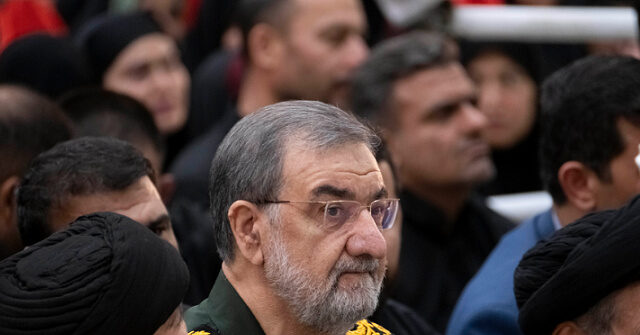
Iran’s top national security official on Sunday called Washington’s response to Tehran’s demands over the Strait of Hormuz “inadequate” and threatened to strike American-linked undersea communications cables, data centers, and artificial intelligence facilities across the region if war resumes. Maj. Gen. Mohsen Rezaei, secretary of Iran’s Supreme National Security Council, the powerful body overseeing the Islamic Republic’s national security and defense policies, delivered the warning as Tehran sought concessions from President Donald Trump’s administration despite an ongoing U.S. naval blockade and mounting economic pressure. Speaking to Iranian state broadcaster Press TV, Rezaei put the value of American-linked technology infrastructure in the region at more than $2 trillion and warned that those assets could become targets in another war. “The pulse of the American economy in this region runs through our part of the world,” he said, warning that previously excluded infrastructure, including undersea cables and artificial intelligence facilities, would be targeted if fighting resumed. The threat goes beyond earlier Iranian demands to impose fees on undersea communications cables passing through the Strait of Hormuz, raising the prospect of attacks on infrastructure supporting international communications, financial transactions, and technology services throughout the region. Rezaei’s remarks came as Tehran pressed Washington to accept seven conditions for reopening the strategic waterway and resuming negotiations, including lifting the American naval blockade and restrictions on Iranian oil sales. The Iranian official asserted that Washington had accepted some of Tehran’s demands but did not identify which ones, and the Trump administration has not publicly acknowledged agreeing to any of the conditions. “We are not in the process of responding to the Americans. They have responded to us, and we consider their response inadequate,” Rezaei said. He also insisted that Iran would not return to its previous negotiating framework, while maintaining that Tehran had not abandoned diplomacy. Trump had already rejected Tehran’s earlier proposal, which sought American concessions in exchange for reopening Hormuz, telling reporters, “I reject their proposal.” The president has nevertheless kept diplomatic channels open, describing recent exchanges with Tehran as “productive discussions” while maintaining the blockade and refusing to retreat from his demand that Iran be prevented from obtaining a nuclear weapon. Trump also said last week that he did not intend to launch new attacks against Iran before the November midterm elections, although he has repeatedly left open the possibility of renewed military action if negotiations fail. “We’re going to win,” Trump said during earlier remarks on the negotiations. “As far as I’m concerned, it’s going to be one way or the other. And it’s going to go pretty quickly.” The administration’s objections extend beyond Tehran’s demands over Hormuz to its refusal to make the nuclear concessions Washington considers essential to any broader agreement. U.S. Ambassador to the United Nations Mike Waltz dismissed Iran’s earlier proposal as a “garbage deal,” emphasizing that Trump would not accept an agreement allowing the regime to continue pursuing nuclear weapons. Vice President JD Vance similarly said last week that Tehran must meaningfully reduce its uranium-enrichment capabilities to secure an agreement. Iranian officials, however, have continued rejecting those demands. Mohammad Eslami, head of the Atomic Energy Organization of Iran, said Thursday that Tehran would neither relinquish its asserted right to enrich uranium nor surrender its existing enriched uranium stockpile. Asked whether Iran would abandon enrichment, Eslami responded, “Under no circumstances.” Meanwhile, Treasury Secretary Scott Bessent said Sunday that the administration’s campaign to cripple Iran’s economy had moved beyond maximum pressure to “absolute isolation,” as Washington seeks to cut off the regime’s remaining sources of revenue and access to international financial markets. Through Operation Economic Outcast, the Treasury Department has targeted Iran’s oil exports, shadow-fleet shipping network, and sanctions-evasion operations while tightening restrictions on the regime’s access to overseas assets. Bessent pointed to the halt in new Iranian crude shipments, the collapse of the rial, and dwindling foreign currency reserves as evidence of the mounting pressure on Tehran, describing an economy increasingly unable to sustain normal activity. The Treasury secretary suggested that continued economic isolation could ultimately force a breakthrough, comparing the uncertainty surrounding Iran’s future to the sudden collapse of the Berlin Wall. “I don’t know how this ends. You never know how this ends. The Berlin Wall just came down one day,” he said. Washington’s economic offensive is backed by a U.S. naval blockade that has sharply curtailed Iranian oil exports while allowing shipments from neighboring Gulf producers to continue. On Saturday, U.S. Central Command announced that an American fighter jet disabled the Panama-flagged cargo vessel M/V Ocean Molica, also known as Arika Sun, after it ignored repeated warnings and attempted to breach the blockade following its departure from an Iranian port. The precision strike disabled the vessel’s propulsion system without injuring its crew. Since the blockade resumed in July, CENTCOM has turned back 135 vessels, disabled four commercial ships, and destroyed ten tankers linked to the Islamic Revolutionary Guard Corps’ shadow fleet. Despite the blockade, Rezaei insisted Tehran would retain authority over the Strait of Hormuz, including the ability to impose charges related to shipping security, insurance, and environmental protection — conditions Washington has repeatedly rejected. Iranian forces have also threatened vessels using routes they consider unauthorized, amid additional attacks on commercial shipping through the waterway. The Islamic Revolutionary Guard Corps (IRGC) attributed several recent tanker incidents to vessels encountering naval mines, although those accounts have not been independently confirmed. Iran’s threats have also extended to American military forces as additional U.S. assets move toward the region. On Sunday, an IRGC spokesman posted an image depicting a missile system targeting an American aircraft carrier, accompanied by the message: “We are waiting.” The warning came amid reports of further American military deployments and continued preparations for possible operations against Iran, despite Trump’s decision to hold off on new strikes before the midterm elections. For now, Washington is maintaining its blockade and tightening economic pressure while leaving open the possibility of a negotiated settlement, with Trump making clear that the confrontation will ultimately be resolved “one way or the other.” Joshua Klein is a reporter for Breitbart News. Email him at jklein@breitbart.com. Follow him on Twitter @JoshuaKlein.
Iran Calls U.S. Hormuz Response ‘Inadequate,’ Threatens to Hit Undersea Cables, AI Centers if War Resumes
Full Article
Original Source
Read the full article at Breitbart →KhanList aggregates and links to publicly available news content. We do not host full articles from third-party sources. Always verify important information with original sources.