
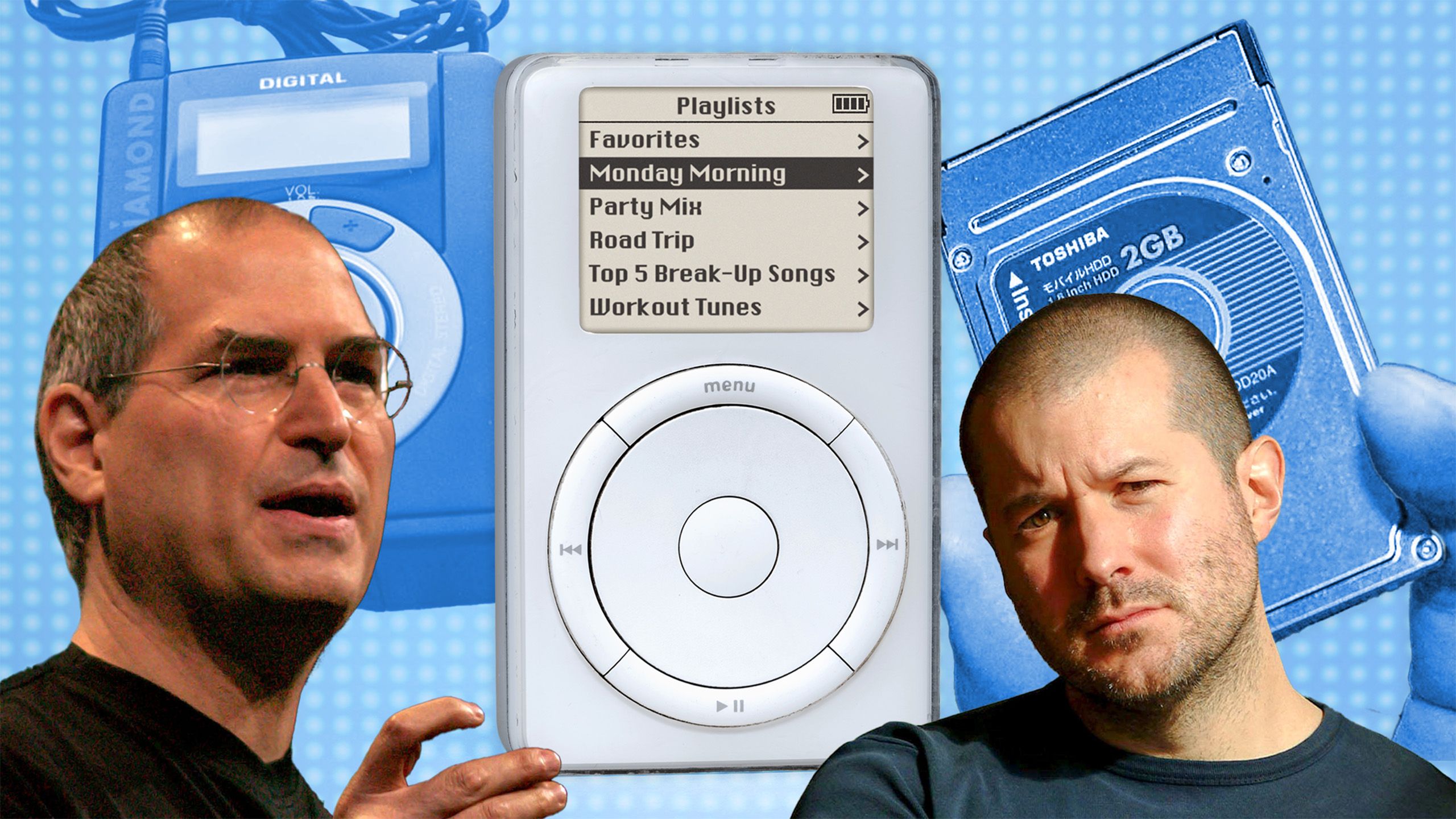
(Image credit: Tom's Guide/Getty/Shutterstock/Apple) The iPod is long gone now, but it was the product that turned around Apple's fortunes, got PC users to take the Apple brand seriously, established Apple as a player in mobile devices, and went on to revolutionize the music industry and lay the groundwork for the iPhone. And it did all of that in a tiny window of time, from its introduction in the fall of 2001 to the rapid rise of the iPhone beginning in 2007.Here are 25 things you might not know about how the iPod came to be, and its legacy. 1. Steve Jobs thought he missed his moment (Image credit: Mario Tama/Getty) In the year before the iPod began development, Steve Jobs introduced a whole new concept in order to sell Macs: the "Digital Hub." The idea was that a proliferation of new gadgets — most notably digital cameras and digital video camcorders — worked best when connected to a computer, and that meant a Mac. This was the origin of the iMovie app, which exists to this day. But despite Jobs's personal love of music, he never really noticed the rise of MP3s, Napster, and the new wave of MP3 players (like the Diamond Rio) that were hitting the scene. It was only in late 1999 that Jobs realized that he had been so focused on photos and video that he had missed the digital music revolution."I felt like a dope," Jobs told Fortune's Brent Schlender. "I thought we had missed it. We had to work hard to catch up." Apple quickly reached out to the developers of SoundJam, as well as another MP3 app called Audion, and made it clear that it was interested in bringing those developers to Cupertino to work on a crash project that became iTunes. 2. iTunes owes its life to an MP3 player, but not the iPod (Image credit: Shutterstock) Apple couldn't have made the iPod without iTunes, which performed most of the important tasks of organizing and syncing so that the tiny device didn't need as much brainpower or custom software. But iTunes wasn't built with the iPod in mind.Instead, former Apple engineer Bill Kincaid started building SoundJam, the app that would one day become iTunes, in order to let Macs sync with the Diamond Rio, an early MP3 player that held roughly a dozen songs. To help with the user interface, Kincaid enlisted former Apple intern Jeff Robbin, and the pair went on to create the app that formed the basis of iTunes. Jobs bought SoundJam, moved Robbin and Kincaid into an office a short walk from his own, and began the process of building an MP3 player jukebox app with Jobs's sensibilities in mind. 3. It all started with a hard drive (Image credit: Yoshikazu Tsuno/AFP/Getty) In 2000, Jobs decided Apple needed to build its own MP3 player. Early the next year, a bunch of Apple executives (including Jobs, marketing director Phil Schiller, and hardware chief Jon Rubinstein) were in Japan for Macworld Tokyo. Rubinstein took the opportunity to make a tour of Apple's suppliers, and at the end of a meeting with Toshiba, execs brought out a new product that they admitted they hadn't found any use for.It was an incredibly tiny 5GB 1.8-inch hard drive, much smaller than anything found in a laptop in those days. Rubinstein and operations exec Jeff Williams took one look at it and realized that it would be perfect for that MP3 player. Rubinstein called Jobs and said he needed a $10 million check to buy out every single drive Toshiba could make. Jobs was happy to oblige, and the trajectory of the iPod was sealed: it would be built around that little Toshiba drive. 4. Apple hired a contractor to run the iPod team (Image credit: Wei Leng Tay/Bloomberg /Getty) In 2001, Apple was a much smaller company than it is today, and it was intensely focused on turning around the Mac product line after years of stagnation before Jobs returned to Apple in early 1997. As a result, Rubinstein felt that he couldn't devote any of his senior people to the MP3 player project. Instead, he asked around Silicon Valley and ended up with a referral to a guy who had been trying to build portable devices (including MP3 players) at his own startup for a few years.Rubinstein reached that guy, Tony Fadell, when Fadell was on a chairlift, skiing at Vail. Fadell was intrigued, as he had worked with numerous early Mac legends earlier in his career at General Magic. But Rubinstein refused to tell him any details about what Apple wanted him to build until he took the job. Fadell signed on for an eight-week contract, and only then was told that he was going to be spinning up a team to build an Apple MP3 player. 5. The iPod's product manager tried to leave Eight weeks into the project, as the project was hurtling forward, Fadell expressed uncertainty about whether he wanted to keep working on the iPod or if he should go back to his startup. Rubinstein ended up demanding that he sign on as an employee right in front of the entire iPod team. Fadell agreed, but he also never forgave Rubinstein for putting him on the spot. The two executives would clash repeatedly over their tenures at Apple. 6. The iPod's killer feature also made it brutally incompatible (Image credit: Apple/Getty/Tom's Guide) In 2001, most computers used USB 1.0 for peripherals. But transferring MP3s at USB 1.0 rates was excruciatingly slow. Apple estimated you'd need ten minutes to transfer one CD's worth of music via USB. But not so with the iPod, which was built around the newer, much faster FireWire standard that was common on digital camcorders during that era. Most new Macs were shipping with FireWire, as well as a handful of PCs.FireWire could transfer an entire album in something like 30 seconds. It would have been excruciating to transfer 1,000 songs to the iPod at USB 1.0 speeds. The result was an incredibly fast syncing process with iTunes, and the optional ability to load your personal files on the iPod hard drive – but it meant that even if Apple built or licensed some Windows software to sync to the iPod, almost no PCs could connect to it.A couple of years later, the much faster USB 2 standard arrived, freeing the iPod from FireWire at last. 7. The iPod ran on someone else's operating system We're so used to Apple building and owning the whole widget, hardware and software. But Apple of 2001 was still trying to ship the first stable, usable version of Mac OS X while also keeping Mac OS 9 alive. It didn't have the time to build an entirely new operating system for the iPod, and certainly not if it was going to ship by the end of 2001.So Apple relied on a small Silicon Valley company called PIXO, which had built a tiny embedded operating system atop a processor built by a company called PortalPlayer. PIXO and PortalPlayer were creating products designed for portable devices, including figuring out how to use a spinning hard drive in a music player without skipping or killing the battery. (They came up with a clever system of buffering audio, then spinning down the hard drive until it was needed to fill the buffer again).The companies also had connections with other links in the digital music supply chain, introducing Apple to the Scottish company that would supply the digital-to-analog audio converter that fed the iPod's headphone jack. 8. The iPod was dumb, and iTunes was smart (Image credit: Apple Computer/Getty) With very little time to build an interface on top of the PIXO operating system, Apple made a fateful and smart decision: It offloaded as much of the work that went into building the iPod's music database and file organization as possible onto the connected Mac running iTunes. iTunes did all the heavy lifting and synced the results to the iPod, allowing the iPod software to remain relatively lightweight, and let Apple focus on building a pleasant interface on top of PIXO's software.The one drawback to this approach is that it meant that only iTunes could sync with the iPod, which meant it couldn't work even with Windows PCs with FireWire ports. Eventually it added support for Windows, first via MusicMatch Jukebox and later iTunes itself. 9. Fadell used a good/better/best approach to impress Steve Jobs When it came time to unveil potential designs to Jobs, Fadell took the advice of Rubinstein and revealed mock-ups one at a time, from worst to best. Fadell showed off a player with a slot, into which you could plug a spinning hard drive or a flash memory card. It ran on double-A batteries. Jobs thought it was too complicated.Next was something more like the Diamond Rio, a compact flash-memory based device, but with dynamic memory. If its rechargeable battery ever got too low, the memory would be wiped and you'd need to re-load all your songs. Jobs thought that was no good.Then Fadell assembled something very much like the iPod from an array of component parts already on the table, a bit like snapping together Lego. Jobs seemed intrigued by the result, at which point Fadell revealed something very much like the final iPod design, which had been hiding under a bowl on the table the entire time. Jobs was sold. (Image credit: Shutterstock) Jobs hated that the other MP3 players in the category were covered with buttons and hard to navigate. He felt that Apple needed to find a better way, especially if users were expected to load a thousand songs on the device.The answer was counterintuitive and pretty brilliant — the iPod's interface was driven by a wheel that you spun around, with a button in the middle that you'd click to select an item. The wheel was encircled by four other buttons to take you up a level, forward or reverse, or pause/play. It made driving the iPod's hierarchical interface easy and fast, which is what Jobs insisted on.What's funny about it is that the scroll wheel didn't come from Apple designer Jonathan Ive, or Fadell, or Rubinstein. It came from Apple marketing executive Phil Schiller, who had been inspired by a Bang & Olufsen land line he had at his house. Jobs loved it, and Fadell quickly agreed that the wheel could be part of his device. 11. To hide the iPod's design, Apple built a "Soviet rocket launcher" (Image credit: Panic Blog) Apple is famously secretive, and it didn't let even most employees working on the iPod actually see what it would look like. Instead, it created impossibly ugly plastic enclosures for its guts, which were mostly air inside. On the outside was a big wheel, a screen, and a bunch of buttons. Employees said it looked brutal and ridiculous, like a vintage Soviet rocket launcher. 12. The iPod is the reason Jony Ive loves the color white (Image credit: Paul Harris/Getty) The caricature of Jony Ive as a designer is that he was someone obsessed with minimalism, and usually appeared on Apple product videos inside an entirely white room. But in 2001, he was not that guy. Ive was the guy who had designed the original iMac, a very unusually shaped computer with translucent colored plastic. It was the opposite of minimal — it was meant to draw attention.But for the iPod, he took a different approach. Ive believed that the personal nature of the iPod, that it was a small thing you carried in one hand and slipped in a pocket, required an entirely different approach to an iMac. He wanted it to be "restrained, pure, and quiet." And that's what led him to white.But if it was going to be white, it was going to be really white. Jobs and Ive argued about exactly which shade, but once they settled, they also made sure that the headphones were entirely white — an Apple branding coup to this day. 13. The name is a reference to a classic movie (Image credit: Alamy) Nobody seems to remember the moment when "iPod" was picked as the product's name. The iPod's code name was P68, which is far from memorable. A group of execs and people in Apple's marketing department, as well as people from Apple's ad agency, kept meeting and throwing out ideas. Most of them were terrible.One name thrown out by Apple creative director Vinnie Chieco was, he said later, inspired by the fact that it was the year 2001, and in "2001: A Space Odyssey," the astronaut Dave Bowman famously orders the mad computer HAL to "open the pod bay doors" and let him fly his space pod back in. Pod – that sounded futuristic.Nobody really liked it. Schiller thought it sounded sinister, like the pod people from "Invasion of the Body Snatchers." But Steve Jobs thought it might work... with Apple's telltale lower-case letter "i" (introduced with the iMac) stuck on the front of it.In the run-up to the product launch, Jobs never seemed to truly embrace the name. But no other name came along that was better, so it stuck. 14. The manufacturer didn't even read the contract In a show of hardball supply-chain negotiating tactics that would become an Apple hallmark over the next two decades, Apple's potential manufacturer for the iPod was given no time to consider or even read its contract with Apple. Apple's ruthless supply executive, Tony Blevins, went to Taiwanese manufacturer Inventec, put a contract down on the table, and told them to sign it or lose the business.Blevins was probably a great poker player. Apple didn't have many alternatives to using Inventec. But rather than insisting on showing the deal to its lawyers, Inventec executives just signed the contract — and built the iPod. 15. The whole thing was done in less than a year Today it seems that we hear about new Apple products a couple of years before they arrive, at the very least. But Apple of 2001 was a much smaller and more nimble company.Still, the speed of the iPod's development is staggering when you think of it. In February, Rubinstein and Williams saw Toshiba's hard drive and got Jobs to write them a $10 million check. Apple announced the iPod eight months later, and shipped it nine months later. 16. Apple cleaned out Bay Area record stores to buy CDs (Image credit: Spencer Platt/Getty) When it came time to introduce the iPod, Jobs was concerned that Apple would be accused of furthering Napster-style MP3 piracy. In those days, digital music wasn't for sale online; you had to buy CDs and "rip" them to your hard drive... or just use peer-to-peer file sharing to download them for free.Apple planned on giving iPods to journalists who attended the event, but they realized that forcing journalists to find a FireWire-equipped Mac, install a prerelease version of iTunes that synced with the iPod, and convert their own music was asking a lot. So instead, every iPod came equipped with a selection of music.The problem was that Apple didn't have the right to load that music on those iPods. It came across as reinforcing the idea of the iPod as a piracy device.So instead, Apple dispatched its PR and marketing people to local record stores to buy multiple copies of every CD they were planning on pre-loading onto the iPod. The result: journalists didn't just receive a prerelease iPod when leaving the event, but a gift bag that also included a taped-together cube of CD jewel cases representing the albums that were preloaded on the iPod. 17. The product launch event was lightly attended due to 9/11 If you didn't live through it, you might not realize that the announcement and release of the iPod happened in the aftermath of the 9/11 attacks. And as a result, Apple's launch event on October 23 was lightly attended, with many international and even East Coast outlets declining to make anyone fly out to California. Apple managed to fill its Town Hall conference center with lots and lots of Bay Area journalists (Macworld magazine brought at least a half-dozen people, myself included) and a lot of Apple employees as well.The 9/11 attacks also affected the product's launch in November, since it was meant to draw people to Apple's then-new retail stores — but in that era, people were reluctant to go to shopping malls or other high-profile public places. 18. The guy from Smash Mouth played a prominent role in the product video (Image credit: Theo Wargo/WireImage/Getty) As was usual for the period, Apple's introduction included a lengthy demo from Steve Jobs, as well as a few pre-produced product videos. One featured Jony Ive extolling the virtues of its design — and yes, the color white — at length. Another, though, was essentially a proto-reaction-video of several professional musicians being amazed by what the iPod represented.If you know your 2000s music, you may not be surprised by the appearance of electronic artist Moby or pop singer Seal. You may be more surprised to see Steve Harwell, the late singer of the band Smash Mouth. But make no mistake: Harwell was a huge presence in Apple commercials during this period, including one introducing the concept of burning your own audio CDs. You may think the Internet has gotten worse in the last decade or two, but it was pretty bad even back in 2001. In the wake of the iPod announcement, a reader of the aggregation site Slashdot submitted a link to Macworld's coverage over the event with a summation of the product's features and prices.Famously, Slashdot editor Rob "CmdrTaco" Malda offered a one-line critique of the product: "No wireless. Less space than a [Creative Labs] Nomad. Lame."Sorry, Malda's going to have to live that one down forever. 20. It wasn't a hit… At first Because the original iPod didn't work with Windows, it was a strictly Mac-only product. The second-generation model added limited Windows support (which Steve Jobs allowed only under protest!), but you still had to have a PC with FireWire, which was rare. Only with the third-generation model, which supported USB, did the iPod take off. 21. The iPod halo effect was real and huge for Apple (Image credit: Bob Riha/Getty) To put it bluntly, the iPod completely rehabbed Apple's brand image. A company that was viewed as having seen better days, who made a computer that was incompatible with PCs and used by 5% of the computer-using population, was just too weird and sad. But then the iPod happened, and PC users fell in love with it, and once you love an Apple product, you start to wonder whether those computers Apple makes might be worth looking into — and oh, what luck — Apple happens to have a retail store in my local shopping mall.It was a huge swing in fortunes for Apple. Mac sales began to grow rapidly. And the entire thing laid the groundwork for the iPhone. 22. The iPod really only had five years as Apple’s golden child (Image credit: Justin Sullivan/Getty) It's stunning to think about it, but by the time the first USB iPod arrived, the iPhone was only four years away. The biggest hit iPod model, the iPod Nano, debuted two years before the iPhone was announced. If you lived through that era, it's hard to really conceive of how relatively quickly it came and went. But maybe it's better to burn out than to fade away?To be clear, iPod sales peaked in 2008 with 55 million sold, but the iPhone would blow past that number with 72 million by 2011. 23. The iPhone music app was originally called iPod (Image credit: Shutterstock) How big was the iPod? When Steve Jobs introduced the iPhone, one of its three primary features was to be a great iPod. So much so that the music app on the iPhone was, for several years, called iPod. Branding! 24. The iPhone used the iPod connector until iPhone 5 (Image credit: Shutterstock) Today's iPhones use USB connections, and for many years (from the iPhone 5 onward) they used the tiny Apple-designed Lightning port. But the first five iPhone models all shipped with Apple's iPod dock connector port on the bottom. It's just one of the many ways that the iPhone owes a lot of its legacy to its mobile-device predecessor. 25. My daughter might be the first "iPod Baby" Apple handed out those cubes of CDs and demo iPods to the press after the iPod launch event on October 23, but the product didn't ship to the public until November 10. In those intervening two-plus weeks, members of the press were pretty much the only people outside of Apple to have access to the exciting new music player.Something else happened during that brief window: My wife and I had our first child. (Yes, this means my daughter turns 25 this year, too.) And, yes, we built a playlist to play in the birth room, and brought the iPod along with a portable stereo with a cassette adapter that let us play the iPod out of some speakers into the room. I'm a little dubious if Apple would have let any of its employees out in public with an iPod before it was announced, which may mean that my daughter was the first baby to be born with an iPod in the delivery room. If someone else can beat that story, I don't want to hear about it. Jason Snell writes Six Colors (sixcolors.com) and co-hosts Designed in California (designed.fm), a podcast about Apple history that’s currently telling the story of the iPod’s origins.
iPod 25th Anniversary: 25 things you need to know about the product that changed Apple (and the world)
Full Article
Original Source
Read the full article at Tomsguide →KhanList aggregates and links to publicly available news content. We do not host full articles from third-party sources. Always verify important information with original sources.