
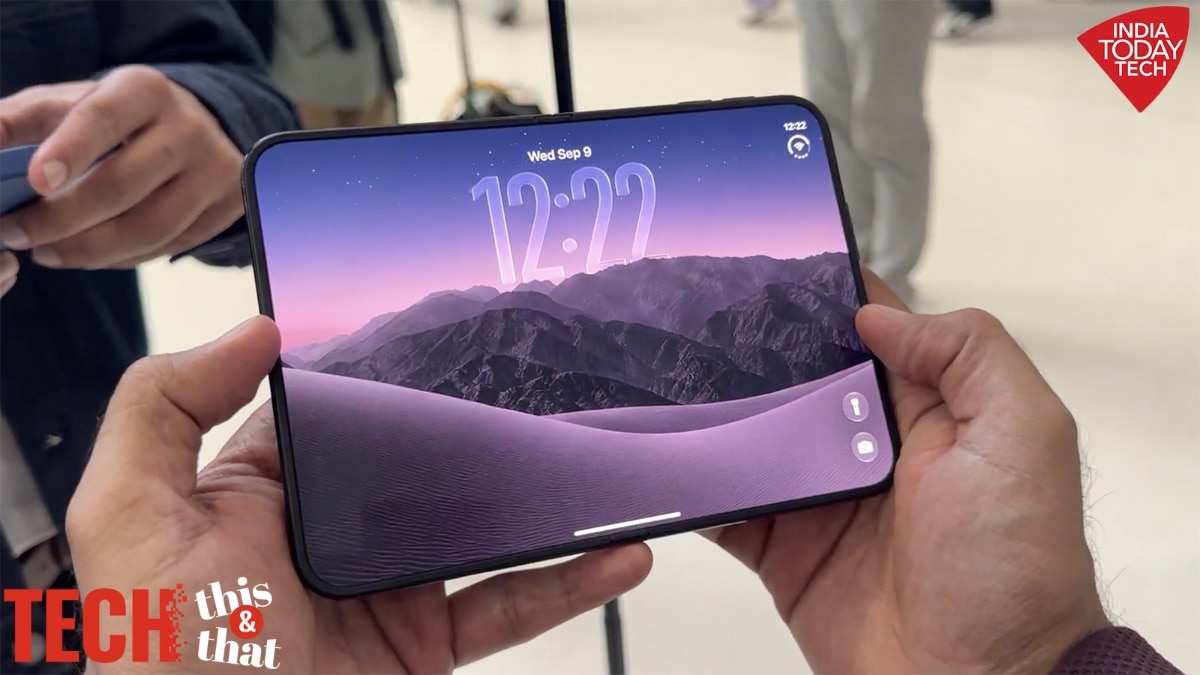
By now we know quite a lot about the Apple iPhone Duo. Yet, knowing about it and trying it in person are two very different things. Even if you know everything about the Duo, once it arrives on October 23, check it out at a nearby store. It will surprise you.The iPhone Duo is Apple's first-ever foldable iPhone, it goes on sale in India next month.Apple launched the iPhone Duo, its first foldable phone, on September 9. There were three phones launched that day — the iPhone Duo, the iPhone 18 Pro and the iPhone 18 Pro Max. Two of them, the 18 Pro devices, are now available in India as well as globally. The iPhone Duo, however, will be coming in a little late but just in time to capture, at least in India, the Diwali shopping season. It will go on sale in India from October 23.Over here at India Today Tech, we will have more to say about the device closer to its sale date. But recently I had a chance to see and briefly try the Duo in person. It is a remarkable phone, something that the world got a sense of on its launch day. But seeing and trying the phone in real is a different experience. It manages to surprise in several ways when you hold and use it irrespective of how well-prepared you are for it.Foldable phones are not new. Apple is actually late to the party. But this is not uncommon for Apple. It tends to wait instead of rushing in and once it comes in, it tries to use an approach that is somewhat different from what others are using.This is most clearly evident in the iPhone Duo, particularly in its design. Unlike the more common designs for the foldable phones — a tablet style or a flip phone style — Apple is using a pocket book design, complete with a straight spine and then rounded edges. Or a design that is closer to a thick passport. The rounded edges on the right part of the device make it stand out compared to other foldable phones and I have a feeling that many Android brands will follow this design in the coming months. As I tried the Duo last week, there were several things that made a mark on me. First let’s talk about the design. Apple says the passport size and shape means the phone fits in hands snugly and is extremely easy to carry and use in its folded state. This is largely true, although I believe that the phone may feel a bit broad if you have small hands. Regardless, the almost square form factor makes it fit in hands more naturally when you are walking with it, carrying like you would a pocket book or a passport. The iPhone Duo has same aspect ratio for the inner and outer displays. Beyond the shape that can fit in your hands comfortably, there is also a little bit of science — or rather maths — about the screen size and the shape of the iPhone Duo. The screens, the 5.4-inch outer as well as the 7.6-inch inner, have an aspect ratio that is square root of 2:1. In other words, the aspect ratio of 1.4:1. The special bit here is that the square root of 2:1 has a geometric property, which also governs the paper size of A3, A4 and A5. You can fold or divide this shape in half multiple times and the aspect ratio will always remain the same. This means on the iPhone Duo the aspect ratio of its outer screen is exactly the same as the aspect ratio of its inner display. It also means that apps can use the two displays in multiple ways by dividing the screen in half and still retain the same aspect ratio. There is a simplicity to the square root of 2:1 which developers as well as Apple can use in different apps, features, and user interface.Probably this is one reason why when you take the Duo out for a spin, the software and apps on it feel extremely cohesive. The uniform aspect ratio also means that Apple can implement with ease the kind of crowd-pulling interface animations that let the software transition from inner screen to outer screen or vice versa.But it is not just the uniform aspect ratio, and the resulting magic in the interface, that surprises when you pick the Duo and use it. The whole phone feels quite sophisticated, in ways other foldable phones in the market don’t. This is primarily because of two reasons.One, what I loved about the Duo the minute I picked it was its folding and unfolding mechanism. Apple is using magnets in the phone’s body to ensure that the phone folds with a satisfying snap. At the same time, these magnets are calibrated perfectly to ensure that you never have to pry open the device forcefully. Just like the software transition between the inner and outer display, the folding and unfolding mechanism too is seamless and utterly satisfying. It is, by far, the best folding and unfolding mechanism I have tried on a phone. The iPhone Duo has a passport-like form factor when folded. And two, it is the matte finish aka nano texture on the inner display that steals the show. Apple says it opted for a matte finish on the inner display because it wanted to reduce glare on a larger screen, which is often going to be used for content consumption. Irrespective of the reasons, the matte finish immediately tells the user that they are holding a phone that is more sophisticated and premium than other foldable phones in the market. It also, I believe, allows Apple to minimise the crease on the inner screen. It is fainter than I had hoped to see and barely visible unless you particularly look for it. It is, again in a pleasant surprise, barely noticeable under the finger as you glide across the screen. The Duo does not have a creaseless foldable display. But it is the closest to a creaseless experience I have seen so far in nearly 8 years of foldable phone history.The rest of the phone is typical Apple, but with the limits imposed by the unique foldable form factor. The hardware is top notch, or at least that is the impression it gives. The titanium body feels strong, and finishing is without any blemish. The software is polished, complete with a few unique tricks and animations that make use of the larger display in some clever ways.Inside the phone there is the powerful A20 chipset, and despite the extremely thin profile of the phone, the device seems to run cool and efficiently. The two cameras on the rear are not in the same class as the cameras in the iPhone 18 Pro, but this is a limitation that foldable phones are still trying to solve. On the inner display, the Duo has a camera that is under the display. Is it a compromise? We will see when we take a detailed look at the phone in a few weeks. But I believe it may come across as a compromise. Similarly, we will see how much the lack of Face ID will matter, or if the Touch ID — offered through the side button — will be able to compensate for it?Overall, the iPhone Duo looks like a fantastic package, almost prohibitively expensive but fantastic. Apple has done a few things differently compared to Samsung and others. But there is a logic behind them, and most notably Apple has done things in a way only it does — without restraint and without keeping the cost in mind. The folding and unfolding mechanism, for example, seems simple and effortless but there is a lot of engineering wizardry behind it. Same is the case for the matte finish on the inner display and that barely-there crease.Can the Duo, despite being a foldable phone, touch the hardware heights achieved by the iPhone 18 Pro series? I doubt it. But in many core areas it should match the Pro series. And in terms of experience, I have a feeling, the Duo will more than match and surpass all foldable phones we have seen so far.- EndsPublished By: Armaan AgarwalPublished On: Sep 22, 2026 09:57 IST
iPhone Duo quick review: Even if you know everything about Duo, it will surprise you
Full Article
Original Source
Read the full article at Indiatoday →KhanList aggregates and links to publicly available news content. We do not host full articles from third-party sources. Always verify important information with original sources.