
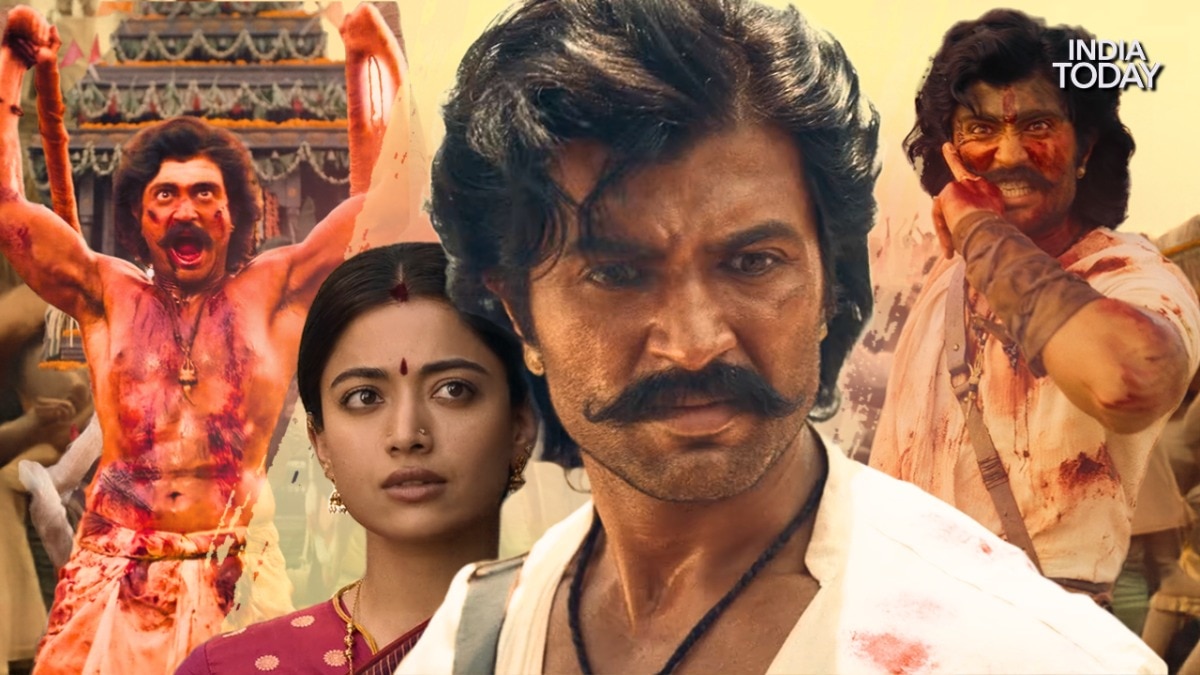
Indian cinema has always had a curious obsession with heroes who cannot be defeated. They can take on an entire army, walk into a hail of bullets and emerge with barely a scratch. They can be outnumbered, outgunned and surrounded, but the outcome is rarely in doubt. The hero will win because, well, he is the hero. Somewhere along the way, invincibility has become shorthand for heroism. The audience, however, has been saying, “Not anymore.”The obsession with the invincible messiah, the one-man warrior and the saviour of the masses raises a larger question: does a hero really need to be invincible to be heroic? The problem isn't necessarily that these characters are larger than life. It's when films confuse being destined to win with earning a victory. Vijay Deverakonda and Rashmika Mandanna's recent film Ranabaali offers a case study in how that distinction can make or break a hero.Set against the Great Madras Famine of 1876–78, Ranabaali opens with the birth of a prodigal son, destined to save the people of Rayalaseema, who worship the deity Bhadramallanna. Right from the get-go, a single scene establishes that Singanamala Bobbili Ranabaali (Vijay Deverakonda) is destined to become a fierce warrior who protects his people from a devastating future. It also establishes that he will die only after fulfilling this destiny.And so begins the problem: if the hero's survival is already written in the stars, how much danger can the audience really believe he is in? Ranabaali grows up to be a fierce fighter whose injuries in battle barely leave a mark on his body. Nothing can happen to him because of plot armour. Correction: prophecy armour. No amount of critical injury is enough to stop him. Even the henchmen out to get him stop after shooting two arrows, despite having immobilised him. They don't go for the kill. He is anyway invincible, so what is the point of wasting any more arrows? Let's approach the beast in close combat so he can maul us all to death, is what these genius henchmen must have thought. A still from the trailer of Vijay Devarakonda's Ranabaali, where the titular character is severely wounded (Photo: YouTube/T-Series Telugu) The problem extends beyond this scene. As the story progresses, Ranabaali barges into an enemy base, a British camp where the officers are armed with guns. That doesn't matter to our invincible hero because those bullets are no match for his majestic stallion, and he is as skilled with his sword as the Marvel mutant Deadpool, dodging and deflecting bullets aimed at him.And this keeps repeating throughout the film, like a loop. His invincibility when pitted against guns becomes almost universal: either the guns don't work, or the exploited workers of the British join hands with him. Not even once does a bullet so much as graze our mighty Ranabaali. These observations about the film's lack of even basic cinematic logic and its reliance on convenience and coincidence are not intended merely to ridicule it. They point to a larger problem: when a lead character's invincibility depends on everything except his own hard work, it comes across as plot armour rather than might. Of course, Vijay Deverakonda looks the part, and he performs it convincingly, too. But the problem lies less with the actor playing the character and more with the writer-director who created him.The problem with prophecy armour is that it takes the uncertainty out of a hero's journey. When a character's survival is guaranteed by divine intervention, at least until the main objective is achieved, every battle becomes less about the danger he faces and more about the spectacle the filmmaker can create around him. The audience is no longer wondering whether Ranabaali will survive a gunfight; it is waiting to see how he will walk away from it. The difference is crucial.Interestingly, Ranabaali offers glimpses of the character that could have been whenever the focus shifts from the warrior to the man. His growing dynamic with Rashmika Mandanna's Jayamma brings out a more human, likeable side to him. These moments give Ranabaali something his battles rarely do: emotional texture. They allow us to see a person with relationships, attachments and something beyond a prophecy to fight for.The irony is that the film comes closer to making him a compelling hero when it stops trying so hard to establish his invincible might. This is where the comparison with SS Rajamouli's Baahubali becomes interesting. Why did Rajamouli spend so much time establishing that both Amarendra Baahubali and Bhallaladeva became fierce warriors through rigorous training? Why did he have Mahendra Baahubali carry a huge Shivalinga or climb an entire mountain with nothing but his bare hands to showcase his might? Because strength, when demonstrated through effort, becomes part of a character's journey rather than a quality handed to him by destiny.Amarendra Baahubali, too, was an invincible character who had to be betrayed by Kattappa to be taken down. But his invincibility was never the only thing that made him shine. It was his heart, his nature and the way he treated people that made him a beloved figure. His strength was impressive, but so was his sharp mind, which came into play in battle strategies and set him apart from Bhallaladeva.Even Superman is invincible, but what makes him an interesting character is that he is vulnerable not only to Kryptonite but also to the heart beating within him that has become human, and to the people who have found a place in it. Without that emotional vulnerability, he would simply be a one-note alien wrecking machine with a weakness.Vulnerability does not make a hero weaker; it gives his strength meaning. A warrior who can be defeated must learn how to fight smarter. A leader who can make mistakes must learn to take responsibility for them. And a man who can lose someone or something he loves has a reason to fight beyond fulfilling a prophecy. These limitations create possibilities for conflict, growth and difficult choices. Without them, a hero risks becoming little more than a spectacle the story keeps moving from one fight to the next. Indian cinema does not need to stop making larger-than-life heroes. It needs to give them more life beyond the larger-than-life image. Ranabaali could have been a far more compelling character had the film explored what his strength cost him, where it failed him and what he had to overcome beyond the men standing in his way. A prophecy can establish that a hero is destined for greatness. It cannot, by itself, make that greatness worth watching.- EndsMUST WATCH:
Invincible hero, vulnerable story: What Vijay Deverakonda's Ranabaali gets wrong
Full Article
Original Source
Read the full article at Indiatoday →KhanList aggregates and links to publicly available news content. We do not host full articles from third-party sources. Always verify important information with original sources.