
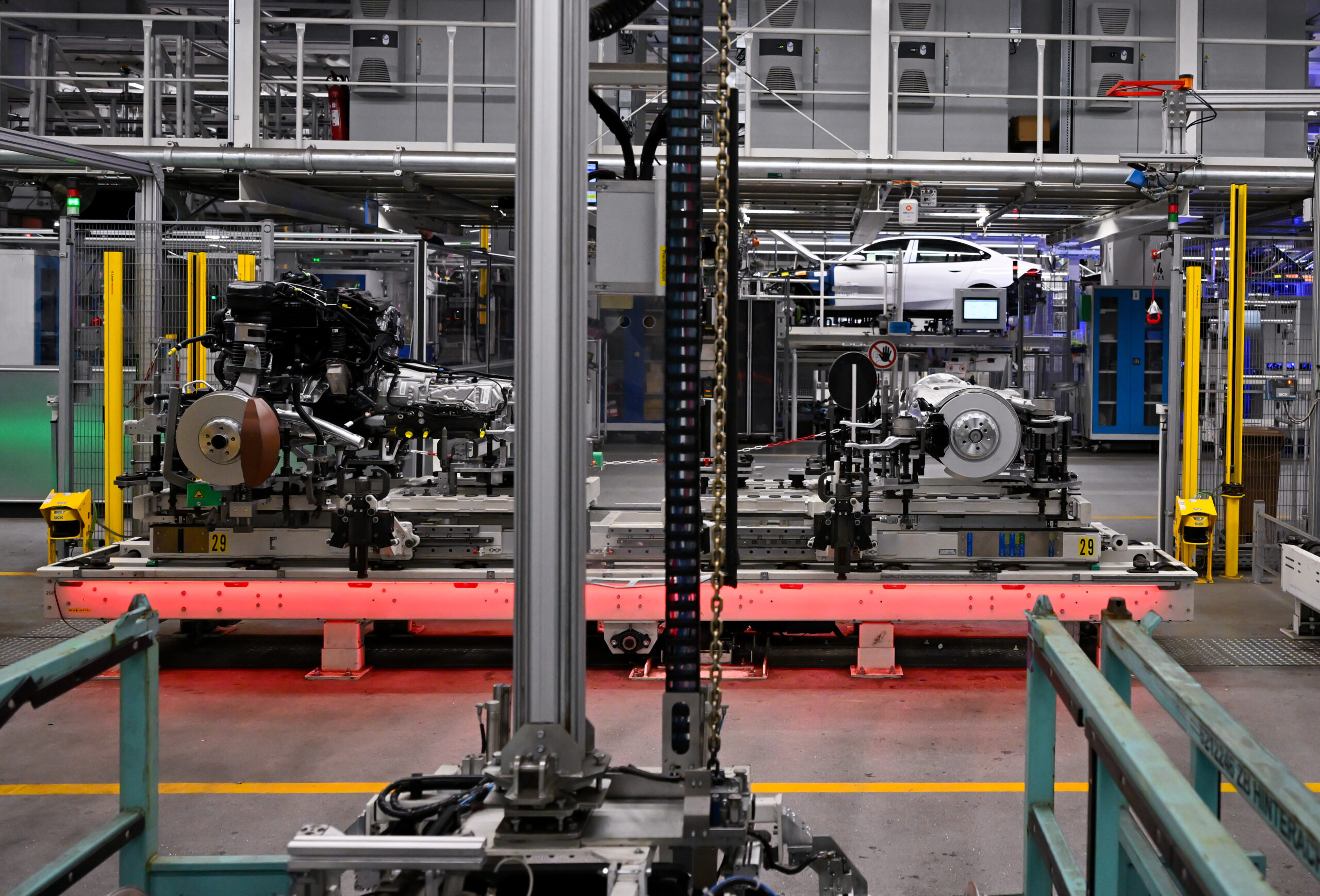
October 2, 2026 • 10:15 am ET Charles Lichfield This article is part of a series published by the Atlantic Council’s GeoEconomics Center examining how Central and Eastern Europe can navigate the profound shifts underway in European trade and industrial policy. Read the first and second installments. The striking drop of German investment in Central and Eastern Europe (CEE) points to a broader challenge: finding new sources of capital before the region’s manufacturing base begins to erode. To the credit of the eleven European Union (EU) member states in the region, neither weaker German investment nor slowing German demand for their exports has yet undermined their economic dynamism. CEE firms’ export competitiveness and resilient domestic consumption have so far more than offset these pressures. But without alternative sources of capital, the region’s manufacturing capacity could atrophy. Even worse, some alternatives could deepen the region’s already heightened exposure to geopolitical volatility. A familiar rule of thumb still holds when it comes to CEE’s investment stock. European firms built out their supply chains by investing in both existing and new factories, EU regional funds subsidized infrastructure modernization, and private equity has become increasingly interested in key energy infrastructure nodes and successful retail chains. That model, however, is beginning to shift. Opportunity is just next door As Western European capital becomes less dependable, CEE’s own investors offer a potential pool of financing. However, even as corporate lending to the region has declined and many Western European investors have left, CEE-to-CEE investment remains an underused resource. Local investors have picked up the slack as limited partners here and there, but their role remains limited and uneven across the region. The table above shows that investment into CEE-11 manufacturing and services originating from the CEE-11 represents a small 8.3 percent of all investments from the EU—and 6.4 percent of the total. One important caveat is that up to 10 percent of investments are carried out through Special Purpose Entities (SPEs) based in Luxembourg and the Netherlands in all countries except Hungary, where SPEs are used in over 60 percent of cases. But even accounting for this distortion, there is little evidence of a sustained increase in neighbor-to-neighbor investment. The figure exceeds 10 percent in smaller markets, either because they invest heavily in each other, as in the Baltics, or because the richer CEE markets have made onward investments into Slovenia, Croatia or Bulgaria. Romania stands out as a market with considerable room for growth: its CEE investment figure is low despite substantial potential for cross-border industrial and infrastructure projects. A closer look at the table below—showing where the CEE-11 invest—confirms this gap. Firms in less developed markets are understandably investing locally, but their capital is dwarfed by investments from further afield. Meanwhile, CEE’s core industrialized markets are mainly investing in Western Europe, including through SPEs that can sometimes channel capital back into CEE. Poland has the region’s largest outward stock, but it is heavily skewed west, while its investment in CEE remains largely domestic. Only Polish refining and petrochemical firm Orlen has been a regular investor in distribution networks in neighboring Czechia. Hungary appears more committed to the region, although its figures are boosted by OTP Bank, which started acquiring banks across the region in the early 2000s. Czechia appears to have diversified sharply away from the region in 2024, although data gaps—particularly in neighboring Slovakia, where Czech investors are active—make that shift look larger than it may actually be. None of this means CEE firms should be discouraged from investing elsewhere, or that regional investment should be assigned a quota. Czech firms’ investment in Western Europe, for example, is a sign of growing international reach. The missed opportunity is that regional investors could do more to shape how CEE’s manufacturing capacity adapts to falling demand from traditional German buyers and develops new outlets across the Single Market.Investors in Western Europe and further afield are also responding to this opportunity. Non-EU capital accounts for 19 percent of the region’s inward stock, although China’s share is considerably smaller than the commentary around Chinese investment suggests. Most of the flow comes from North America and “friendly” Asian markets, including US private equity firm GTCR’s €4.1 billion purchase of pharma company Zentiva and Canada’s Couche-Tard’s $8.6 billion offer for the Żabka retail network in Poland. The problem is that Chinese investment is heavily concentrated in the manufacturing sectors now suffering from weak German demand. CATL’s €7.3 billion battery plant in Debrecen, Gotion’s plant in Slovakia, and BYD’s car factory in Szeged, Hungary, are prominent examples. These facilities all sit inside the Single Market, shielding their owners from whatever tariff wall Brussels builds next. The chart below also shows that EU-based assembly units for Chinese brands rely on inputs imported from China—a challenge that the EU’s Industrial Accelerator Act (IAA) will have to address head-on. Rebooting investment frameworks The looming EU funding debate adds another layer of uncertainty. The Visegrad Four will rightly argue that their outsized contribution to Europe’s manufacturing capacity warrants ongoing investment in competitive energy and faster, more loadbearing transportation. But with usually friendly capitals like Vienna pushing for lower budgets, and Czechia and Poland moving into the richer half of EU members, CEE should prepare for a less generous flow of regional funds. Income from investments made in Western Europe will partially offset this through the balance of payments, confirming that CEE investors are right not to keep all their chips in the region. But that is hardly a substitute for investment in the infrastructure on which the region’s industrial model depends. The longstanding quest for North-South connectivity inside the region remains valid. What is failing are the schemes meant to crowd private capital into these projects. Announced with much fanfare in 2016, the Three Seas Initiative (3SI) has delivered only fourteen projects. Slovakia, a crucial manufacturing hub and one of the economies most exposed to Germany’s crisis, illustrates the problem. The EU Commission’s under-celebrated Juncker Plan successfully deployed €643 million in EU guarantees to mobilize €2 billion in Slovak investments on a fully commercial basis. Slovakia’s direct share of the 3SI commercial fund, by contrast, is limited to a handful of green energy acquisitions, with no transport infrastructure projects to show for it. Where can the region turn instead? Poland’s reported €400 billion infrastructure budget gap before 2040 and Romania’s €100 billion gap are difficult to square with the countries’ high fiscal deficits. But the problem is not a lack of investor interest. The Japan Bank for International Cooperation’s recently opened Warsaw office, for instance, as well as the fact that 28 percent of the total amount deployed by Gulf funds in 2025 went into the region, demonstrate that international capital is available. Governments will therefore need better-tailored crowding-in schemes, with a tighter regional or sectoral focus. A more deliberate strategy CEE must do its part to save what can be saved of Europe’s auto supply chain, preferably in tandem with European firms rather than relying on Chinese investment. The risks of welcoming foreign direct investment without question are increasingly obvious, but the region will never have a uniform policy, and there is little point pretending otherwise. Even the capitals that broadly agree on the security implications have struggled to coordinate. The Balts and Poland are the security “hawks,” joined by Czechia increasingly often, but different market sizes and a shared need for capital have prevented them from turning that common position into collective leverage. Yet there is still low-hanging fruit to be had from a tougher approach, especially with regard to local workforce development and technology transfer. Engaging seriously with the proposals under discussion for the IAA should be a priority. Embracing the IAA would also help manufacturers pivot into adjacent sectors if Germany’s industrial malaise continues. Precision machining and power electronics are readily transferable to grid equipment, transformers, cabling, and rolling stock—all markets that should be allowed to benefit from the IAA’s “Buy European” provisions. New data centers need not be concentrated in Western Europe either. Impressively, Romania accounts for over 40 percent of the CEE region’s upcoming rack capacity, making the semiconductor ecosystem around this investment worth developing. Czech and Polish clusters already have depth in photonics and specialty materials. The European surge in defense spending is often put forward as the answer to CEE’s industrial challenges, but this is misleading. Germany’s rearmament will require some metals and chemicals the region can provide, but the new target to spend 3.5 percent of GDP on defense will not go entirely toward new kit, and procurement for finished goods is likely to favor German providers. In fact, Poland’s procurement alone, at nearly 5 percent of GDP, is almost more promising for the region. The CEE-11 should aim to nurture the manufacturing base they host, offering it the funding, energy, and infrastructure it needs to pivot to the right sectors as barriers around the Single Market are likely to grow higher, at least against China. More nimble investment frameworks, combined with a more deliberate use of EU screening standards to safeguard jobs and secure new technologies, could help the region preserve its industrial base, continue to prosper, and increase its geopolitical heft. Charles Lichfield is the director of economic foresight and analysis and the C. Boyden Gray senior fellow at the Atlantic Council’s GeoEconomics Center. At the intersection of economics, finance, and foreign policy, the GeoEconomics Center is a translation hub with the goal of helping shape a better global economic future. Image: A BMW powertrain is on display at a BMW plant. Source: REUTERS.
Investing in Europe’s next growth engine
Full Article
Original Source
Read the full article at Atlanticcouncil →KhanList aggregates and links to publicly available news content. We do not host full articles from third-party sources. Always verify important information with original sources.