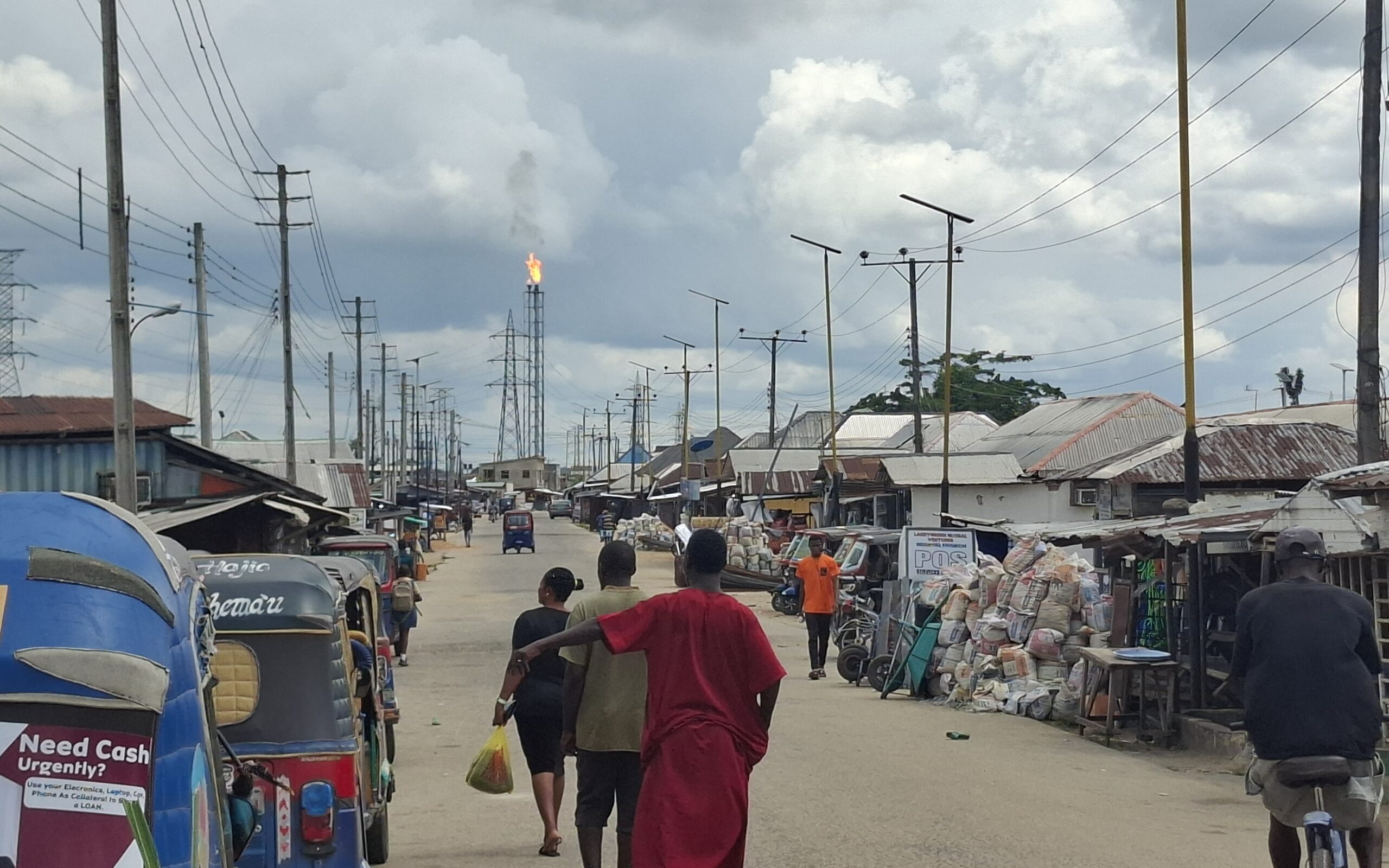
The journey to Akata begins where the road ends. From Atabrikang, a visitor boards a speedboat and travels for about 30 minutes through winding waterways before reaching the fishing community in Ibeno Local Government Area of Akwa Ibom State. The community sits between the Atlantic Ocean and the Qua Iboe River. For generations, the water sustained almost everyone here. That memory is still fresh for Monday George. As a young fisherman in the early 2000s, he targeted octopus. The shallow coastal waters were rich, and the market was good. “There was plenty,” he recalled. “We caught octopus regularly, and we had different types of fish. Back then, if you worked hard, fishing could take care of your family, and you could consider yourself rich.” Monday George The work paid enough for him to marry early and support his growing household. Around 2010, he said, he contributed N40,000 every week to a local thrift scheme. “At that time, that was serious money.” Today, he laughs when reminded of it. The laughter is not because it is funny, but because it sounds like another lifetime. According to him, things started changing around 2012. Fish catches declined. Water temperatures seemed higher. Species that had been common for decades gradually became difficult to find. “We started noticing that the water was no longer as cold as before. The octopus reduced first. Then other fish started disappearing,” he said. Many fishermen now return with little or nothing. “It is only bonga that we catch easily now. The bigger fish have moved farther away,” Mr George said. Reaching those fishing grounds requires more fuel, larger boats, and greater risk. Many, including Mr George, cannot afford it. Now, he no longer contributes to any thrift scheme. He said his concern now is feeding his four children. “There are days I go out and come back with nothing.” What is unfolding in Akata is, at its heart, a methane story. The warming waters, the failing catches and the eroding shoreline are the local face of a climate crisis that methane is helping to accelerate. The gas is escaping from oil and gas operations that surround these communities. “For communities living near oil and gas facilities, methane is not an abstract climate issue,” said Country Manager for Nigeria at the Natural Resource Governance Institute (NRGI), Tengi George-Ikoli. “It is connected to the air they breathe, the health risks they face, the quality of their farmland and fishing waters, and their everyday experience of living alongside extraction activities.” Deadly search for fish For some fishermen, the collapse of catches in shallow waters has forced a move into deeper parts of the Atlantic. That decision cost one family dearly. Papa Sam still struggles when speaking about his older brother, Udeme. For years, both men fished in coastal waters until Udeme decided to try deeper offshore grounds. “He said he was tired since the fish near us were no longer enough,” Papa Sam recalled. Papa Sam Around November 2024, Udeme began venturing farther out to sea; his catches improved almost immediately, and his family started rebuilding financially. Then, in March 2025, he died while fishing offshore. “He wanted to survive,” his brother said, his voice low and suddenly strained as he fought back tears. “Now I am taking care of his six children.” Where houses once stood In Akata, the environmental changes are visible beyond the unproductive water for these community members, who are predominantly fishers. Near the shoreline stands a ruined structure destroyed by the sea tides. Residents identified it as the former health centre. Ruined Primary Healthcare Centre block with water tank by the sea coast A damaged water-tank stand still rises above the rubble, and community members say both structures once stood safely inside the village. Now the Atlantic surrounds them. Gloria Thomas, a princess of the community, walked PREMIUM TIMES through the area. She pointed towards open water. “People lived there. Hundreds of houses were there,” she said. The ocean has since claimed them, and according to residents, severe coastal erosion and rising sea levels accelerated around 2013. The destruction has had consequences beyond housing, as the community lost its only health centre and a private school. Today, many children in the community are out of school because their parents cannot afford a daily one-hour boat ride to and from school. PREMIUM TIMES reported that Akwa Ibom State has a high prevalence of out-of-school children. In Akata, a medical emergency begins with a 30-minute boat trip as residents must first travel by water before continuing by road to access healthcare. “We have lost many lives, especially pregnant women,” Ms Thomas said. The encroaching ocean, driven by climate change, has also split what was once a single community into two sections, now known locally as Akata I and Akata II. Land has become scarce, leading to increasing disputes, while many families unable to cope have left the community. “There is hardly anywhere to farm now. Some people had no option except to relocate,” she said. Flares on the horizon Akata lies within waters that host major oil and gas assets. Among them are OMLs 67, 68, 70, and 104, which were recently acquired by Seplat Energy from Mobil Producing Nigeria. Oil production in the area dates back to 1970. For decades, gas has been flared during petroleum operations. Flaring is the most visible sign of how that gas is handled, but it is not the only way. When associated gas is flared efficiently, most of its methane burns off, converting to carbon dioxide. When flares burn poorly, or when gas is vented or leaks before it ever reaches the stack, raw methane escapes directly into the atmosphere unburned. When PREMIUM TIMES visited the area, flare stacks were visible from several locations within the shallow waters. Across the Akata community, at the Qua Iboe Terminal in Mkpanak, thick, dark smoke rose from a flare. The plume remained visible from kilometres away. Gas flare from QIT Terminal In Mkpanak, residents told PREMIUM TIMES that they can no longer drink rainwater because it is usually contaminated with soot. Residents said that nose soot, eye irritation, chest discomfort, and breathing difficulties have become common complaints. Several community members said they frequently experience itchy eyes, persistent coughs and episodes of breathlessness, particularly during periods when emissions and flaring activities appear more intense. “I use cotton wool to clean my nose from time to time. Yet, the soot I bring out is terrible. Others experience the same. As a result of the flare, chest pains are common here,” Aniebiet Nathaniel, whose shop is across the QIT, said. Aniebiet Nathaniel PREMIUM TIMES recently reported how gas flaring has turned some Akwa Ibom oil communities into furnaces. To better understand these claims, PREMIUM TIMES visited the primary healthcare facility serving the Mkpanak community. At the health centre, the officer-in-charge, Hope Samuel, said respiratory-related complaints are among the conditions regularly seen by health workers. “Each month, we have at least four to six cases of difficulty in breathing and tightness of the chest,” Ms Samuel said. “Those are only the people who come here. Many others treat themselves at home and do not report to the health facility.” Data reviewed from the National Oil Spill Detection and Response Agency’s gas-flare tracker showed dozens of flare locations scattered across territorial waters connected to Akwa Ibom’s coastline. The same data indicate that the former Mobil assets flared approximately 130.7 million standard cubic feet of gas between 2021 and 2023. Infographics on gas flare & Methane data of Mobil But Akata’s fishers and residents at Mkpanak are surrounded by more than one operator. Beyond the former Mobil assets now owned by Seplat Energy, the waters around the community are also home to OML 99 and OML 100, operated by TotalEnergies. From the shoreline, community members pointed towards two offshore facilities they identified as belonging to the company. PREMIUM TIMES could not independently verify ownership from the beach. Yet what communities see is the flames, the smoke and the soot. It is the only visible part of the emissions story. The emission with the greatest climate impact is one they cannot see at all. Scientists have highlighted the dangers of methane, an invisible greenhouse gas released through venting, leaks, equipment failures, and incomplete combustion during flaring. Methane traps more than 80 times as much heat as carbon dioxide over a 20-year period, and unlike smoke from a flare stack, it often escapes unnoticed. Because it is invisible, methane has long escaped the scrutiny that visible flaring attracts. But that is beginning to change. “Methane is one of the most powerful greenhouse gases driving near-term warming,” said Ms George-Ikoli. “It is also becoming an economic issue. “New international regulations, including emerging methane requirements in major export markets such as the European Union, mean that countries and companies will increasingly be judged not only by what they produce, but by how they produce it.” Unlike some operators, TotalEnergies has publicly outlined methane-reduction and gas-flaring commitments. On its website and in public disclosures, the company says it ended routine flaring on OML 100 in December 2023 and achieved zero routine flaring across its upstream operations in Nigeria. The company also says it has deployed its Airborne Ultralight Spectrometer for Environmental Applications (AUSEA), a drone-mounted technology designed to detect and measure methane emissions from oil and gas facilities. Ahead of the COP28 climate summit, TotalEnergies announced a cooperation agreement with the Nigerian National Petroleum Company Limited to conduct methane-detection campaigns using the technology across facilities in Nigeria. The company described the initiative as part of efforts to identify leaks, improve emissions monitoring and reduce methane releases. When PREMIUM TIMES visited the area in early June, no visible flare was observed from the offshore facilities identified by residents as belonging to TotalEnergies, in contrast to flare activity seen elsewhere in the region. Oil facility alleged to be operated by TotalEnergies captured from the beach However, several questions remain unanswered. This newspaper requested from TotalEnergies, through a media enquiry, details of methane emissions detected through AUSEA surveys in Nigeria. This included whether the technology identified previously unknown leaks, venting points or emission sources; what quantities of methane had been measured; whether the findings differed from conventional emissions inventories; what corrective actions followed the surveys; and whether the results had been submitted to the Nigerian Upstream Petroleum Regulatory Commission (NUPRC). PREMIUM TIMES also requested copies or summaries of independent verification reports relating to greenhouse gas emissions from OMLs 99 and 100 and asked whether the company intends to make methane-monitoring results publicly available. TotalEnergies did not respond to our enquiry. The absence of a response does not invalidate the company’s publicly stated commitments. However, without disclosure of underlying data, survey findings, verification reports or asset-level methane inventories, it is difficult to independently assess the effectiveness of those commitments in the waters where communities such as Akata live with the consequences of a warming climate. Yet, concerns raised are echoed elsewhere, about 280 kilometres from Akata and Mkpanak communities. Seven years without a child More than 280 kilometres from Ibeno, in the Ogboinbiri community in the Southern Ijaw Local Government Area of Bayelsa State, another resident worries about something she cannot see. Two flare stacks burn continuously near the community. Their glow dominates the night sky. Gas flare from two flare stacks at Ogboinbiri It requires a long journey through creeks and river channels to reach the Ogboinbiri community, which sits within OML 63, one of the former Nigerian Agip Oil Company assets acquired by Oando Energy Resources. According to Oando, OML 63 is the second-largest license in its portfolio in terms of reserves and production. It comprises several producing fields that have been developed since exploration began in the early 1970s. Visibly ageing, corked oil wells stand near the community entrance. PREMIUM TIMES counted five. Visibly ageing corked oil wells at Ogboinbiri Ebieredi Daniel lives roughly a 10-minute walk (783 metres) from the production site, where two flare stacks burn. Ms Daniel has been married for seven years, yet she has never conceived. Infographics on gas flared by Oando on OML 63 “There was pressure at the beginning since people talk when a woman does not have children,” she said. Medical tests conducted at different facilities repeatedly produced the same diagnosis: hormonal imbalance. Initially, doctors never told her that gas flaring or methane emissions occurring near the oil production site caused the condition. But when she discussed the environment around her home, she said they told her it could significantly contribute to her challenge. Scientific literature has examined connections between environmental pollutants associated with oil and gas activities and reproductive health outcomes. A 2025 Oxford Academic review on climate change and reproductive health noted that endocrine-disrupting chemicals can interfere with hormone signalling, fertility and reproductive development through multiple biological pathways. For women like Ms Daniel, those scientific findings feel painfully personal. But one experience continues to haunt her. A friend facing similar reproductive challenges relocated from the community and months later became pregnant. “She called me and said she was six months gone. I pray one day I can also leave,” Ms Daniel said. We keep hearing the same thing- hormonal imbalance Faithful Fineman, a woman who lives a few poles from the flare site, said women in Ogboinbiri regularly discuss fertility challenges. Some have experienced repeated miscarriages, while others struggle to conceive. “The complaint we keep hearing is hormonal imbalance. When women go to hospitals, that is what many of them are told. But when they leave and stay elsewhere, they give birth,” she said. Faithful Fineman She also remembers a time when local waters provided an important source of income. Water snails once thrived in nearby creeks, and women harvested them in large quantities and sold them in local markets. Today, they are increasingly scarce. “We used to get them easily, but now we go farther away,” she said. Even when snails are collected elsewhere and brought home, she said, many die before market day. “The environment is hotter now,” she said. For families already struggling with declining livelihoods, every loss matters. Farmlands left behind Ebi Aaron, a cocoyam farmer in Ogboinbiri, no longer farms the land he inherited from his father. The heat, he said, has changed everything. Ebi Aaron Years ago, cocoyam flourished near the community, but today, he rents farmland elsewhere, which has increased his costs. “I have seven children, and when you add my wife and me, we are nine people,” he said. The extra travel, rent and labour have become part of everyday survival. “The stress has made me look older than my age,” Mr Aaron said. The concerns raised in Ogboinbiri are echoed elsewhere in Bayelsa. Under the glow of fire In Obunagha community in Yenagoa Local Government Area of Bayelsa, residents live close to facilities within OML 28, an asset formerly operated by Shell and now operated by Renaissance Africa Energy, following the completion of the asset acquisition in 2025. At night, gas flares illuminate the sky above the community. Braibi Jack, a single mother of three, complains that the money she spends on buying clean water for her household consumption drains a significant part of her earnings. Gas flare at Renaissance facility at night “The rainwater here is always black because of the gas flare. We can’t use that to wash, not to mention cooking or drinking. So, each day, I spend at least N800 on water. Multiply that by 30 days. Is that good for someone whose salary is N40,000 a month?” She asked. For Winner Eneni, a resident of Obunagha, one of the most visible effects is the rapid deterioration of corrugated roofing sheets. “If you don’t change the roof within five or six years, it starts leaking,” he said. “The flare corrodes it.” He worries about what prolonged exposure could mean for human health. “If it can damage iron this quickly, imagine what it is doing to people breathing it every day. The heat alone causes sleepless nights and other skin discomfort”. In Rumuekpe in Rivers State, for instance, the flare has disappeared, but the question is: where did the gas go? Rumuekpe offers a glimpse of what residents say happens when flaring and other oil operations stop. The community, located within OML 22, hosted facilities where flaring occurred for years. When PREMIUM TIMES visited in April, the flare stack was no longer burning, and grass covered the areas that residents said were once barren from exposure to intense heat. For farmer Willicent Obio, the difference has been immediate. Before now, he rented farmland in neighbouring communities because crops struggled near the flare, but today he farms at home again. “You can see the difference yourself,” he said. Nearby, Caroline Elems, a resident of Rumuekpe, said that nights have become easier and that people sleep better. She said farm yields have improved, and even fish are returning to nearby waters. “Before, everything suffered. The crops would dry up,” she said. Now cassava grows where many residents had long stopped planting. Men have begun setting fish traps in wetlands that had become largely unproductive. “The fish are coming back. Even some places that looked dead before are alive again,” she said. “We do not need a scientific report to tell us there was a problem.” For residents, the end of the flare has been an unambiguous relief. From a methane standpoint, however, the more important question is what became of the gas that was once burned. If the associated gas is now captured and put to use, both flaring and methane emissions have been curbed. But if a flare is simply switched off while the gas is vented unburned, or escapes from idle equipment, methane emissions can actually rise, because a flare at least converts most methane into less-potent carbon dioxide. Without monitoring data at the site, the improvements residents can see and feel cannot, by themselves, confirm that methane emissions have decreased. Nigeria’s methane promises Nigeria has made some of the most ambitious methane-reduction commitments in Africa. That ambition sits alongside another. “Nigeria is currently pursuing two ambitions at the same time,” Ms George-Ikoli observed. “On one hand, we are seeking to expand gas production and position gas as a key part of our economic and energy future. On the other hand, we have made significant commitments to reduce methane emissions, eliminate routine gas flaring, and contribute to global climate goals.” The challenge, she said, “is whether these ambitions can be delivered together, and at what cost if they are not.” The country is a signatory to the Global Methane Pledge and has committed to ending routine gas flaring by 2030. Under its updated Nationally Determined Contributions submitted to the United Nations climate framework, Nigeria also plans substantial reductions in methane emissions from oil and gas operations. The target is a 60 per cent reduction in methane emissions from the sector between 2031 and 2035 and a 95 per cent reduction in fugitive methane emissions by 2050. Infographics- Methane Emissions are rising among major operators To support those targets, the NUPRC issued the Guidelines for the Management of Methane and Greenhouse Gases in the Upstream Oil and Gas Sector in 2022 and followed up with the Gas Flaring, Venting and Methane Emissions (Prevention of Waste and Pollution) Regulations, 2023. The regulations require operators to maintain methane-emissions inventories, establish Leak Detection and Repair programmes, submit Fugitive Methane Emission Data, keep daily flaring and venting records, and develop Flare Elimination and Monetisation Plans aimed at ending routine flaring. Yet, nearly three years after the regulations came into force, the regulator itself has acknowledged significant challenges in methane measurement and reporting. In a directive issued on 11 April, NUPRC said it had observed “technical capacity limitations and infrastructural MRV gaps” during implementation of the methane guidelines. Infographics of Gas flare by Renaissance at Yenagoa MRV refers to measurement, reporting and verification systems used to quantify greenhouse gas emissions. The commission said the gaps had affected implementation and prompted it to organise targeted workshops and industry guidance sessions to improve operators’ capacity to measure and report methane emissions accurately. To address the problem, NUPRC directed operators to adopt standardised templates for Greenhouse Gas Emissions Management Plans and emissions inventories. It also instructed companies to report emissions using the Intergovernmental Panel on Climate Change Tier 2 methodology starting in the third quarter of 2026 and to transition fully to higher-accuracy, measurement-based Tier 3 systems by January 2027. The directive is important because it highlights a central challenge confronting methane regulation in Nigeria: many emissions remain estimates rather than direct measurements. For NRGI, that gap between rules and results is the heart of the matter. “Progress on paper is not the same as progress in practice,” Ms George-Ikoli said. “The real test lies in implementation. Are commitments being met? Are emissions being measured accurately? Are regulations being enforced consistently? And most importantly, are the experiences of affected communities reflected in the decisions being made?” The Petroleum Industry Act goes further. It prohibits routine flaring and venting and requires operators to submit plans explaining how emissions will be reduced and eventually eliminated. The Gas Flaring, Venting and Methane Emissions (Prevention of Waste and Pollution) Regulations, 2023, established detailed compliance obligations. Infographics Mandatory actions by Oil & Gas companies on methane abatement Among other requirements, operators must submit Flare Elimination and Monetisation Plans, maintain Fugitive Methane Emission Data records, prepare methane inventories, keep daily flaring logs and implement leak-detection programmes. The regulations also require approved plans to be tied to enforceable implementation milestones. Among the companies examined in this investigation, TotalEnergies was the only operator found to have publicly articulated methane-monitoring initiatives and specific commitments relating to routine flaring and methane abatement in Nigeria. READ ALSO: Gas Flare: Foundation trains Akwa Ibom oil community on how to demand environmental remediation A review of public disclosures, company websites, and available sustainability documents did not identify any comparable asset-specific methane-reduction commitments from Seplat Energy or Renaissance Africa Energy for the operations covered in this investigation. That distinction makes the lack of a response more significant. Public commitments are important. Yet evidence demonstrating progress is even more important. However, without robust monitoring systems, independent verification, and transparent disclosure, it becomes difficult for regulators, communities, and the public to determine how much methane is being released, where it is coming from, and whether reduction targets are being achieved. These gaps formed a central part of PREMIUM TIMES’ enquiries to oil companies and regulators. Questions that remain unanswered To determine whether these obligations are being met, PREMIUM TIMES sent detailed enquiries to Seplat Energy, Oando, Renaissance Africa Energy, TotalEnergies and NUPRC. The newspaper requested methane-emission inventories, Fugitive Methane Emission Data reports, annual gas-flaring volumes, flare-efficiency records, methane-slip estimates, leak-detection reports, flare-elimination plans, milestone agreements, environmental assessments and regulatory compliance records. Seplat was specifically asked to explain why methane emissions reported by the former Mobil assets increased from 223.6 million metric tonnes of CH₄ in 2022 to 256.3 million metric tonnes in 2023, according to figures contained in Nigeria Extractive Industry Transparency Initiative disclosures. The company was also asked how much of those emissions came from fugitive leaks, venting and flaring, and what measurable reductions had been achieved since then. Distance between the Oando’s oil facility and Ebieredi Daniel’s home Oando and Renaissance were asked to provide evidence of compliance with methane-monitoring, reporting and flare-reduction requirements across assets now under their control. NUPRC was asked whether operators had submitted mandatory flare-elimination plans, executed milestone agreements, maintained methane inventories and complied with reporting obligations under the 2023 regulations. The regulator was also asked to disclose enforcement actions, sanctions, compliance notices and operator-specific performance data. None of the companies provided responses as of the time of filing this report. NUPRC also did not respond. Their silence leaves unanswered questions not only about methane emissions, but also about transparency, accountability and compliance with regulations designed to protect communities living closest to Nigeria’s oil wealth. Some of that gap is being filled outside the industry. The Emissions Monitoring and Accountability Tool (EMAT), developed by NRGI and its partners, brings together emissions, flaring and disclosure data from Nigeria’s oil and gas operators to help journalists, regulators and citizens hold companies to their public commitments. The human consequences of these emissions are well-captured in “Flaring Lives: The Human Cost of Methane Emissions in the Niger Delta”, a 16-minute documentary co-produced by Policy Alert and We The People, with support from the NRGI. Through the voices and experiences of affected communities, the documentary lays bare the devastating health, environmental, and livelihood impacts of methane emissions and routine gas flaring, highlighting the urgent need for stronger corporate accountability, regulatory enforcement, and meaningful action to protect vulnerable populations. This story was supported by Policy Alert in partnership with the Natural Resource Governance Institute Discover more from Premium Times Nigeria Subscribe to get the latest posts sent to your email.
INVESTIGATION: Gas flares, poisoned lives, regulatory failures in Nigeria’s oil fields
Full Article
Original Source
Read the full article at Premiumtimesng →KhanList aggregates and links to publicly available news content. We do not host full articles from third-party sources. Always verify important information with original sources.