
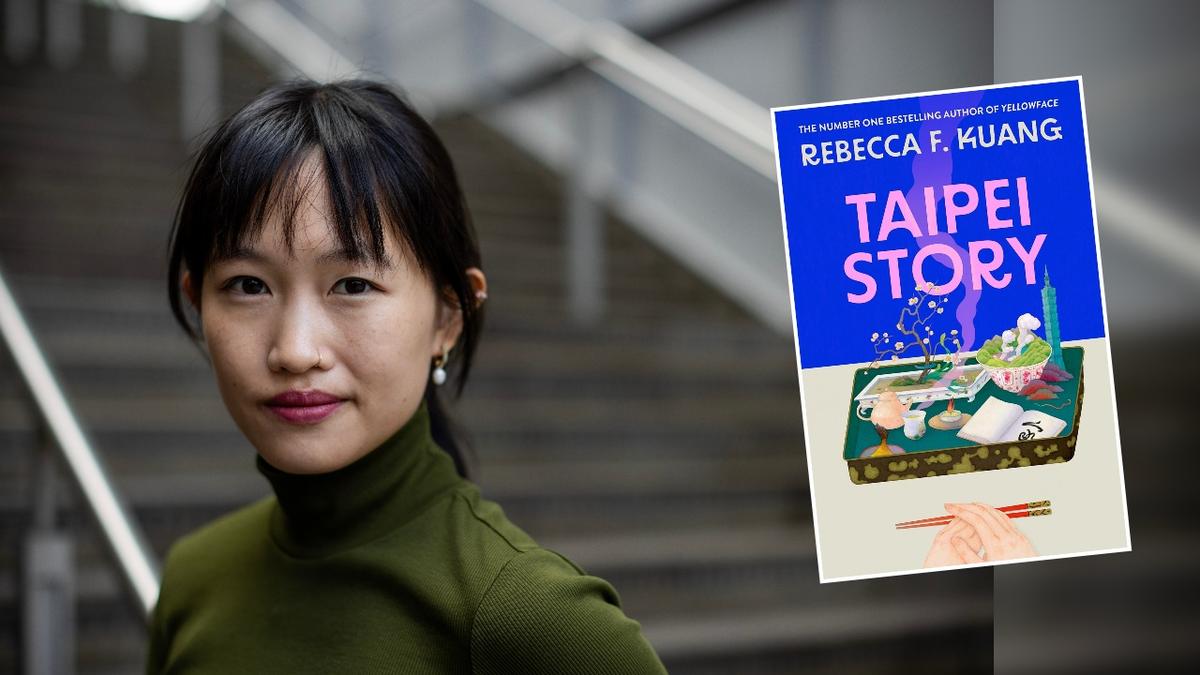
This is Rebecca F. Kuang’s seventh novel and only her second contemporary work after ‘Yellowface’ (2023). | Photo Credit: Toby Madden Author Rebecca F. Kuang, who writes fantasy as R.F. Kuang, was born in Guangzhou, China, and raised in Dallas, Texas. She rose to prominence at just 21 with the publication of The Poppy War (2018), the first instalment in her acclaimed grimdark fantasy trilogy, which drew on Chinese history and mythology while exploring the violence and moral ambiguities of war. Since then, Kuang has moved fluidly between genres, writing historical and speculative fiction as well as contemporary novels that examine questions of race, identity, language and cultural power. Her latest, Taipei Story (HarperCollins India), is the bestselling, award-winning author’s seventh novel and only her second contemporary work after Yellowface(2023).In Taipei Story, Chinese-American college freshman Lily Chen spends a summer in Taiwan attending an intensive language programme. What begins as a formative experience abroad becomes something more urgent when Lily suddenly loses her grandfather on the mainland, forcing her to confront family, language and the complicated relationship between the identities she has inherited. Edited excerpts from a Zoom conversation with Kuang:Taipei Story is obviously a very personal novel for you. Did you ever think about writing it as autofiction or memoir? No, I always knew I wanted it to be fiction because I’m really interested in what genre templates can allow us to do. Once I had the themes I wanted to work through, like grief and confusion and struggling to reconnect with your heritage, I thought [they were] really good themes to explore through a coming-of-age novel. A story where the protagonist would be a lot younger and be experiencing [many] things for the first time. If I wrote it as a memoir, it’s not that interesting because I was almost 30 when I lost my grandfather and I had figured out a lot more things by then. I had a much more comfortable relationship with my extended family and with Chinese. So, I think it was more fruitful to dramatise and explore these things from the perspective of somebody who would have struggled much more. Some of Rebecca F. Kuang’s popular books. You make an interesting point in the book about the fantasy versus reality of the concepts of homecoming and belonging. Was this one of the themes that drove you? That’s really what the book is, trying to subvert the fantasy of homecoming. A lot of people have this dream that if they can just learn the language, if they can just return, they can sort of pretend that those years never passed and that there’s a version of them that never left and is close to their extended family and is perfectly comfortable in a foreign city. But many, when they do go back, are disappointed by their homecomings. They find that no matter how hard they work, they don’t quite belong. And that’s because they’ve chosen to make their life in a different place, and that’s okay. Taipei Story follows in a long tradition of Asian film and Asian-American film that acknowledges that sometimes you leave for good and you have to make peace with that distance. I think Ang Lee films are especially touching in this regard, particularly his trilogy that includes The Wedding Banquet (1993)and Pushing Hands (1991). Do you find that your multilingual experience has impacted the way you write or how you approach storytelling? Oh, for sure. Just as I feel all this freedom to reinvent myself in different languages, I also feel the freedom to reinvent myself in different genres. Having grown up on the outside, sort of, of various linguistic communities at first makes you pretty perceptive. You’re always paying attention to speech codes and mannerisms and just vernaculars that other people take for granted and don’t even think about when they’re using them. Also, certainly for me, I don’t feel like there’s any voice that is my natural default voice. I’m always choosing a voice depending on the context; it doesn’t mean that it’s dishonest. It just means I code-switch a lot. And I also do this in literary genres. I pick whatever narrative voice is right for that story, but I don’t feel locked into any kind of rhythm. Every novel you’ve written has explored varied genres. Is this dictated by the story you are working on? I’m bad at planning ahead too far. I sort of just follow my gut. I notice what I’m gravitating towards, what I’m reading a lot of, and I always wait for that click between the set of questions I want to explore and the right genre format in which to tell it. Genre is such a flexible, useful thing. It’s like a colour on a palette that you can use to sharpen or exaggerate different elements of something you want to crack open. Some of it is also just luck and spontaneity. I’m always open to telling a story in a way that I never have before. That’s the fun of not planning ahead — I have no idea what I’ll be working on two years from now, which is exciting. The interviewer is a Mumbai-based author and editor. Published - October 05, 2026 05:40 pm IST
Interview | Rebecca F. Kuang on challenging the idea of home and homecoming in ‘Taipei Story’
Full Article
Original Source
Read the full article at Thehindu →KhanList aggregates and links to publicly available news content. We do not host full articles from third-party sources. Always verify important information with original sources.