
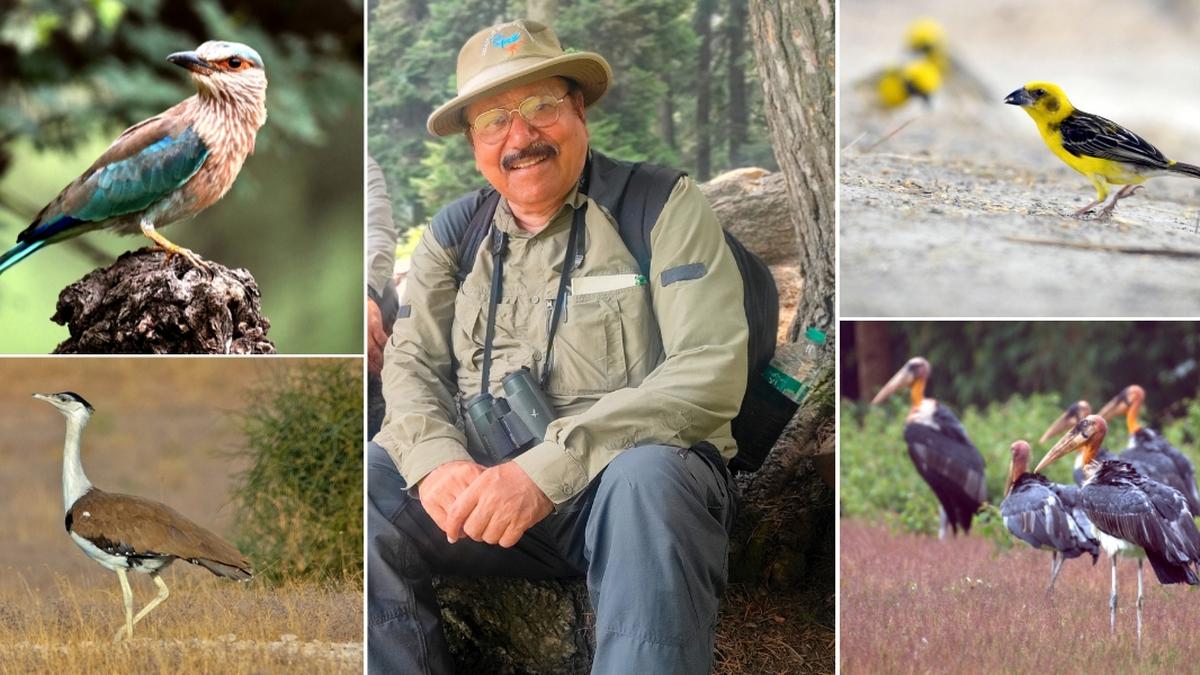
Noted conservationist and ornithologist Asad Rahmani’s latest book, Where Have the Birds Gone? Empty Nests. Quiet Skies. One Question (Indian Pitta, an imprint of Juggernaut Books), is dedicated to lost species: “the mountain quail, pink-headed duck and numerous other species that were exterminated, with an apology from humankind”. This sombre beginning sets the tone of his nuanced book.Where Have the Birds Gone? illuminates “the scale of the crisis confronting birds today — a crisis unfolding not with a single dramatic blow, but through the steady erosion of safe skies, quiet habitats and the fragile continuity on which avian life depends,” writes the Lucknow-based Rahmani, former director of Bombay Natural History Society and author of 27 books and 150 peer-reviewed scientific papers.The book begins by focusing on 14 of India’s most threatened birds, including the white-bellied heron, green munia, the Bengal florican and Jerdon’s courser, evaluating the factors that threaten their existence. These include habitat loss and fragmentation, alien species, wind farms, power lines, dams, illegal pet trade, pesticides, poaching, glass buildings, and free-ranging stray dogs, which have become apex predators in many ecosystems, according to the 76-year-old. “In India, dogs are reported to have attacked 80 wild species, including 31 threatened species, four of which are critically endangered,” he writes, throwing in a sobering statistic. “In Ladakh, for instance, free-ranging dogs kill nearly 60 per cent of the chicks of the black-necked crane, a species listed by the IUCN as ‘vulnerable’ to extinction.”The book is full of dispiriting facts such as this. For instance, skylarks have declined by nearly 80% while Indian rollers have seen a 30% decline in 12 years; according to BirdLife International and the IUCN, 1,256 species — about 11.5% of all birds — are currently threatened with extinction, and fewer than 120 great Indian bustards persist, largely confined to two pockets in Rajasthan.But it isn’t all doom and gloom. “I believe that I am an optimist (you cannot be a conservationist without being one),” he writes, citing success stories like the greater adjutant, painted stork, and spot-billed pelican, before offering conservation solutions rooted in “common sense rather than technological wizardry or cutting-edge science”.Some of these solutions include expanding protected areas, conservation breeding, undergrounding power lines along major migratory routes and reducing free-ranging dog populations, states Rahmani, who firmly believes this. “If India truly aspires to be a Vishwaguru, a teacher to the world, then leadership must extend beyond economics and geopolitics. It must encompass sustainability, climate stability, environmental protection, equity, human rights and the rights of wildlife,” he says.Edited excerpts from an interview: The Indian roller | Photo Credit: Asad Rahmani The Greater Adjutant in Assam | Photo Credit: Asad Rahmani Through birds you explore myriad facets of wildlife, from global biodiversity threats to Earth’s sixth mass extinction and climate change and human-wildlife interaction. What makes birds an effective entry point? Birds and plants are almost the first things we see as children, which is why we feel connected to them. There are lots of positive stories about birds in our literature and culture, and birds like house sparrows and crows have become accustomed to us. Also, birds are not dangerous: no bird has killed a human being so far. Another big reason why people like birds is that birdwatching is the second-most common (nature-related) hobby in the world, after gardening. Even if we live in small homes, we put flowers on our balconies as a symbolic gesture because we want to bring nature back into our lives. When we go birding, therefore, we aren’t just looking at birds, but at the whole environment. That’s why we end up getting concerned about other things, too. One thing that came up in this book was that Project Tiger, while certainly offering conservation benefits, wasn’t enough to save many of our threatened birds because these birds don’t always live in protected areas. Could you tell us more? Well, I wrote a book on India’s threatened birds in 2012. There, I analysed 156 species of threatened and near-threatened birds and where they are found. We found that 50% are not found in Project Tiger areas, or, even if they are, they don’t breed or spend much time there. For instance, the Sarus crane is found in Project Tiger areas, but it does not breed there because big cats like tigers and leopards can easily swim and eat it. Of course, many birds have benefited from forest protection, but to say everything is protected by [flagship programmes such as] Project Tiger or Project Snow Leopard is not true. Once we accept this, we can think of other ways to protect them. Egyptian vulture | Photo Credit: Dhritiman Mukherjee Great Indian bustard | Photo Credit: Dhritiman Mukherjee You’ve championed the Great Indian bustard for many years. The critically endangered bird nearly became India’s national bird before losing out to the peafowl. Is everything stacked against the bustards? Everything is against them, starting with habitat change: these birds are long-lived and long-ranging. Even in areas where they are not killed, their population declines as their habitats shrink. The biggest killer of the bustard, however, is high-tension wires. Bustards are largely terrestrial birds and only fly when disturbed by a predator, which is becoming more common because of free-ranging stray dogs in these areas. This means that the chances of a bustard hitting a wire have increased tremendously. These birds fly at the level of these wires and have a visual blind spot: they see well to both sides but have narrow frontal vision, so they often miss what is directly in front of them. They don’t necessarily die of electrocution, but get injured and fall to the ground below, where the predator will be eagerly waiting for them. Finn’s weaver or yellow weaver | Photo Credit: Asad Rahmani Given that we live in a country where many underprivileged people, particularly pastoralists, fishers and indigenous people, share spaces with wildlife, how do we protect their homes and livelihoods as well as preserve what is left of our wilderness? There is no single answer because the situation varies from species to species, culture to culture, area to area, and habitat to habitat. But we certainly have to listen to these people and try to protect these spaces through traditional methods. Community conservation matters more than ever because population growth and shrinking available land have also reduced tolerance for wildlife. In general, if people are not harmed by an animal, they are more tolerant of it, which makes community conservation for animals like birds and reptiles much easier. Wildlife, like leopards, for instance, become a bigger problem for understandable reasons: no one wants their child to be killed by an animal. But India’s beauty is that, despite such a large population in such a small area, we have not lost any large animals. People in this country don’t always support conservation, but they never oppose it. preeti.zachariah@thehindu.co.in
Interview | Ornithologist Asad Rahmani on his new book ‘Where Have the Birds Gone?’
Full Article
Original Source
Read the full article at Thehindu →KhanList aggregates and links to publicly available news content. We do not host full articles from third-party sources. Always verify important information with original sources.