
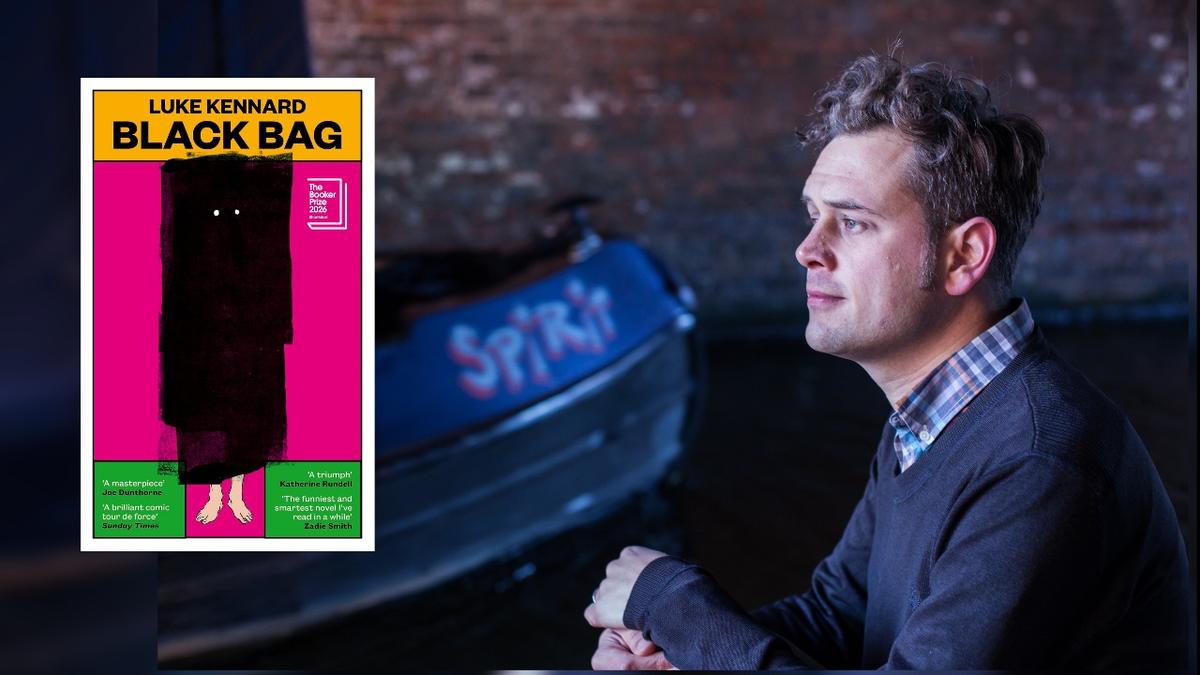
Home Books Authors 2026 Booker Prize-ShortlistedKennard has based his book on an experiment conducted at Oregon State University in the U.S. in 1967Updated - October 02, 2026 06:26 pm IST A satirical take on the campus novel, Luke Kennard’s ‘Black Bag’ defies easy literary categorisation. Luke Kennard’s Booker-shortlisted novel, Black Bag (published by John Murray), is a social experiment in and of itself. Inspired by the 1967 experiment conducted by Charles Goetzinger, the story here is told through the eyes of the narrator-protagonist, a struggling actor, who is chosen to play ‘black bag’ for a university professor conducting his own experiment. A dark humour-infused satirical take on the campus novel, Black Bag defies easy literary categorisation. Here, the author discusses the thought process behind the novel and his future literary experiments. Edited excerpts: What was it about the black bag experiment or the mere-exposure effect that inspired your novel? I was reading about attraction theory (an area of social psychology) for a completely different project, and the black bag experiment was referenced in a footnote. I loved it immediately, but the thing that struck me as interesting was what it would be like for the actor, rather than the participants, and the ideas the experiment was testing. So, I just started from there. As with your previous works, ‘Black Bag’ is brimming with social commentary, particularly the normalisation of late-capitalist technocratic ways of being. I think we have to meet the times we’re writing in, we have to be willing to attend to those things. I was worried, when I was writing it (from around 2021) that it was going to take me years and that all the things I was angry about would have moved on or changed and that it would be obsolete. But, thankfully, the tech bros are still pushing the same garbage. So, thanks to their utter spiritual and intellectual paucity, my novel stayed relevant. The protagonist, who plays ‘black bag’, is shown to be constantly ruminating on the sad state of affairs in the creative arts. Do you share his views? Yes and no. I wanted him to be a kind of lightning rod to channel all of the creative frustrations of anyone who’s trying to make any kind of art in the current climate, mine included. In the U.K., particularly, I feel like it’s completely looked down on, shamed even, unless you’re making a lot of money. But it was like that when I was a child, too. You only get to do this out of a sense of defiance, really. What was your thinking behind the relationship between ‘black bag’ and the academic Justine Pearce in the novel? The narrator’s relationship with Justine was initially a parody of the campus novel trope where a depressed middle-aged academic has an affair with a beautiful young student… I wanted to write the opposite of that. But then, I became more interested in their dynamic and what it gives him; that, paradoxically, he feels somehow seen or loved or accepted by Justine. I think she’s actually a very loving person. What are the differences in your approach as a writer when you are composing poems as opposed to writing prose? There’s a playfulness to writing poetry, a kind of musical improvisation, but using an instrument I built myself out of scraps of other instruments. I find fiction harder, because it also has to be systematic, has to deliver on a story, has to justify the eight or so hours the reader has spent with it. When I’m writing poetry, I’m enjoying myself and I’m trying to express and articulate complex things which I think are worth exploring, to the extent that I’ve dedicated half my life to it. But nobody else particularly wants it or reads it. (Laughs.) What would you like to write about next? I became obsessed with Robert W. Chambers’ 19th century gothic masterpiece The King in Yellow a couple of years ago; particularly, the idea of a cursed play script that ruins the lives of anyone who reads it. I’m working on a novel that changes the script to a cursed Ph.D manuscript, partly because it’s a good way of getting a network of characters together (the student, supervisors, examiners). I’m also gradually editing my Selected Poems, which has involved going over about 25 years of work. It’s simultaneously fun and mortifying. The interviewer is a Delhi-based literary critic and research scholar. Published - October 02, 2026 06:24 pm IST
Interview | Luke Kennard on writing against the technocratic times in his novel ‘Black Bag’
Full Article
Original Source
Read the full article at Thehindu →KhanList aggregates and links to publicly available news content. We do not host full articles from third-party sources. Always verify important information with original sources.