
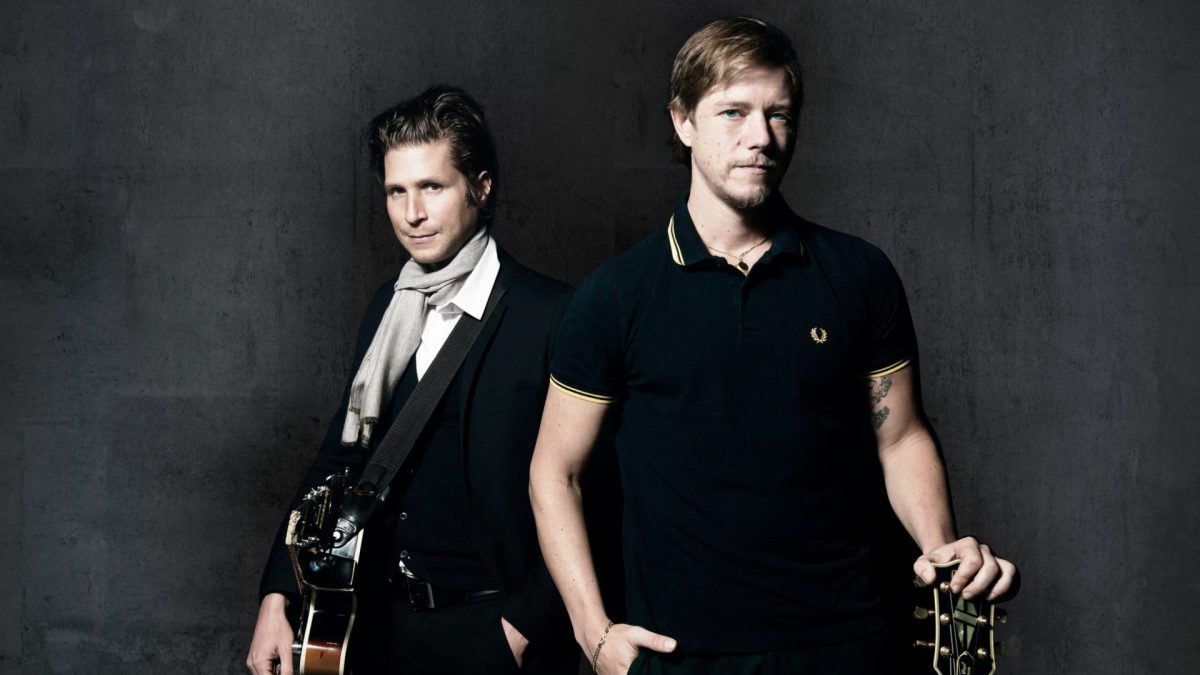
Interpol frontman Paul Banks is attempting to explain what has made the New Yorker’s eighth album This Mirror Weighs a Ton such a triumph. They’ve made some smart and different types of creative choices, he says, which we’ll get to later. Sometimes, “larger cosmic forces” make it a good moment to release an indie rock record, which he thinks is the case. “But I also think, like, hey, sometimes cool shit just happens.” It is perhaps unfair to say the brilliance of This Mirror Weighs a Ton has come out of nowhere, although Interpol have spent 20 years in the shadow of their stellar early Noughties peak. It was a time when their dark-suited, cryptically melancholic, angular monochrome post-punk – both movingly elegiac and dancefloor ready – showcased the moodily nocturnal side of New York, in contrast to peers The Strokes and Yeah Yeahs Yeahs. Their cinematic 2002 debut Turn on the Bright Lights and 2004 follow-up Antics sold one million between them, and crystallised Interpol as the dark masters of the New York rock revival. Interpol have been releasing perfectly fine if overly familiar records ever since. In 2011, they survived the loss of original bassist, the enigmatic and charismatic Carlos Dengler, but previous heights had been out of reach. Until now. This Mirror Weighs a Ton distils everything that made Interpol great – a handful of angular, agitated indie anthems – with fresh depth and new angles. These include the ambient, trip-hop-inspired wonder of the title track; evocative piano ballads in “Enemy” and haunting closer “Sudden”; songs that take in glockenspiels, woodwind and, for the first time ever on “So Rides the Reindeer”, an acoustic guitar. It is a true return to form.Banks is sitting on a couch at their management’s office in Shoreditch alongside guitarist Daniel Kessler. They are the two surviving original members from Interpol’s 1997 formation. Drummer Sam Fogarino joined in 2000; newly full-time members bassist Brad Truax and keyboardist Brandon Clayton joined as touring musicians in 2011. Founding members Kessler, left, and Banks, right, with Sam Fogarino, who joined in 2000 (Photo: Wendy Redfern/Redferns) Banks and Kessler represent the two sides of Interpol. Banks, an imposing, bleached-haired figure who sits purposefully upright on the edge of the couch, is the wordsmith and melody man who does most of the talking. (“Just poke me if I’m going on too long,” he says to Kessler at one point.) Like his lyrics, Banks’ chat has an esoteric quality. Ask him about the themes of the new album – self-reflection, the inhumanity of AI, global war, modern life’s dislocation – and he says: “I’m just really fascinated in the world that we live in and have always been. But just the power of language and spin, and how we can shape and adjust narratives – does truth exist outside of language?” On the other hand, Kessler, whose distinctive piercing minimalist playing is the starting point for the majority of Interpol songs, reclines back on the couch looking like he’s just left a movie set: perfectly coiffured hair, dark shades and tailored jacket and shirt. For the first time since “PDA” in 2002, he sings on an Interpol song, adding vocals to storming, classically Interpol single “Shout Out Loud”. It was Banks’ idea, and he took some convincing. “I’ve never had aspirations to sing,” Kessler says. It doesn’t sound like he’s in a rush to do it again. “No, it was fun. Doing it live I’ve realised I can only do it if I emote in the moment. It’s been fun doing it.” Those smart and creative choices, then: firstly, to allow touring bassist Truax into the band permanently and into the writing process for the first time. Banks, who before then had played the bass for studio recordings, decided he no longer wanted to play bass. Why? “Why is anything ever decided by any artist?” Banks says. “He took his chance. So that was new blood.” Then there is the choice of producer, Andrew Wyatt, a New Yorker and friend of the band who had worked with Banks on his project with Wu-Tang Clan’s RZA, Banks and Steelz. It was the first time Interpol had worked with an outside producer so holistically, Banks says, and from such an early stage in the process. Wyatt also had a studio in Manhattan, which meant Interpol wrote and recorded in New York for the first time since 2014’s El Pintor. “Wow,” Kessler says, as if he’s just realised. “It was great to be somewhere where you have so much history and sense of belonging.” Interpol perform on ‘Late Night With Seth Meyers’ in 2014 (Photo: Lloyd Bishop/Getty) “The writing sessions at Gonzo’s really speak to me too,” Banks says of a rehearsal space that used to be an old band haunt in the earliest days: music store Mondo Kim’s Video in the East Village. “It was very close to where both Paul and I used to live,” Kessler says. “That was the coolest record store,” Banks says. “We used to hang out. Brad used to work there. I used to put up Interpol fliers up there and sell our demos there. To Brad! So that was a crazy full circle moment.” Those old days around the turn of the century, the scene that also spawned LCD Soundsystem, The Walkmen and TV on the Radio, gave New York an updated version of the CBGB’s punk era: a much-romanticised period already in rock folklore. Is there anything misunderstood about the era? “I feel like the portrayal seems quite accurate,” Banks says. “There’s so much photographic evidence. Although at the time I remember feeling like I wanted to push back around 2003 – ‘We’re not all friends with all these bands.’ But in retrospect, we were all going to the same clubs.” “We would talk about this a lot,” Kessler says. “‘Oh, we wish that we could actually find like-minded spirits to play with.’ And we rarely saw it. There was a romanticism which I felt at that time was not convenient, but this idea we’re all there lending each other instruments [was not true]. All of a sudden, The Strokes were the first band to break and really garner all this attention. I never heard about them before.” “I also had never even heard of The Strokes,” Banks says. “I was handed one flyer by one of their team right before they broke. It’s funny, he was also dressed in a suit and tie, and I made a silly uncouth quip about their name. And I remember the guy looking at me very blankly, and I was like, ‘OK, that guy didn’t think I was very funny.’” “But I do think it was a very unique moment in time,” Kessler says. “It’s pre-social media, it’s pre-internet really finding its usefulness.” “I used to worry it was journalists looking for a story,” Banks says. “But the spotlight was indeed validated. These are actually great bands that have lasted the test of time.” Much has changed since then. Banks now lives in Berlin with his fashion designer wife Juliet Seger (who sings backing vocals on the title track) and their two young children. He worked on This Mirror Weighs a Ton in the throes of early fatherhood. “I don’t really give a f**k what happens with my career as long as my children are happy and healthy,” Banks says. “But at the same time, I would like to be the best version of myself now. So that includes being a good artist and a good professional who shows up for my collaborators. And inevitably that’s going to translate into some sort of depth or focus.” Fatherhood hasn’t made its way into the songs per se. “I wouldn’t,” he says, slightly affronted. Kessler jumps in with an impromptu song: “Train set, I couldn’t get it for you…’” But it does play into “Wounded Soldier”, about Banks being exposed to distressing war footage from the Russia-Ukraine conflict scrolling on his phone. “I was on Instagram following a Ukrainian boxing account, and this guy suddenly starts posting crazy graphic footage of soldiers being killed by kamikaze drones. It’s just the most harrowing, horrible thing I’ve ever seen. And maybe it’s being a father, there’s just such a deep, deep sadness this is the world we live in. I had to acknowledge it to exorcise it.” On highlight “Iron City”, Banks imagines a conversation between a human and AI. Just a day before we speak, Dr Dre gave something of a rallying cry for AI, saying: “The only people who see it as a threat are people who have trouble creating.” “From Dre’s point of view, in the world of fake samples, there could be something interesting there,” Banks says. “But if you look at AI as: how do I commodify making art so that people like it and then they pay for it? Who f**king cares? That’s not the reason why people like us make music anyways. If you’re an artist, AI is not gonna help me express myself. It’s just gonna make some shit.” “I’m the last person to the party for technology,” Kessler says. “I’m like, ‘I guess I have to get a cell phone now.’ But there’s always going to be a curiosity behind – what is the idea? Why did this person create this music? How was it created? People want something that is actually true and sincere.” As Interpol show, if you work like that: hey, sometimes cool shit just happens. ‘This Mirror Weighs a Ton’ is out now. Interpol tour the UK with Bloc Party from 20 November
Interpol: ‘People romanticise the Noughties music scene. We weren’t all friends’
Full Article
Original Source
Read the full article at Inews →KhanList aggregates and links to publicly available news content. We do not host full articles from third-party sources. Always verify important information with original sources.