
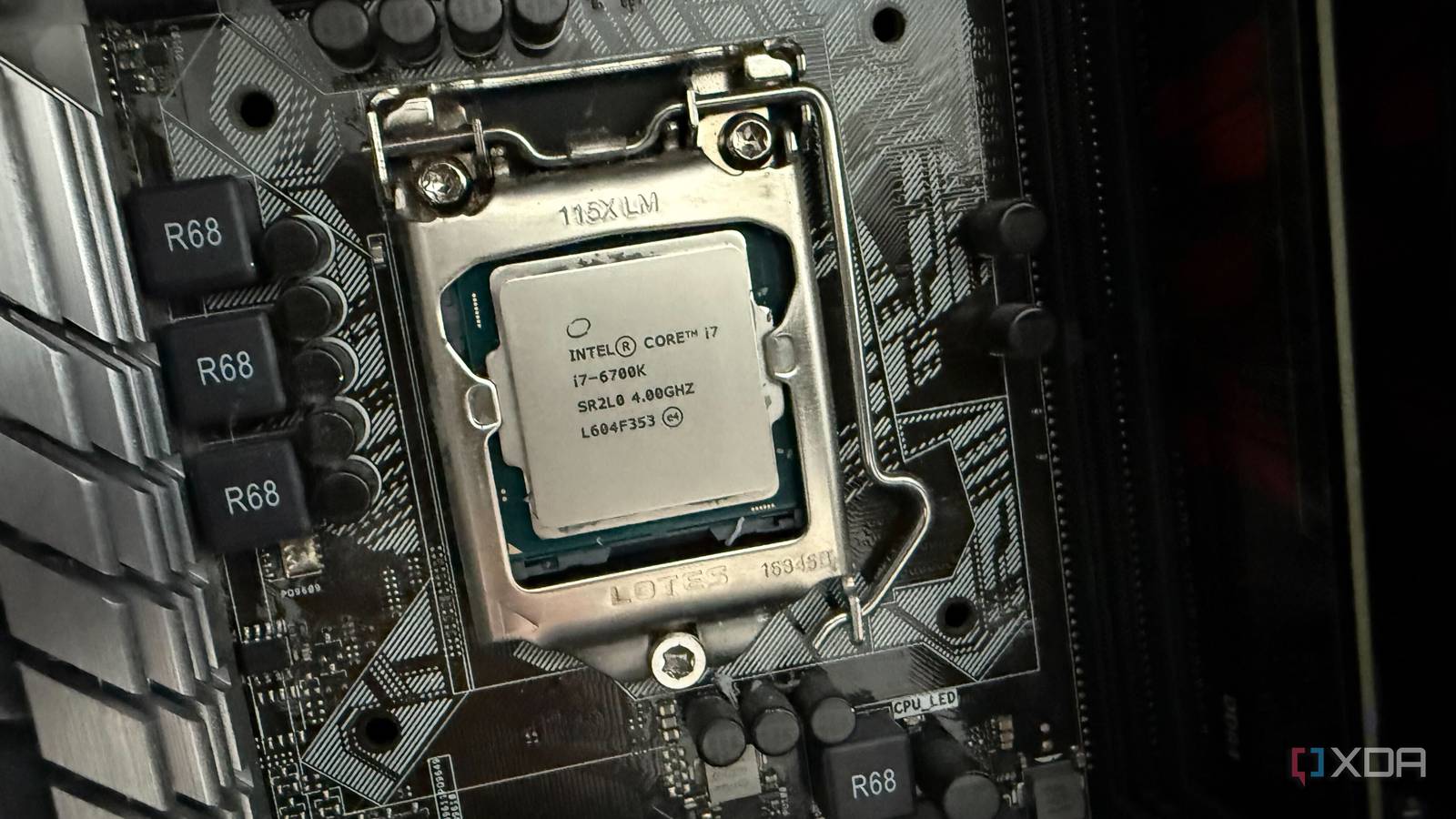
Published Nov 2, 2026, 4:30 PM EST Hamlin has been in the tech field for over nine years. Since 2017, his work has appeared on MakeUseOf, Android Police, OSXDaily, Beebom, and more. He served as the Senior Editor at Valnet's MakeUseOf for over two years before joining XDA. He uses a high-end gaming rig for desktop use and a MacBook for traveling, but dislikes some of the quirks of macOS. You're more likely to catch him at the gym or on a flight than anywhere else. Intel's 8th-gen CPUs launched almost a decade ago, so I wouldn't blame you for thinking they're practically obsolete at this point. After all, even today's entry-level Ryzen CPUs can put the "high-end" i7-8700K to shame in gaming benchmarks. But the point of those CPUs today isn't to prove they can still compete with what's available on the market. It's about how much performance you're getting for the money and whether you actually need anything faster for your use case. With RAM and GPU prices losing touch with reality this year, I think Intel's 8th-gen lineup deserves another look, especially if all you want is a general-purpose PC that can also handle some gaming when paired with an entry-level GPU like the RTX 3060. I was able to find i7-8700K listings on eBay for under $70 and even spotted Z370 motherboards for half that price. That's barely over $100 for a 6-core CPU and motherboard combo, which I think is a pretty good deal in 2026. We wouldn't be having this discussion if these were 4-core CPUs Remember when Intel used to be obsessed with sticking to four cores for its mainstream CPUs year after year? Well, Coffee Lake ended that streak in 2017, shortly after AMD shook up the CPU market with its first-generation Ryzen processors. Intel's 8th-gen lineup brought 6 cores to both the Core i5 and i7 models, with hyperthreading being limited to the latter. That's a pretty significant jump considering even the flagship i7-7700K was stuck with four cores and eight threads despite launching the same year. Fast forward to 2026, and even though we have 12-core, 16-core, and 24-core desktop CPUs, six cores are still considered the baseline for a decent gaming PC. Just look at how many entry-level Ryzen CPUs still ship with six cores today. Of course, that doesn't mean the good old i7-8700K can hold its own against these newer chips because CPU architectures have come a long way over the past nine years. But if these CPUs can still handle some modern games at reasonable frame rates when paired with the right GPU, I doubt most people would find them slow for everyday use. Windows 11 officially supports these CPUs That means no workarounds to get Windows 11 running Intel's 8th-gen CPUs are among the oldest to support Windows 11 officially. What's funny is that even the first-gen Ryzen and mainstream 7th-gen Intel CPUs, which also launched in 2017, aren't officially supported. Sure, you can still get Windows 11 running by bypassing its hardware requirements, but I wouldn't want to deal with that if I were putting together a PC for everyday use. The fact that you can get a CPU that made the cut for less than $70 is a pretty big deal, especially now that Windows 10 has reached end of support. Now, you could argue the CPU isn't the only thing Microsoft checks when you install Windows 11, since your PC also needs to support TPM 2.0 and Secure Boot. But that shouldn't be a problem with Z370 and Z390 motherboards. Intel's Platform Trust Technology (PTT) takes care of the TPM requirement, although you may have to enable it in the BIOS along with Secure Boot. So if you don't want to bother with bypassing the CPU requirement, I think Intel's 8th-gen CPUs are as old as I'd be willing to go for a used build. Buying into a dead platform isn't a great idea But at these prices, does that even matter? Yes, there's a catch to buying a CPU from nine years ago. You're spending money on a platform that peaked forever ago. Sure, you could upgrade to a used 9900K later if you're not happy with the performance or really need those two extra cores, but that's about as far as you can go. And let's not forget you're stuck with DDR4 and PCIe 3.0, so there's no getting around the fact that you'll have to replace your motherboard if you ever want newer features down the line. But then again, you're barely spending over $100 on the CPU and motherboard. And that's assuming you're going for the i7-8700K. You could even get an i5-8600K for under $40 and save even more money if you like. Of course, RAM is going to be expensive if you don't already have some DDR4 lying around, but even at these outrageous prices, you can still get a 16GB kit for a little over $100. So if you really need a PC right now but don't want to burn a hole in your wallet trying to build one with newer parts, I think Intel's Coffee Lake makes for a great stopgap option. Intel's 8th-gen CPUs help you get by, and that's what matters In an ideal world, we wouldn't even be talking about buying a used nine-year-old CPU in 2026. But this isn't an ideal world, and with component prices showing no signs of coming down anytime soon, I think we need to reconsider parts most people would've written off years ago to find value. I wouldn't really call the i7-8700K a gaming CPU anymore, but it can still handle newer titles, provided you're realistic about the kind of performance to expect. And if you just want a general-purpose PC, I think even an i5-8600 or i5-8400 should be more than enough for the next few years. It all comes down to whether these CPUs are still good enough, and for the price, it's hard to say they aren't.
Intel's 8th-gen CPUs are the most underrated used chips you can buy
Full Article
Original Source
Read the full article at Xda-developers →KhanList aggregates and links to publicly available news content. We do not host full articles from third-party sources. Always verify important information with original sources.