
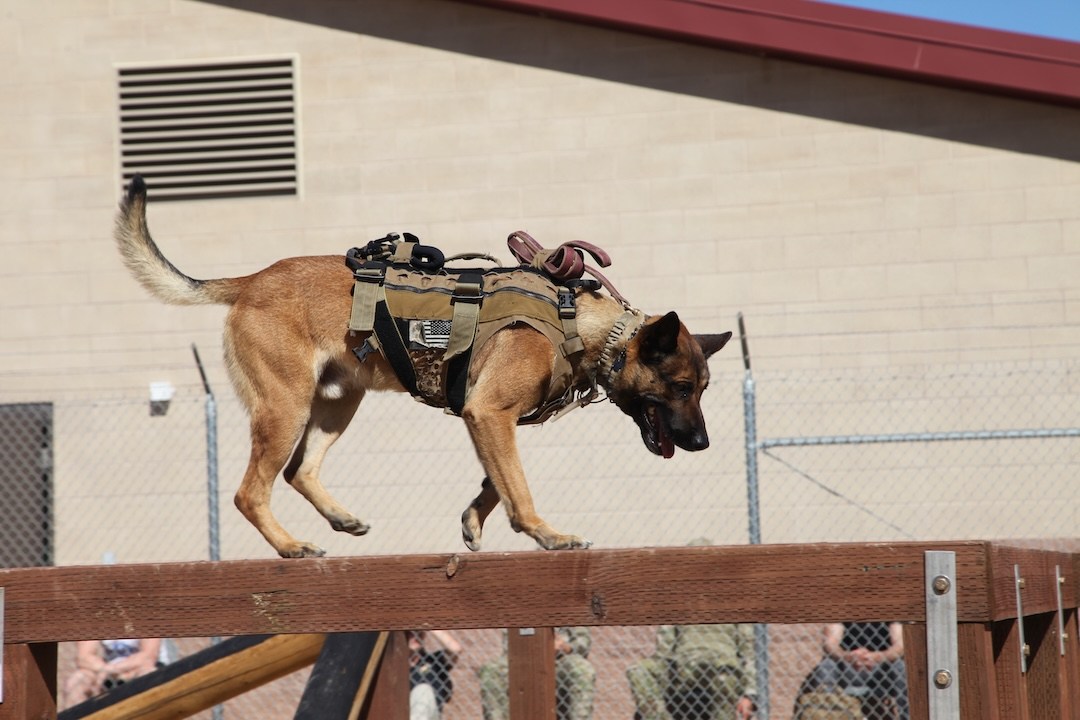
News broke on Oct. 22 that a new startup had raised $200 million to genetically enhance military dogs. The company, Warhound, was launched by billionaire entrepreneurs Ben Lamm, founder of biotech company Colossal Biosciences, and Palmer Luckey, founder of defense technology company Anduril Industries. The two planned to bring their respective companies’ strengths to the venture. Lamm would apply Colossal’s gene-editing technology to improve the dogs’ physical capabilities, while Luckey would equip them with advanced military equipment. The unusual mission, combined with the founders’ track records, left plenty of questions about what Warhound had planned. Some speculated that the company intended to create cybernetic superdogs, while others accused its founders of trying to expand an industry that should instead be replaced with robots. But in a news release shared in response to the initial reporting, Warhound described a more grounded goal: rebuilding the domestic supply of dogs for the military, law enforcement and first responders. In an interview with Military Times, Lamm and Warhound’s co-founder and chief executive David Spirk, who left a senior position at Palantir for the startup, expanded on that statement, discussing the conversations that sparked the mission, the problems they want to address and the product they hope to sell. Together, they said they want to do more than bring the supply chain to the United States. Their plan includes cloning top-performing dogs, editing genes associated with health problems and introducing standardized training to puppies as young as two weeks old. A meeting of minds A U.S. Army military working dog with 5th Special Forces Group participates in directional control training at Muscatatuck Training Center in Butlerville, Indiana, from Sept. 21 to 26, 2026. (Spc. Jennifer Roblero/U.S. Army) The idea for Warhound was born out of conversations Lamm had with Luckey beginning around April 2025. They had met at the Moonshots Summit, where they appeared as guest speakers. “Palmer’s really excited about animals, and he knows I run both the extinction and species conservation company. So, we’re talking about all kinds of stuff, like can you communicate with animals, all these things leveraging technology, and then he started talking to me about the working dog program,” Lamm said. According to the Defense Department, only about 13% of the dogs trained to become military working dogs come from domestic breeders. Conversely, Warhound estimates that around 80% of the dogs are sourced from overseas, mostly Europe. Lamm described those breeding programs as “a little bit puppy millish.” Because of supply issues and the time it takes to train a working dog, Warhound estimates that it takes roughly three years before a dog becomes operational. The company said more than half the dogs procured are ultimately deemed unfit for service, meaning the government has to “train roughly 200 dogs today to field 100 working animals tomorrow.” To address the problem, Lamm said his conversations with Luckey over the past 18 months have evolved from identifying the problem to figuring out how technology could help solve it. “[Luckey] thought that Anduril could provide a lot of the tech and enabled hardware around this,” Lamm said. “And we could provide the cloning and the genetic engineering.” The science behind Warhound A U.S. Army working dog assigned to 7th Special Forces Group waits for the next command from his handler during a training exercise at Muscatatuck Training Center in Butlerville, Indiana, from Sept. 21 to 26, 2026. (Spc. Jennifer Roblero/U.S. Army) Since launching in 2021, Colossal has raised more than $435 million to fund its efforts to revive extinct animals and conserve the genetic material of endangered species. The company’s current valuation is approximately $10.2 billion. To expand its capabilities, Colossal acquired Texas-based Viagen Pets and Equine last year. Lamm said Viagen has “very high cloning efficiencies … and Warhound will be leveraging Viagen as it relates to dog cloning, which is their core business.” In 2025, Colossal demonstrated its capabilities by cloning former NFL quarterback Tom Brady’s dog. But cloning and gene editing are distinct processes. According to the National Institutes of Health, cloning produces a genetically identical copy of an existing animal, whereas gene editing involves directly altering an organism’s DNA to change specific characteristics. With gene editing, “you’re taking the random chance out of nature,” Lamm said, adding, “Genetic engineering is looking at the genome, finding things that are broken in the genome, wrong in the genome, or could lead to health consequences, and fixing and removing that.” Gene editing has been used to create specific characteristics in several animal species. Scientists, for example, have used the technique to make pigs more resistant to certain diseases; cattle better suited for hotter environments; and fish grow faster. But its application in dogs remains limited. In August, the company Kindred Companion Sciences unveiled what it described as the first genetically edited dogs. The biotech company created two hypoallergenic beagles using gene editing to remove a DNA sequence associated with a major dog allergen. However, Lamm said he does not anticipate significant challenges to applying the technology to working dogs. “We’re working on stuff that’s like a hundred times more advanced than, you know, a couple dog edits,” he said, referring to his team at Colossal. “When we made our dire wolves, we made 20 edits, which included edits specifically from dire wolves in those variants that had not existed for over 12,000 years in the genome, so not only can we make edits, but we can even make edits with lost alleles,” he added. Engineering a better working dog Australian Special Operations Command personnel participated in a multi-purpose canine training exercise hosted by 7th Special Forces Group at Muscatatuck Training Center in Butlerville, Indiana, from Sept. 21 to 26, 2026. (Spc. Jennifer Roblero/U.S. Army) While the science might not be a problem, Warhound co-founder Spirk said the company’s immediate focus is identifying “the best of the best” dogs and breeds to biobank, as well as developing the company’s “Warhound standard” for training working dogs. He explained that a wide variety of dogs are used across federal, regional and local agencies. Warhound is working with different government organizations to identify the top-performing animals, though he declined to say which ones. He said they are “understanding who wants what type of dog, and what the specialized capabilities of that dog are.” “You can imagine that the dog that we need sitting outside McDill Air Force Base is much different than a dog that somebody’s going to jump out of a helicopter with,” Spirk continued. Using genetic material collected in the biobank, Warhound scientists will map the animals’ genomes and look for opportunities to edit genes to improve their overall health, wellness and longevity before beginning the cloning process. “Once the scientists do their magic and make these dogs, we will immediately begin training,” Spirk said, adding that their experts suggest training should begin for puppies as young as two weeks. The idea behind early training, he explained, is to breed dogs to the highest standard, and then begin acclimating them to the tasks and conditions they’ll be expected to encounter in the field. For example, he said, a dog trained primarily on asphalt might struggle to function on a different surface, such as grass or sand. “You’re just naturally going to have a better product coming out when we domesticate the production,” Spirk said. The first Warhounds should be “coming off the line” in about two years, he said. Once Warhound figures out the right balance of nature and nurture for working dogs, Spirk said the company would like to explore ways to apply its research to the other 98 million dogs in America. “Nobody’s ever had the resources to do it and to figure it out,” he said, adding, “It’s pretty motivating.”
Inside Warhound’s plan to engineer a better military working dog
Full Article
Original Source
Read the full article at Militarytimes →KhanList aggregates and links to publicly available news content. We do not host full articles from third-party sources. Always verify important information with original sources.