
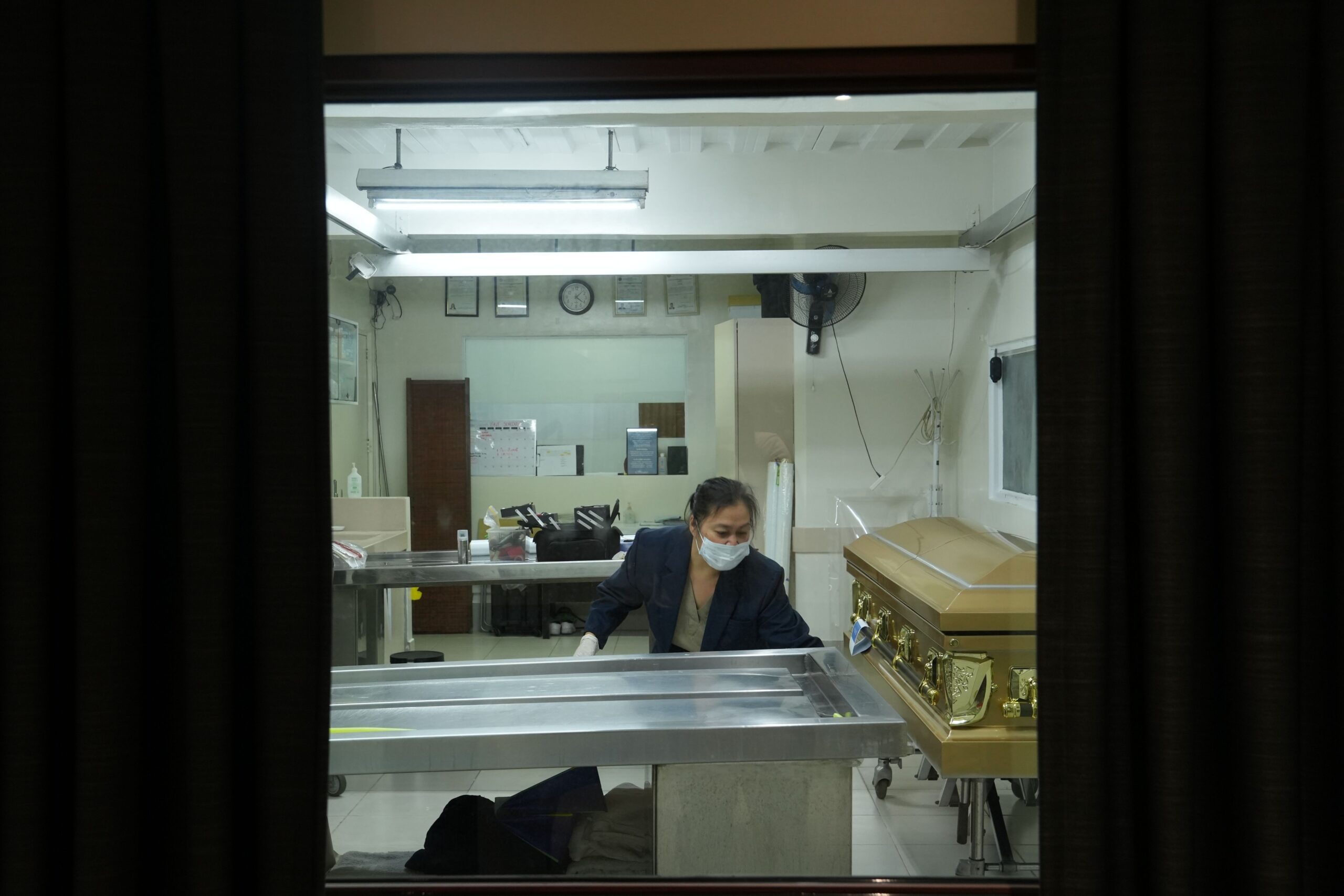
First of two parts For 19 years now, 48-year-old Joycel Regalado has made a living by facing death. She works on the remains of the departed, making sure that the memory of a beloved who has gone ahead of grieving family members is preserved. It is a final act of honoring that memory, of bringing comfort to the afflicted. She had not always been interested in this kind of service — mortuary science, or the study of managing deceased human bodies. The closest she had been to it was helping with the processing of death certificates for the funeral services business of her relatives. They persuaded her to get a license for embalmers so she could help in the business. At age 23, she enrolled in an accredited Department of Health training program for embalmers and undertakers. On her first try, she passed the licensure exam and decided to head to Manila to try her luck. She left Bacolod to prove to her family that she wasn’t meant for just paperwork, and that she was actually capable of doing the work itself. Joycel ended up with Arlington Memorial Chapels along Gregorio Araneta Avenue in Quezon City, armed with the necessary guts to do the job of respectfully handling the dead. As senior embalmer at Arlington today, she has done services for more than a decade already, multiple times daily. She still remembers her first time working on the remains of a baby. Already wearing her protective gear, she couldn’t help but weep with the bereaved family as she felt their anguish. “Mahirap kasi nanay din ako.… [Pero] kahit umiiyak, gagawin ko…Iniisip ko na lang na kailangan ko itong gawin para ma-preserve din yung baby [at] makita siya ng mommy niya, ng pamilya niya,” she recalled. (It was difficult because I am also a mother…. But even if I was crying, I did my job…I was thinking that I needed to do it to preserve the baby so the mother and family could still see the body.) The task is not that different, day in and day out. She receives the body from the hospital, washes it thoroughly, sets the features of the face, drains the blood and injects formalin — the chemical that preserves the body — into the arteries. Organs are drained and formalin is injected into the body cavities to preserve the organs. She double checks where fluids could leak from incisions in veins and arteries then stitches parts of the body. After she washes and dries the body, she grooms it, using a photograph of the deceased as her guide. Light cosmetics are applied to restore skin tone before the body is dressed in clothes provided by the family. It is finally put in a casket for viewing. COVER. Joycel Regalado prepares clothes and grooming tools for a deceased older woman she has embalmed. Jake Gomez/Rappler The entire process takes an average of two to four hours, in some cases possibly longer, depending on the body’s condition. ‘Nasanay na ako’ 47-year-old, on-call embalmer RJ Cabillan has been in practice longer than Joycel. For him, it’s been almost 25 years of constantly seeing the dead at multiple funeral homes every week. “Hindi na bago sa akin ’yung mga body, mga katawan ng pasyente, mga namamatayan. Kasi wala na, nasanay na ako,” he said. (The bodies of patients and relatives of people who have passed away are nothing new to me. I’ve simply gotten used to it.) MORGUE. Embalmer RJ Cabillan shows some of the tools he regularly uses at Belmont Funeral Service – a trocar needle and an aspirating syringe, used to drain the body of fluids. Eirene Manatlao/Rappler He had grown accustomed to being around bodies of the deceased since he had been accompanying his father — also an on-call embalmer — to work as early as age 9 or 10. By age 13, RJ began assisting his father in embalming the dead. “That’s how I acquired the skills and eventually entered the field of embalming,” he said in a mix of English and Filipino. After finishing high school, he first took on a construction job. But after he got weary of contractual setups, his father persuaded him to return to the embalming business. He did in 2001, and has never looked back since. RJ found his way to Belmont Funeral Services in Novaliches, Quezon City, where he’s been working as resident embalmer for four years. Like Joycel, RJ could not help tearing up while also embalming a baby. The experience, he said, reminded him of a personal tragedy — when three of his children passed away about two years apart, owing to pregnancy complications. “Mapapaluha ka rin kahit anong tigas mo…Hindi mo maiiwasan ’yun.” (No matter how tough you are, you can’t help but end up in tears…There’s no avoiding it.) No matter how difficult it was, RJ said he had to keep doing his job and pushing forward. Comparisons Years of experience have desensitized both Joycel and RJ to the sensory demands and anxieties of mortuary work. Although both share the same job description as an embalmer, their daily routines differ based on the clientele they serve: Joycel works at a high-end facility, while RJ provides embalming services to low- and middle-income funeral homes. As an in-house embalmer at Arlington, Joycel has a fixed shift schedule and focuses only on her areas of responsibility. RJ, for his part, waits for calls from four of the funeral homes he also serves. Joycel has a fixed salary. Pay for senior embalmers can range from P25,000 to P30,000, depending on experience, on top of which is a benefits package that includes a rice subsidy, clothing and footwear allowance, routine medical checkups, and job-related hazard vaccinations. They have comprehensive machines, equipment, and a broader range of amenities. EQUIPMENT. Regalado uses an arterial injection pump (white equipment), along with other tools, to pump formalin through the arteries. Jake Gomez/Rappler RJ, on the other hand, charges P1,000 per body for his services. There have been times when he has had to manually pump formalin because of the absence of automated machinery. MANUAL. Cabillan uses syringes and needles to manually pump formalin and drain bodily fluids. Eirene Manatlao/Rappler Compared to other countries, their pay is extremely low, considering the hazards of the job. Joycel recalled preparing a corpse that had live worms in its legs. After an extremely repulsive experience, RJ now declines to embalm decomposed bodies. Both work on four to six bodies a day, depending on the month. Joycel said work gets heavier during the hotter seasons. Their counterparts in the US are paid much higher. In 2025, embalmers in the US received an average annual salary of P3.7 million* or around P300,000 a month. Unusual work Not many appreciate the work that embalmers do. Joycel said she has been asked, “Out of all the jobs out there, why is that your job?” While embalming was once belittled as an occupation, Joycel said she aims to challenge that perception, emphasizing that embalmers complete formal studies and earn professional licenses. When RJ was once asked how he is able to handle bodies of the deceased at work every day, he replied, “For me, that’s just normal. Given how long I’ve had this experience, I’m no longer afraid.” Joycel asked: “Kung wala kami, sino ang mag-aayos ng patay?” (If we weren’t here, who would take care of the dead?) She takes pride in her work. “Embalmers are still needed; embalmers are still in demand,” she said. Valuing life Her job has taught Joycel to value her time with the living. “I realized that life is not just about work. I need to set aside time and balance for my family’s well-being, as well as for how I interact with others. Be kind, be understanding. Be good, and do good,” she said in a mix of English and Filipino. RJ echoed the importance of time with family, adding that accepting death as a part of life is a better way to look at things. “Because we’ll arrive at the same outcome at some point in our lives,” he said. For Joycel, her job as an embalmer is her ultimate good deed. “What we do for the deceased…We bring comfort to their families. We help lighten their [spirits]. That’s the only way I look at it.” (To be concluded) – Rappler.com NEXT: Filipino embalmers — last caretakers of the dead, seldom cared for *$1 = P63.74 as of October 30,2026
Inside the world of Filipino embalmers
Full Article
Original Source
Read the full article at Rappler →KhanList aggregates and links to publicly available news content. We do not host full articles from third-party sources. Always verify important information with original sources.