
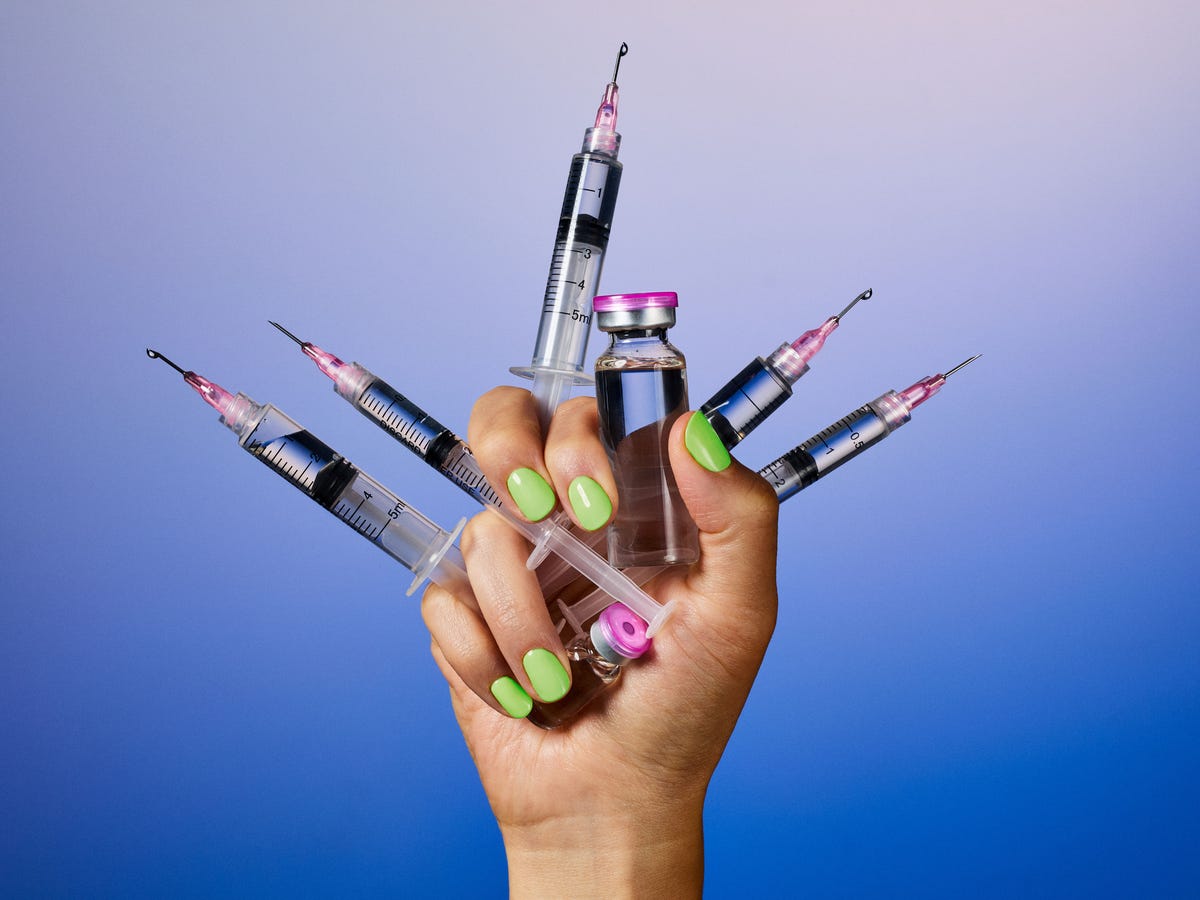
14 min readGina, a Californian in her 40s, was a true early adopter. She first heard about peptides eight or nine years ago, and as a very active woman with a few sports injuries, she was drawn to compounds like Body Protection Compound 157 (BPC-157) for their supposed healing properties. She initially opted for pills rather than injections: “At the time, I chickened out and bought the oral pills, even though I knew they were not going to be as effective.” Today, she and her husband embrace an extensive DIY protocol of injections beyond just BPC-157.Though there wasn’t much information circulating about peptides when Gina started on her journey, social media today makes it seem as if everyone is secretly—or openly—injecting. Peptide-related content has exceeded 130,000 posts on Instagram and drawn more than 230 million views on TikTok as of May 2026. Women talk and post about their peptide experiences, some using the hot pepper emoji as a cheeky way of discussing “peps.” Approachable-looking content creators make “let’s reconstitute the ultimate beauty peptide together” vlogs where they show off their vials of peptides to the camera with all the casualness of demonstrating how a shade of blush looks in certain lighting.This is a far cry from the once hush-hush conversations happening mostly among serious weightlifters. Over the past several years, peptides have been embraced by anti-establishment MAHA types, optimization-obsessed tech bros in Silicon Valley, teen “looksmaxxing” influencers, and now, women. For women, the peptide search tends to fall into the categories of injury healing, chronic pain easement, reproductive and hormonal disorder help, quality of life improvement, and other issues that conventional medicine often fails to address. Many of the women interviewed for this story described feeling tired of being ignored by traditional health care—and ready to take risks.Jarren VinkA Very Modern Origin Story There are two key things to know about peptides: its scientific definition and what people actually mean when they’re talking about the stuff.Scientifically speaking, peptides are short chains of amino acids, the building blocks of protein. The body naturally produces peptides to regulate hormones, appetite, mood, and more. You can find peptides in all protein sources, including chicken, eggs, beef, and shrimp.Peptides in a drug or supplement context refer to specific synthetic chemical compounds designed to affect the human body in some way. It’s what the P in GLP-1s stands for. Peptide-based therapeutics aren’t new—there are more than 100 FDA-approved medications in existence, like insulin (created in synthetic version in 1978!) and cardiovascular drugs such as Angiomax. But the key difference between GLP-1s and, say, BPC-157 is that the former have undergone years of clinical studies to gain approval from the Food and Drug Administration and similar regulatory bodies in other respective countries, while the latter...has not.And the 2026 peptide evangelists on TikTok aren’t talking about insulin or Angiomax. They’re likely proselytizing for the edgy gray-market stuff sold “for research use only.” Some of the most popular peptides on social media are BPC-157, GHK-Cu (also known as copper peptides), and TB-500, which are often combined with other peptides into what’s known as a “stack”—basically, a tailored supplement combination.There is also a class of peptides known as secretagogues, which encourage the production of another substance in the body. In the case of peptides like CJC-1295 and ipamorelin, they stimulate the natural production of human growth hormone. This mechanism is what made peptides popular with bodybuilding and related muscle-building and strength-training types for so long: It was a way to bypass bans on HGH in sports competition.“The use of [the word] peptide makes it sound like it’s a food, or something like protein, because it is just a small protein. But in reality, what we’re talking about are novel drugs”—i.e., new drugs that haven’t been approved or marketed, says Pieter Cohen, MD, an associate professor of medicine at Harvard Medical School, who studies supplement safety. In other words, calling them peptides in casual conversation makes people think they’re just like food. But in reality, these are essentially new drugs that we’re experimenting with at home. “If we said, ‘Yeah, let’s take a novel drug, inject a novel drug to see if it works,’ I think we’d have a clearer sense of what we’re doing,” says Dr. Cohen.And even though the discourse around today’s peptides typically excludes approved GLP-1s, the popularity of peptides might be due in no small part to the rise of GLP-1s.Back in 2022 through 2024, when GLP-1s were $1,200 a month out of pocket and in short supply, patients with prescriptions were searching for providers who could meet the need more affordably and consistently than places like CVS and Walgreens. In the United States, 503A compounding pharmacies stepped in to fill the gap. These pharmacies synthesize drugs from FDA-approved bulk substances (basically, ingredients) to fill a specific prescription for a patient, rather than dispensing a branded product off a shelf.Compounded drugs are primarily regulated by state pharmacy boards, rather than the FDA, and lack the standardized safety and efficacy testing of branded drugs. These compounding pharmacies helped patients with prescriptions who either couldn’t obtain their meds through a regular pharmacy or could but wanted to save a little money. For Jasmine, 27, who was prescribed a GLP-1 for weight loss and possible polyendocrine metabolic ovarian syndrome (PMOS), using a compounding pharmacy meant the difference between a $200 price tag and an $800 bill when her insurance denied the drug.Not only did the simple idea of regular injectable medicine become more palatable through the GLP-1 explosion, but using compounding pharmacies also became normalized for consumers.Though compounding pharmacies are the “cheaper” option for GLP-1s, for other peptides, the service is actually pretty expensive—a month’s worth of doses generally costs anywhere from $200 to $500. That price becomes especially tough to swallow when the alternatives being sold on sites like Temu are priced as low as a few dollars per dose.The argument then becomes this: If people are using peptides anyway, should the FDA loosen restrictions so that people don’t have to resort to sketchy sites to acquire them?Jarren VinkA Woman’s WorldThe reality is that there isn’t enough data—on long-term side effects, on whether certain peptide stacks may trigger adverse reactions, or on how peptides interact with other common medications—to really know what we’re dabbling with here. Much of the appeal of peptides is based on theory and anecdote, whereas the consequences are real and serious: Hepatitis, severe allergic reactions, and even cancer are all on the table. Most peptide studies have been conducted on animals or in very specific clinical populations, like HIV patients. There simply isn’t enough large-scale clinical data at this point to support the use of peptides.It almost goes without saying that buying raw peptide powders or research chemicals on the Internet can be dangerous. What’s more, not everyone is selling what they claim to be selling. Certificates of analysis or third-party tests don’t have a regulatory body, and they can also be counterfeited. If an 18-year-old can get their hands on a fake ID, so can a purported peptide marketplace. Finnrick, the company behind the largest independent peptide-testing dataset, has tested more than 9,000 samples from over 1,500 vendors. Its data on endotoxins shows that, as of earlier this year, 8 percent of gray-market samples have quantifiable contamination above trace levels—meaning roughly one in 12 vials carries bacterial fragments that can cause fevers or worse.“Self-experimentation without clinical oversight is not empowerment by definition,” says Sara Szal Gottfried, MD, a clinical assistant professor at Thomas Jefferson University and director of precision medicine at the Marcus Institute of Integrative Health. “The word empowerment gets used to cover a lot of situations that are actually just unsupervised risk-taking dressed in the language of agency. Those are not the same thing, and we do women a disservice when we treat them as if they are.”The women willing to take things into their own hands with peptides tend to have a laundry list of frustrations with the medical system and/or with what they want to treat.“Most of the women coming to me right now are frustrated in a very specific way,” says Dr. Szal Gottfried. “The strategies that worked at 35 are not working at 45 or 55. They’re doing the same things—eating well, exercising, sleeping—and their bodies are not responding.… They are coming in with a folder and a mission. They want to know what they can do now.”The research and information gap for the problems women want to address plays a role in the peptide boom too: Menopause, premenstrual dysphoric disorder (PMDD), and PMOS (formerly known as PCOS) are all understudied to begin with, which means that doctors often can’t treat them effectively. The result is that women are often willing to experiment a little bit more to find relief. Enter peptides.Melissa, a 52-year-old based in Decatur, Georgia, had long had her medical concerns about being severely underweight dismissed by doctors. Unsuccessful attempts to gain weight in her late 20s to early 30s eventually led her to self-diagnose and treat what she suspected was celiac disease. Melissa remembers having to tell her doctors, who insisted she was healthy, that weighing 87 pounds at 5'3" was “not good.”Her breaking point came during perimenopause at age 51, after she injured her hip carrying her 9-year-old son. Though an X-ray showed reduced bone density, her doctor insisted she didn’t need to worry about osteoporosis until age 65. A subsequent DEXA scan revealed advanced osteoporosis, but her endocrinologist entirely dismissed her requests to try hormone replacement therapy.Frustrated, Melissa took matters into her own hands and sought out her own version of therapeutics.“It really was an accident.”First, she embarked on a serious physical therapy and exercise and weightlifting program, which helped significantly. Then she began taking over-the-counter DHEA—a prohormone, or hormone precursor, which she says drastically reduced her joint pain, eliminated her night sweats, stopped her chronic skin itching, and gave her more energy. It didn’t fix her increasingly heavy periods, so to balance her estrogen levels, she sourced gray-market progesterone powder legally sold under the disclaimer of being “for cosmetic use only,” mixing it with coconut oil to make her own pills. “I’m misusing this product, which is only because I could not get my doctor to prescribe me hormone replacement,” she says.From the gray-market hormones came the gray-market peptides.Wanting to accelerate her bone growth and density, Melissa decided to start taking ipamorelin, the growth hormone secretagogue. Because she wanted to avoid injecting herself, she meticulously researched peptides with molecular weights small enough to be absorbed through the mucous membrane and mixed the compound into a commercial nasal spray. She now weighs 105 pounds and reports feeling much better, though she notes that she can’t tell any benefit (nor any side effects) from the peptides so far.Gina, the early adopter and biohacker, now primarily uses peptides in the hopes of getting pregnant. Her IVF doctor recommended human growth hormone secretagogues, which are not FDA-approved, to aid in egg growth. But rather than paying the steep compounded pharmacy prices for secretagogues, Gina sources them independently.Today, she and her husband buy their peptide powders online, measuring out the right ratio of peptide to bacteriostatic water (which contains a preservative to keep it free from bacterial growth through multiple uses) and reconstituting accordingly, carefully converting the dosage from milligrams to milliliters. Gina then injects the peptides into her butt, thighs, and occasionally shoulder (her stomach bruises easily). Once she is pregnant, Gina plans to stop using peptides.The Word-of-Mouth PipelineFor those who aren’t finding peptides through, say, the bodybuilding community, or who are seeking hormonal answers, the discovery mechanism tends to be word of mouth. For Sofia, 28, a fitness enthusiast in Johannesburg, South Africa, it started off innocuously. She was at her local independent supplement store buying creatine when she saw a pill bottle for BPC-157. She’d heard whispers about the peptides for months—that it could not only help level up her lifts, but also assist in pain management.Sofia was suffering from a severe shoulder injury that she wanted to avoid getting surgery for; she was also hoping to manage painful periods and daily fatigue. She tried going to doctors and found minimal support. “You know how it is as a woman,” Sofia says. “Anytime you go to a doctor, they’ll be like, ‘Oh, well, such is life. Welcome to being a lady. Have a nice day.’”At the supplement store, she was lingering in front of the BPC-157 pills, mulling over their efficacy, when a sales assistant cautiously began asking her questions. After hearing both her hesitations and what she wanted to treat, he affirmed that she’d need the injectables to get any real relief. Sofia sighed and said, “Where am I supposed to find that?”“He just pointed to his store’s backroom and raised an eyebrow, and I was like, ‘Oh, you do that here,’ ” says Sofia, who has now been injecting peptides on and off for the past two years. “It really was an accident.”In Brooke’s case, she’d noticed that several members of her friend group were looking really, really good. “I learn all of my beauty secrets from my gay men friends,” says Brooke, 47, who lives in Bloomfield, Michigan. “They all teach me about skin care, hair care. They are the ones that got me on the peptides.” For other women, making the leap requires a little push. Elizabeth, a 45-year-old in Las Vegas, was already interested in trying peptides, but it was her husband who ultimately purchased the retatrutide. She credits him as the “final straw” that got them started, noting that he simply told her, “Let’s just do it.”But peptide marketing for women is more varied—and less about optimization—than it is for men. In New York City, several luxury spas and clinics selling peptides use wellness-adjacent language, mentioning “hormone balance,” “cellular rejuvenation,” and “aging gracefully,” alongside services for red light therapy saunas. Brooke thinks that in her area of Michigan, peptide use is less widespread than it is for women in New York City and Los Angeles. But where she sees it, it’s often also folded into the same culture of med spas and longevity clinics. Rather than dealing with the gray market, Brooke gets her treatments through a high-end, boutique compounding pharmacy in Birmingham, Michigan (which also happens to be owned by the city’s former mayor), where she pays between $300 and $400 a shot.“You have to be a little bit pissed off and a little bit rebellious.”And though Instagram and TikTok are popular hubs for peptide hawking, many women interviewed were hesitant to order from creators on those platforms. Reddit, Discord, and private Facebook groups seem to be the trusted, evidence-sifting hot spots du jour, where women will interpret whatever limited academic studies there are, share their stack combinations, and note any benefits or side effects they’re experiencing.“I kind of discarded any information I was getting from influencers with big followings because there’s every chance and probability in the world that they are being paid to push a product,” says Sofia. Instead, she prefers to base her decisions on anecdotal evidence from Reddit because people there “are typically very honest.” For example, many Redditors had scary hot flashes and an abnormally elevated heart rate; others spoke of a “spicy” or itchy feeling on the skin or even violent diarrhea and anxiety.Sofia now takes injectables of BPC-157 and TB-500, which costs her about $55 a month. She reports much better sleep, lighter period cramps, and vastly improved physical recovery over the past two years. “My body felt less like I’d been hit by a truck every single day,” Sofia says. “That stood out to me.”Kelly, 41, entered perimenopause three years ago and uses AI to help research her stack. After initially hearing about peptides in a bodybuilding community, she spent nearly a year researching them before beginning her own regimen. Prior to peptides, Kelly says her periods had become dangerously heavy and her resulting iron became critically low. “No matter what my doctor and I tried, it would not increase.” Since going on peptides, her last two periods have been much lighter and didn’t include any cramping or bloating. She learned via AI that this could be an effect of the peptides.“You have to be a little bit pissed off and a little bit rebellious to want to even embrace this whole technology,” says Elle, a 68-year-old living in Toronto, who started peptides in April to treat injuries from a bad fall. Elle says she was looking at power chairs and walkers, thinking her life was “basically over,” before discovering peptides. “I do not want to be in my 70s, or my 60s. I want to be 40. No matter what, I’m going back there.”Jarren Vink“I’m Throwing Everything at My Health” There’s no shortage of peptide magic stories. But ultimately, it’s hard to know whether any improvements are the result of the injections or something else. For one thing, the type of woman who takes experimental peptides is also someone who wants better health outcomes and may implement proven additional health interventions such as a Mediterranean diet or exercise. Such experimenters acknowledge that their experience is similar to that of a guinea pig—and, as posters on Reddit love to say, “n=1” is not hard proof.“I’m throwing everything at my health,” Gina says. “Sometimes it’s hard to tell which one of those 17 things I’m doing—including peptides—is helping me along.”Not everyone buys the hype. An acclaimed neuroscientist rejected an interview for this story, saying he “would have nothing positive to say about using peptides and would not want to be sued by their aggressive producers with deep pockets due to their burgeoning profits.”And before we can even talk about the future possibility of FDA approval, we need more large randomized controlled trials. “What I’m concerned about most is the lack of evidence in women,” Dr. Szal Gottfried says. “We need a registry to track outcomes, interactions, and best-in-class protocols for women.”With noted peptide obsessive Robert F. Kennedy Jr. at the helm of the Department of Health and Human Services, it’s likely that peptides will stay in the mainstream—and that there will be some momentum for FDA approval sooner rather than later. (The FDA pharmacy compounding advisory committee recently voted to recommend that six popular peptides be removed from the Category 2 list, though the recommendation is nonbinding. More will be considered before the end of February 2027.) If the FDA adds these to the approved bulks list, it means there will be a significant increase in the peptides that compounding pharmacies are allowed to make, offering users a safer way to access them and avoid the hazards of the gray market.“In my friend group, they just know me as this person who’s tinkering with everything.”But gathering data takes time, and people may not want to wait for science or the government to catch up—which leaves them with the risks of the gray market and the high costs of legal pharmacy-compounded peptides.As long as safer options like compounding pharmacies are expensive (or at least more expensive than cheap Temu peptides), people will turn to other distributors. Elle, for example, is considering joining a group buy on Reddit since she can’t afford to spend $125 on a compound that will last her two weeks on her pension salary.But peptides—and the women who use them—are more than just a one-off fad. Their popularity speaks to the willingness of women to self-experiment. Gina pointed to the fact that she’s had an infrared sauna in her one-bedroom apartment since way before it was a trend, for example. “In my friend group, they just know me as this person who’s tinkering with everything.”For women, peptides seem to offer solutions to problems with no answers. “I think the impulse is to say, ‘What is wrong with people that they’re taking untested gray-market peptides?’ ” says Jennifer Reich, PhD, a sociology professor at the University of Colorado Denver. But that’s not fair. Instead, Reich says, the peptide phenomenon is less about individual failings than it is about a problem in society and the culture at large.Photographs by Jarren VinkProp Styling By Ariana Salvato
Inside the Underground World of DIY Peptides
Full Article
Original Source
Read the full article at Womenshealthmag →KhanList aggregates and links to publicly available news content. We do not host full articles from third-party sources. Always verify important information with original sources.